
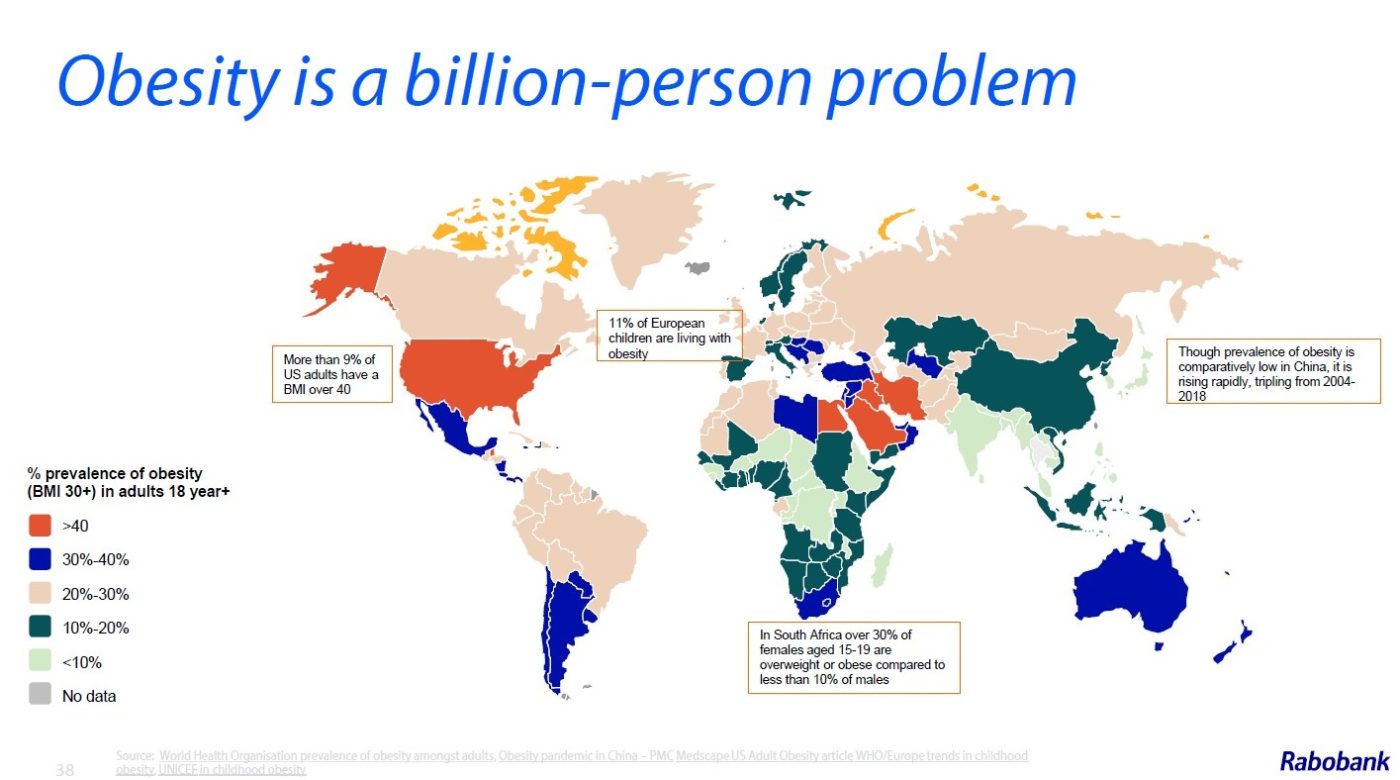
Click on image for a larger view
GLOBAL burger giant McDonald’s is selling a lot more more kid-sized cheeseburgers to adults than it did a few years ago.
This is just one example of the unusual food industry and consumer market distortions that are happening as a result of the dramatic growth in use of weight loss drugs like Ozempic.
At an industry briefing in Brisbane yesterday, Rabobank’s global head of consumer research, Cyrille Filott, said obesity was now a billion-person problem worldwide, with more than 40pc of US citizens now exhibiting a body mass index above 30 (red shading on map above, between 30pc and 40pc in Australia, Mexico and South Africa (blue) and 10-20pc in China (green).
While his talk was principally focussed on consumer trends in the US and Europe, many of the principles apply elsewhere, including Australia.
Rabo first made references to the emerging potentially distortive effects of weight loss drugs on consumer trends during a seminar at Beef 2024 in Rockhampton, and the trend has only gathered pace since.
The arrival of anti-obesity drugs like Ozempic was now having a ‘truly profound effect’ on the consumer market, Mr Filott said.
Back in 2023, the head of the Walmart supermarket chain in the US said weight-loss drugs were having only a marginal effect on sales. But since then, a flywheel effect had occurred.
The rates of obesity was why the uptake of weight loss drugs had been so phenomenal in the US market, he said.
“On average, a person taking Ozempic loses 22pc of their body mass – and by eating less, it has a profound change on the food system.”
Somewhere between 12-15pc of US citizen were now using the drugs; in the US 4-6pc, and in Australia, around 3pc.
One of the barriers to larger uptake has been cost, with Ozempic costing about US$1000/month, but prices were coming down rapidly as competitors entered the market. And some of the key compounds used in the drugs were now coming off patent, which would slash costs further, Mr Filott said.
Up to 50 companies were now lining up to produce generic equivalents, and millions of new users in the US would be eligible for subsidies under Medicare from April.
“If all those people burn 30pc fewer calories, that is quite some impact,” he said.
Latest developments included new formulations that can be taken as a tablet, rather than a regular injection, making access and use even easier.
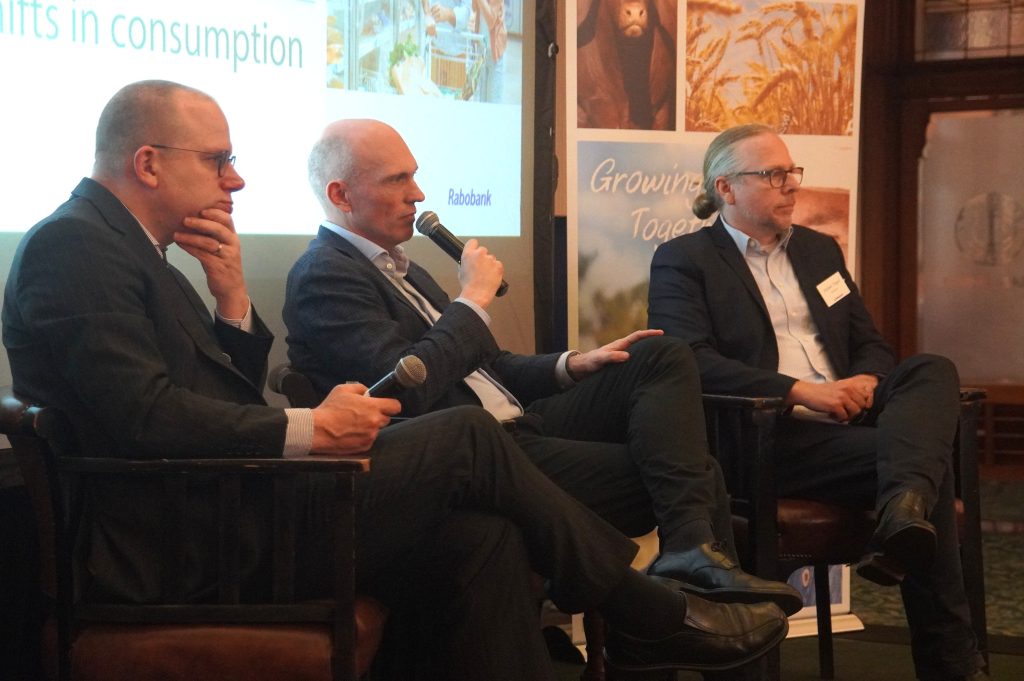
Rabobank’s global head of consumer research, Cyrille Filott, centre, with colleagues Jan Lambregts and Stefan Vogel addressing yesterday’s seminar in Brisbane
Impact on the food industry
So what is the impact from weight loss drugs on the food industry?
An average household, including one Ozempic user consuming 30pc loss calories, spends 6pc less on food, Mr Filott told the gathering.
However within that, the spending is skewed in different ways. Those households spend 12pc less on crisps and bakery snacks, while the increase is seen in protein and healthy products. Overall, portion sizes are smaller.
“Already, we are seeing a really profound change,” he said.
“While the volume component is down, where the food sector needs to step up is in the value component – providing value to that consumer who is on their GLP-1 weight loss journey. That’s about helping them get the right nutrients into their bucket.”
While weight losses drugs were a factor, other trends like healthier lifestyles, an aging population and a disposable income crisis was pushing more Americans to eating and drinking fewer calories, Mr Filott said.
The popularity of pre-prepared ‘ready meals’ were a part of this trend, delivering moderately sized nutrient-dense meal portions lower in fat and salt and higher in protein and fibre.
US consumers were shifting their spending towards nutrient dense food products like meat, eggs, yoghurt and protein shakes and bars, and away from snacks, sugary beverages and frozen meals.
“All this is creating a truly profound shift in the US, and we are seeing this gradually change in other parts of the world also,” Mr Filott said.
“The good news is that if you provide the right (nutrient dense) products, the consumer is interested, and we will continue to see this shift from empty calories to highly nutritious food.”
Asked during question time how farmers should react to the weight loss drug trend, Mr Filott said there were still quite a few unknowns about future usage trends of the drugs.
“People might go on and off the drug, or stay on it forever. Their eating habits might change, having been on the drug for a period. But jumping on and off the drugs may not be good for your body,” he said.
“Micro-dosing is another story, but we don’t know what the usage patterns will be.”
“But what I’d say to farmers is make sure you have the right products. For livestock producers, I’d say the lower volumes consumed issue is offset by the value-point.”
War, higher fuel prices & inflation
Turning to recent consumer impacts from higher fuel prices and inflationary trends, and their impact on disposable income, Mr Filott said in the short term, the Iran conflict might push more consumers out of the food service sector (restaurants, hotels cafes) into retail, to save money by preparing more meals at home.
Eating out, it might push more consumers into cheaper food service options.
“But longer term, as we learned during the COVID period, the effects take time for all these higher prices to trickle through the system,” he said.
In Europe, consumer confidence had been low, and remained low. Some are spending more on Netflix and the beach, and less on dining out. In North America, consumer confidence had collapsed, across all income categories.
“There wasn’t a lot of consumer confidence evident anyway – and the latest Iran crisis doesn’t help,” he said.
The emergence of Sen Robert Kennedy pushing a ‘healthy’ food agenda in the US, came as a result of a movement that was evident in the US already, Mr Filott said.
“An example is alcohol consumption, which is down worldwide, but in the US it is down a lot. In the past, 65pc of Amertican adults said they consumed alcohol, now it’s 56pc. And it’s not along generational lines, and nor is it along male/female lines.
The changing US attitudes about food and diet were gradually spreading across the world, he said.
“On the food side, not all of what RFK Jr is pushing is science-based, but is about beliefs. He is pro Organics, pro the use of animal fats, and pro the use of ‘real’ and ‘natural’ food. And he is very much against everything that is big: big food, big pharma, big agriculture; as well as anti seed oils, ultra-processed foods and chemical dyes.
“It’s a political movement that is changing the food industry.”
Another important recent development was controversial changes to US dietary guidelines, which had produced an inverted pyramid, doubling recommended animal protein intake and promoting whole foods.