
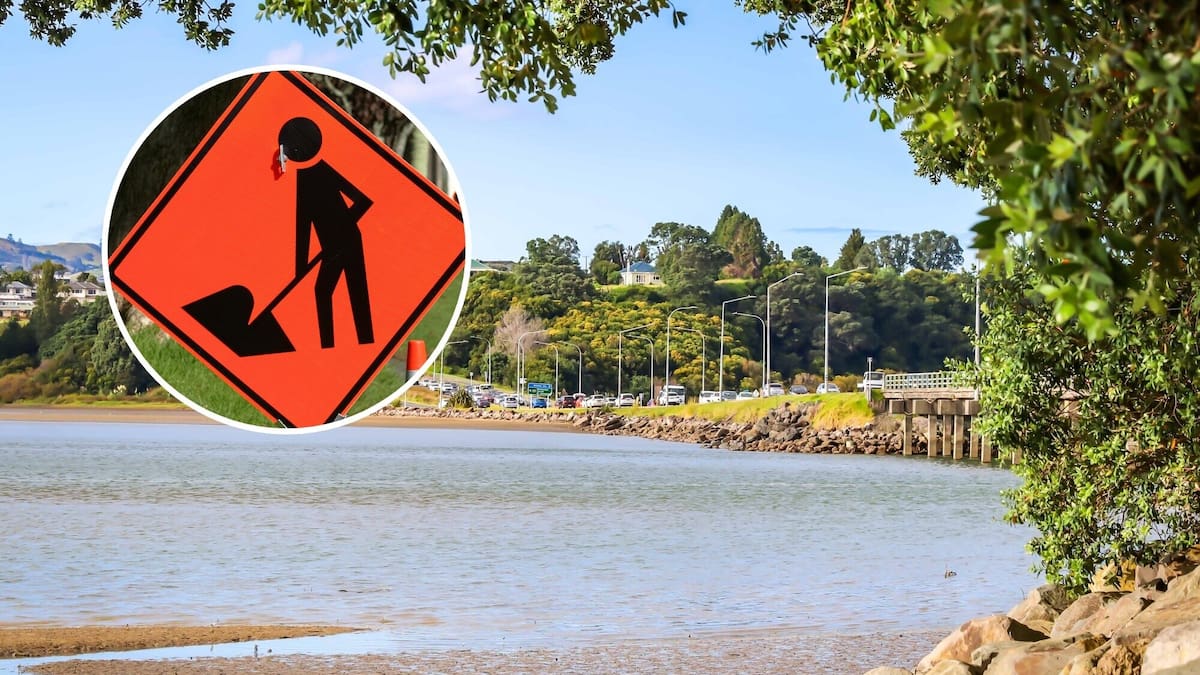
A business leader said disruption on one of the city’s “key links” is likely to have wide-ranging impacts, while a councillor believed a bit of kindness among motorists would go a long way to getting through it.
Traffic disruption ‘unavoidable’
The council’s business case for the project said about 28,000 vehicles a day use Turret Rd, which links several suburbs to the city centre.
Council major projects infrastructure portfolio manager Chris Barton said the council anticipated that during construction, there would be significant traffic disruption, “which is unavoidable”.
Turret Rd is set for changes as part of the 15th Ave to Welcome Bay upgrade. Photo / Kelly O’Hara
Barton said to reduce this, the council sought feedback on a range of proposed short‑term improvements designed to move more people, improve safety and support alternative travel options.
The short-term improvements included smarter traffic signals, lane adjustments, travel time messaging boards and better navigational app data, and support for other travel choices such as walking, cycling and carpooling.
Barton said Fraser St was one of the key alternative corridors.
The proposed improvements and community feedback would be considered in a report to the council late this month.
“We are also working with NZTA, which is investigating the proposed conversion of bus lanes on Hewletts Rd to high occupancy vehicle lanes, which is anticipated to improve the capacity of this key alternative route.”
Tauranga City Council major projects infrastructure portfolio manager Chris Barton. Photo / Ayla Yeoman
Construction was estimated to increase morning peak journeys to and from the city centre.
Estimated morning peak delay:
From Welcome Bay via Welcome Bay Rd and Turret Rd: +9 minutesFrom Pāpāmoa via SH29A and Turret Rd: +11 minutes
Estimated afternoon peak delay:
To Welcome Bay via Welcome Bay Rd and Turret Rd: +17 minutesTo Pāpāmoa via SH2/Hewletts Rd: +6 minutesTo Pāpāmoa via Turret Rd and SH29A: +19 minutes.
To reduce traffic disruption, the council was considering night works, more work during school holidays when there was less traffic on the roads, lane closures, diversions, better traffic monitoring and travel-time messaging, and effective construction set-up.
The project was also likely to be delivered in sections and stages to manage disruption.
“It is possible that Turret Rd/Hairini Bridge will close for short periods of time to allow for work to be done,” Barton said.
“It is unlikely that any closures would be for long periods of time – possibly a few weeks at a time rather than months.”
Barton said the 15th Ave to Welcome Bay link was a key city arterial route that connected between SH2 and SH29A.
Proposed 15th Ave, Turret Rd and Hairini Bridge and causeway changes as part of the 15th Ave to Welcome Bay project. Graphic / Tauranga City Council
He said SH29A was “already constrained” particularly in peak periods at key Welcome Bay, Oropi and Cameron Rd intersections.
“During construction we anticipate this congestion will get worse. However, once the upgrade is completed, additional capacity on the 15th Ave to Welcome Bay link is expected to reduce current congestion and delays.”
He said the council did not anticipate the project would add significant additional congestion on SH2 during construction, but when work was being carried out on 15th Ave there could be additional delays on the SH2 approach to Cameron Rd and 15th Ave.
The council would also consider the impact of changes being made to the SH2 connection to Cameron Rd and 15th Ave for the NZ Transport Agency’s Takitimu North Link project.
‘All in this together’
Welcome Bay ward councillor Hautapu Baker said he would be impacted by the roadworks as he travelled from his Poike home to the council building on Devonport Rd.
He usually drove via SH29A, Welcome Bay Rd and Hairini Bridge.
“Most mornings I take my kids to kura and kohanga in Maungatapu so don’t have the choice of an alternative route as the Hairini Bridge is the most convenient way to go.”
Tauranga City Council Welcome Bay ward councillor Hautapu Baker. Photo / Alisha Evans
He said the council was working with the regional council to “scale up” public transport to help alleviate pressure on the transport network.
The council was looking at upgrading alternative routes, such as Fraser St, to manage the increased demand during this project.
“We are all in this together, and patience and kindness will go a long way in helping us get through this disruptive period well.”
Bay of Plenty Regional Council transport operations manager Simon Bell said the councils would work closely to understand, plan for and communicate any impacts on public transport services as project details were confirmed.
Impact on businesses
Tauranga Business Chamber chief executive Matt Cowley said the city’s central roading network worked like a figure eight, with 15th Ave and the Hairini Bridge “being one of the key links holding the city together”.
“When something goes wrong there, the effects aren’t local – they’re felt right across the network.”
He said if traffic was restricted on Hairini Bridge, vehicles shifted to SH2/Hewletts Rd or took the longer Oropi route instead.
“A lot of people living in Pāpāmoa work in the central peninsula, so those alternative routes will quickly come under pressure, which are already busy at peak times.”
Crowds lined the Hairini Bridge in 2018 after a pod of bottlenose dolphins was spotted in the Waimapu estuary, causing traffic congestion and delays on 15th Ave and Turret Rd. Photo / Josh Malmo
The “fragility” of the network was exposed in 2018 when a pod of dolphins visible from Harini Bridge caused “traffic chaos” across the city.
Tauranga’s roads were full already at peak times.
“Long-term works on a major arterial bridge will only add further pressure to other routes and make travel times far less predictable,” Cowley said.
“With the majority of our highways and arterial routes facing major works over the next few years, I’m concerned that Tauranga’s travel unpredictability is going to catch many people and businesses out.”
To combat this, he said more trades and delivery businesses charged an hourly rate for travel, rather than a per-kilometre fee.
Tauranga Business Chamber chief executive Matt Cowley. Photo / Mead Norton
“Unpredictability also affects staff getting to work, and whether customers are too frustrated by traffic and avoid going to the central peninsula to shop.”
Cowley said most businesses could cope with short-term disruption, but ongoing, city-wide uncertainty was much harder to manage and would need to be factored into business continuity planning.
What the project involves
The project involved widening 15th Ave to four lanes between Cameron Rd and Burrows St, with one general traffic lane in each direction and a lane for vehicles carrying two or more passengers, including buses.
Creating three lanes on the Hairini Bridge and causeway would create a tidal flow system, with two city inbound lanes during the morning peak changing to two outbound in the afternoon.
A clip-on, shared-use path was also planned for the bridge.
A raised centre median was proposed between Cameron Rd and Fraser St, plus new signalised crossings at 15th Ave and Devonport Rd and other intersection changes.
New shared-use paths for walking and cycling were proposed on 15th Ave between Fraser St and Hairini Bridge (south side), and between Fraser St and Grace Rd (north side).
A number of other new traffic signals, resilience works and water infrastructure upgrades were also proposed.
The protected pōhutukawa trees on Turret Rd would not be impacted, and habitat options for the protected white-fronted terns that nest near the bridge are being investigated.
The next steps
An ongoing seismic and structural assessment of the Hairini Bridge would continue until mid-2026.
Public consultation on the full project design was set for later this year, and construction is now expected to run from mid-2027 to 2029 – a slight delay from previous estimates.
Barton said the 15th Ave to Welcome Bay project team had been engaging with residents and businesses on the affected roads since the business case started in early 2022.
“We plan to continue to work closely with residents and businesses as designs and construction plans continue to develop over the next 12-18 months to understand their needs and how we can best help them to manage any disruption during construction.”
The NZTA has co-funded the current stage of work.
Turret Rd and the Hairini Bridge will face disruptions during the Tauranga City Council’s Welcome Bay to 15th Ave upgrade project. Photo / Kelly O’Hara
Hairini slip lane trial extended
The trial reopening of the Hairini Slip Lane has been extended until the 15th Ave to Welcome Bay roadworks start.
The council’s City Delivery Committee agreed to the extension this month after requests from residents and local hapū Ngāi Te Ahi.
The volume of slip lane traffic had increased by about 300 vehicles per day, about 200 of those from the Hairini community.
The slip lane reopened to general traffic in October after seven years of being reserved for buses. It remains closed 6.30am-9.30am weekdays.
– LDR is local body journalism co-funded by RNZ and NZ On Air.
Ayla Yeoman is a Local Democracy Reporting journalist based in Tauranga. She holds a Bachelor of Arts majoring in communications, politics and international relations from the University of Auckland, and has been a journalist since 2022.