
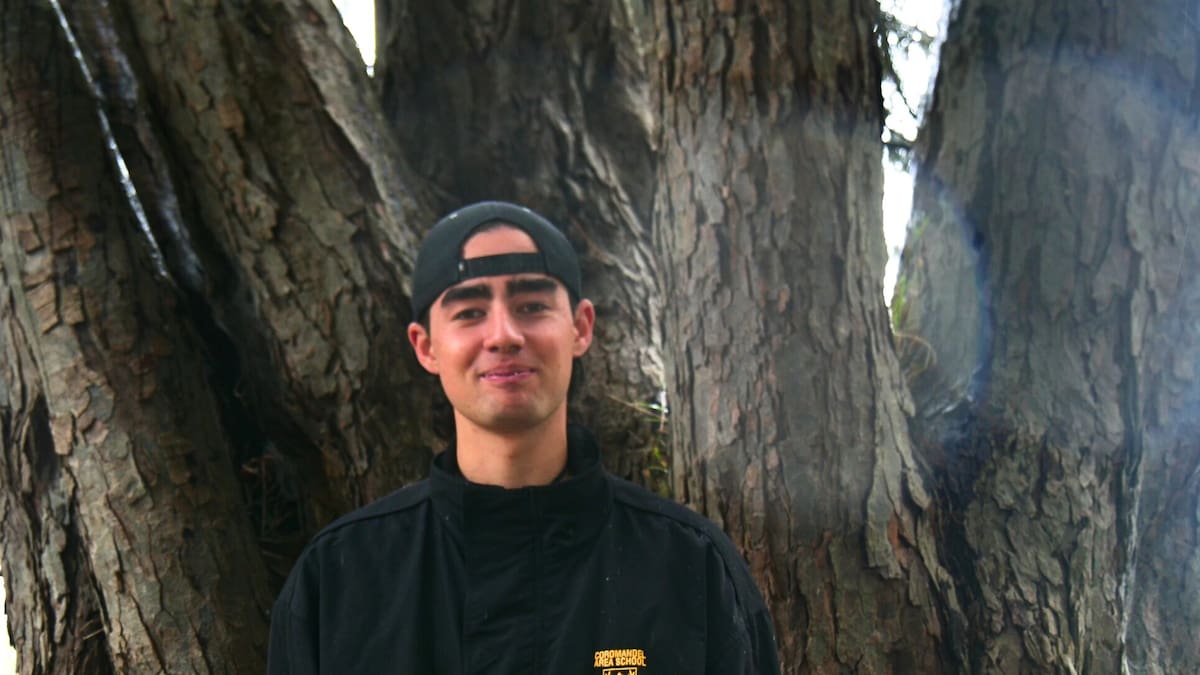
“Educating rangatahi Māori in their own mātauranga means providing a base for youth to thrive in the āhuru mowai of their own world, while still being able to walk in the modern day.”
Understanding the history of his iwi had shaped his view of identity and leadership.
He said some early Pākehā historians wrote about Ngāti Maru as though the iwi had faded away.
“But the fact that I’m sitting here proves otherwise.”
Born in Tauranga, James-Murray spent much of his childhood in Rotorua, where his connection to te ao Māori began early.
He attended a kindergarten run by his aunt, where Māori language and traditions were part of everyday learning.
“That’s where it really started for me.
“We learned stories about Māui slowing the sun, sang waiata and used poi. It wasn’t full kapa haka, but it was our first introduction to those traditions.”
Teachers also played an important role in encouraging his interest in Māori language and history.
At Ngongotahā Primary School, he credited teacher Dean Henderson as one of his biggest supporters.
“He helped me a lot with te reo and learning the local stories of Rotorua.
“He was one of the biggest supporters of my Māori journey.”
Keeli James-Murray.
James-Murray later attended schools across Rotorua before moving to the Coromandel Peninsula in 2022 and enrolling at Coromandel Area School.
He said the move had helped deepen his understanding of te reo Māori and whakapapa.
“This place has probably been the biggest learning centre for me when it comes to te reo and my whakapapa.
“Having teachers who are willing to spend time helping you learn those things makes a huge difference.”
His fascination with history has remained constant.
“I don’t really have many other interests. Most of it is just history.”
Milestones in the community also reinforced the importance of preserving the past.
“This April, we’ll be marking the 125th anniversary of our church.
“We’ll also be celebrating the anniversaries of our marae.”
As part of the Tuia Programme, James-Murray will be mentored one-on-one by Te Tara o Te Ika Māori ward councillor Michael Barlow.
Participants are expected to complete a 100-hour community service project in their community, providing opportunities to share experiences, practise new strategies and demonstrate leadership.
Barlow said he hoped the programme would strengthen James-Murray’s confidence, sense of identity and connection to his role as a young Māori contributing to his community.
“As our first TCDC rangatahi in the programme, Keeli helps open the door for others to follow, showing that rangatahi Māori belong in these spaces.
“I want him to come away feeling supported, valued and inspired to give back to his whānau and hapori in ways that matter to him.”
Barlow also saw real value in how the programme honoured Te Tiriti o Waitangi while nurturing confidence and connection for young Māori leaders.
For James-Murray, leadership is about what someone does rather than the position they hold.
“Leadership is what you do, what you think and what you say.
“You can have leaders who are out there to line their own pockets, or you can have leaders who are out there building papakāinga and māra kai, making things happen in their communities.
“Those are leaders to me.”
While the Tuia Programme offers insight into civic leadership, James-Murray said national politics was not where his focus lay.
“Parliament doesn’t interest me.
“Home interests me. It’s knowing that my people are okay.”
For now, he was focused on learning and preparing for the future.
“For now, I’m just putting powder into my musket.
“I’ll shoot it later.”
The Tuia Programme has been running since 2011, and more than 40 councils across New Zealand now support rangatahi to take part in the leadership initiative.
Tom Eley is a multimedia journalist at the Waikato Herald. Before he joined the Hamilton-based team, he worked for the Weekend Sun and Sunlive. He previously worked as a journalist at Black Press Media in Canada and won a fellowship with the Vancouver Sun.