
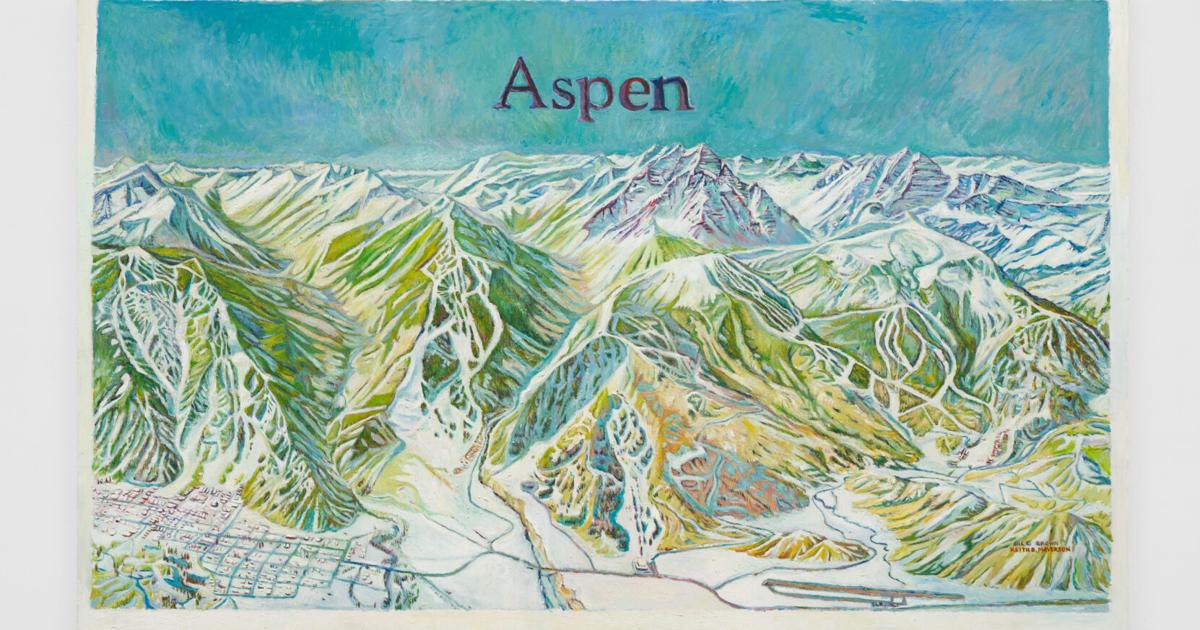

Artist and teacher Keith Mayerson grew up on the Front Range. He visited Aspen in his youth and it left a huge impression on him. His work is featured at the Aspen Art Museum’s show “My American Dream: Rocky Mountain High” that opens Saturday and runs through May 24.
Courtesy of Keith Mayerson
The concept of the Aspen Idea and how it has fueled the imagination of Colorado-born artist Keith Mayerson is the core of his show “My American Dream: Rocky Mountain High,” which opens Saturday and runs through May 24. There is a reception for the artist on Saturday from 5 to 7 p.m., which includes live music on the rooftop bar with the band Whiskey Stomp.
“Aspen has always been like Xanadu for me,” Mayerson said. “It was always sort of utopia on Earth and the show is really an homage to growing up in Colorado. As I grew older, the Aspen idea really influenced my art and my spirit.”
Mayerson is one of the most celebrated Colorado artists of his generation. His show at the Aspen Art Museum comes fresh off the heels of an exhibition, “Shifting Landscapes,” at the Whitney Museum of Art in New York City that ran from November 2024 through January of this year.
Mayerson has taught illustration, cartooning and fine art at New York University, Columbia, Brown and Yale. He is now a fully tenured professor at the University of Southern California, where he started the visual narrative art program in collaboration with the Lucas Museum of Narrative Art.
Mayerson was raised in the suburbs of Denver in the 1970s and ’80s. He spent weekends with his family enjoying the outdoors and visited Aspen many times in his youth.
Mayerson’s introduction to art was not through museums or art classes at school.
“My access through art was through comics,” Mayerson said. “I was a comic kid from kindergarten all the way through.”
Mayerson went to Brown University, where he was the cartoonist for the daily newspaper. After graduating in 1988, he went on to graduate school at the University of California Irvine. His thesis was shown in San Francisco and New York and was featured in the New York Times, which jump-started a career that has lasted 35 years.
American dream
Mayerson’s work is a meditation on personal memory and popular culture. The work in the exhibition is part of a series called “American Dream” that was born out of 9/11.
Meyerson was teaching at NYU at the time when he heard the planes hit the towers, and then went to nearby Washington Square, where he watched the towers fall with his children by his side.
“I didn’t want to focus on the darkness, I wanted to do work that gave me hope and inspiration about the cultural heroes, landscapes and family that have helped sustain me,” Mayerson said. “I wanted to represent the ideals that could really make America great for the future, for us to progress in harmony, in peace, with democracy with a small ‘D.’”
Mayerson came to see his work as an ongoing series of paintings with a common thread about the American dream in its many forms and functions. “I eventually formalized the concept and started calling all my shows ‘My American Dream’ followed by whatever chapter or concept I was working on.”
A painting of a vintage 1980 map of the Aspen ski areas is one of 25 pieces in Keith Mayerson’s show “American Dream: Rocky Mountain High” showing at the Aspen Art Museum beginning Saturday and running through May 24.
Courtesy of Aspen Art Museum
Mayerson brings a comic-strip sensibility to his work — not in a visual sense but in a narrative way. Each work functions like a panel in a comic strip, designed to interact with the other pieces to tell a larger story.
The Aspen show features 25 pieces done with oil painting on linen and one sculpture of Snoopy from “Peanuts.” The subjects all have some connection to Colorado and most are Aspen-centric, spanning decades from Aspen’s early mining days to its countercultural heyday in the 1960s and ’70s, to the present day.
“Keith Mayerson’s work captures a side of Aspen that natives and locals know but that is often less visible to visitors,” said Simone Krug, who co-curated the exhibition with museum Chief Curator Daniel Merritt. “Working from his own experience and archival images, Mayerson showcases celebrated aspects of Aspen’s history and landscape. It’s an honor to have Mayerson continue his ‘My American Dream’ series in a way that will resonate so personally for our Roaring Fork community.”
Cultural icons are also featured in the exhibition. In one piece, John Denver rows down a river in a raft with Jim Henson’s muppets. The painting is not just a collision of ’70s icons, on a deeper level it marks the conversion of two artists who equally promoted empathy, environmental awareness and communal responsibility.
Mayerson was personally inspired by Hunter S. Thompson. In creating a piece on the Gonzo journalist for the show, he listened to audiobooks and interviews of Thompson in an effort to channel the writer’s energy.
Mayerson likens the extensive research he puts into every piece to method acting in which he aims to capture not just an image, but the aura and essence of the subject.
A homecoming
Mayerson’s work has been displayed all over the country but this is his first solo show in Colorado.He described it as a kind of homecoming that is the most personal show he has ever done.
In addition to weaving in childhood memories from his home state, he lost his mother while working on the pieces featured in the exhibit.
“Since my mom passed, I’ve been listening to her favorite music, a lot of Ella Fitzgerald, and I feel like I’m dancing in a non-denominational heaven with my mom,” he said.
A lifelong skier, Mayerson compared painting to making turns on the mountain.
“Painting is like skiing because there is this mind-body connection,” he said. “When you’re skiing, you’re hopefully inspired by the sublime nature and being in wilderness, but your body’s doing its own separate thing.
“Like skiing, when I’m painting, I’m really feeling every curve and form that I’m doing in my mind’s eye, like anticipating a fall line and making those turns or bouncing off moguls. I’m transcending into the landscape or whatever it is that I’m rendering, it feels very much like skiing.”
When asked how he thinks the Aspen Idea of mind, body and spirit has endured over the last 80 years since it was first propagated by Walter and Elizabeth Paepcke, Mayerson was optimistic.
“Aspen has changed,” he acknowledged. “But I don’t think its essential spirit is lost. The intersection of nature, art and culture is still there.”
Mayerson hopes visitors to the show will not only reflect on Aspen’s past, but be uplifted by the present and future.
“I hope that people really receive from the show some visions of the past and the present in the context of the Aspen Idea, and that it renews their own spirit as they think about the philosophy, music, art, culture and sublime beauty of Aspen so they can renew other people’s spirits. The hope is to move forward to a more progressive democratic and harmonious future.”