
A series of solar eruptions and fast solar wind streams are expected to stir up Earth’s magnetic field over the coming days and they’re arriving at one of the best possible times for aurora chasers.
Geomagnetic storms are expected between March 20 and March 21 as a mix of incoming coronal mass ejections (CMEs) and high-speed solar wind streams buffet Earth’s magnetic field. NOAA’s Space Weather Prediction Center has issued a moderate (G2) geomagnetic storm watch through March 21, with a chance that conditions could briefly reach strong (G3) levels.
This means the northern lights could spread farther south than usual over the weekend, putting on a treat for skywatchers at mid-latitudes. What makes this event especially exciting isn’t just the incoming space weather — it’s the timing.
Why the spring equinox boosts auroras
March 20 marks the spring equinox in the Northern Hemisphere, a time known to boost geomagnetic activity and aurora displays. Around both the spring and autumn equinoxes, Earth’s orientation in space allows its magnetic field to interact more effectively with the solar wind. This seasonal boost is known as the Russell-McPherron effect.
What is the Russell-McPherron effect?
First described in 1973 by geophysicists Christophere Russell and Robert McPherron, the effect explains why geomagnetic storms — and the aurora displays they can trigger — tend to peak around the equinoxes.
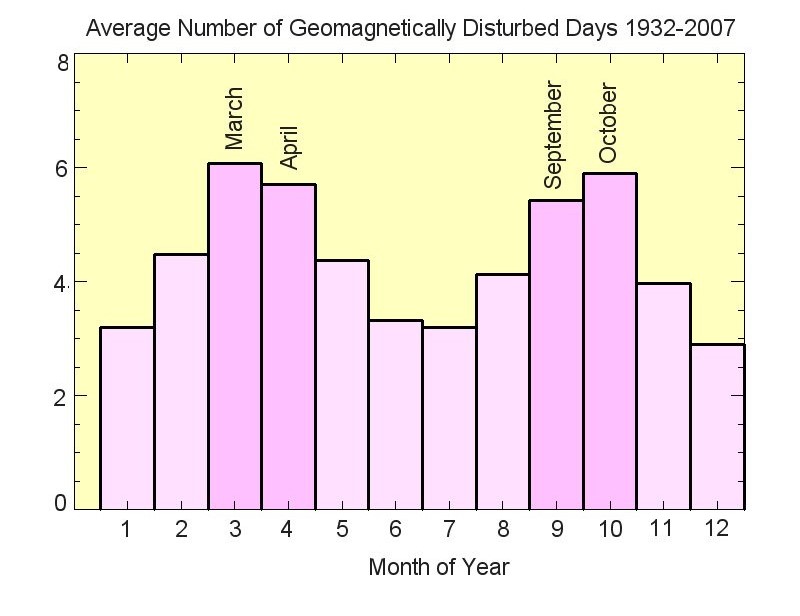
Averaged monthly number of geomagnetically disturbed days for the period 1930-2007. Geomagnetic activity appears to peak during the spring and autumn months. (Image credit: NASA/MSFC – David Hathaway.)
During this time of year, the sun shines directly over Earth‘s equator, giving nearly equal day and night worldwide. Earth is tilted on its axis by about 23.5 degrees, and as it orbits the sun, that tilt shifts how our planet’s magnetic field is orientated in space.
This seasonal shift brings Earth’s magnetic field into a more favorable alignment with the magnetic field carried by the solar wind and incoming CMEs — making it easier for energy to transfer into our magnetosphere.
Why timing can make storms stronger
With more energy being funneled into Earth’s magnetosphere, geomagnetic storms become more likely and often more intense.
To put it simply, the same burst of solar activity can have a bigger impact around the equinoxes than it would at other times of the year. That’s why March and September are often considered the best months to catch the northern lights. With multiple CMEs potentially striking Earth alongside a high-speed solar wind stream this week, conditions are already primed for geomagnetic unrest. Add in the seasonal boost from the Russell-McPherron effect and we could be in for a real treat tonight and over the weekend!
However, auroras can be fickle creatures, so it is possible that despite the seemingly perfect conditions, we could end up with a lackluster show.
The intensity and spread of auroras depend on how incoming solar eruptions interact with Earth’s magnetic field. One key factor is the direction of the magnetic field carried by the solar wind — known as the interplanetary magnetic field. If it points southward, it can more easily connect with Earth’s northward-pointing field, allowing more energy to flow in and supercharge auroras. If it points northward, Earth’s magnetic field can act more like a closed door, limiting how much energy gets through.
That being said, conditions can change rapidly, so make sure you’ve got your cameras charged and your aurora alerts switched on!