
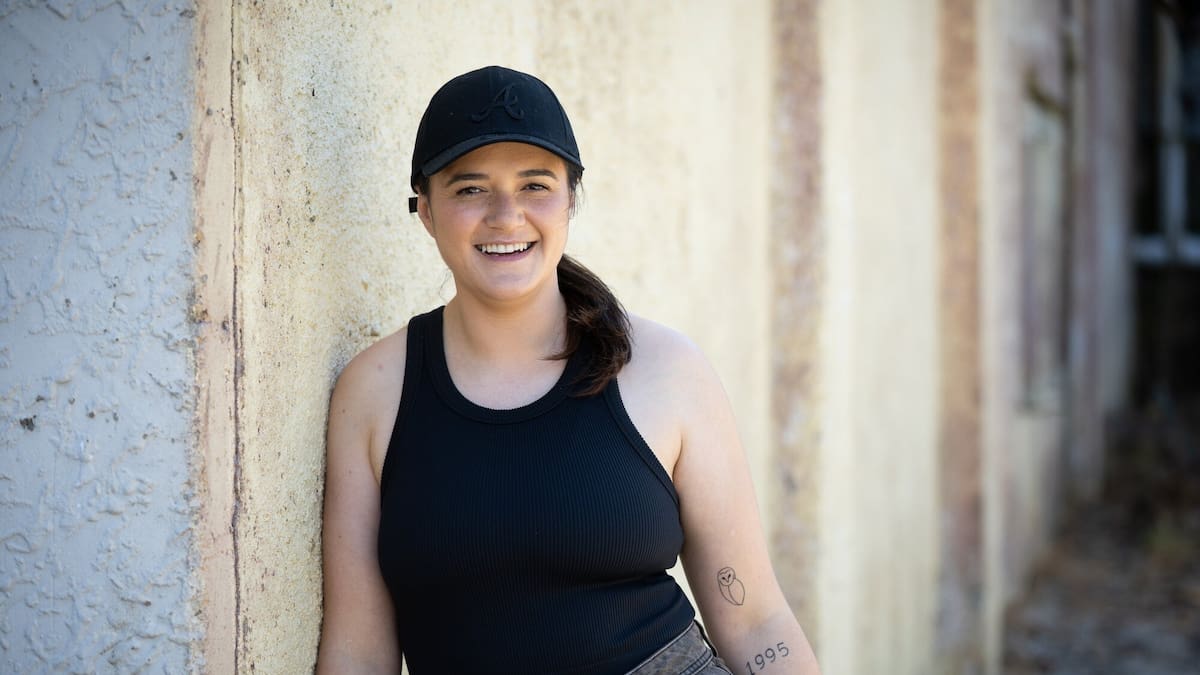
“I woke up to that police knock, which everybody knows. It’s that very specific police knock,” she tells the Herald of that moment, forever ingrained in her mind.
“Move,” an officer said, barging into the house.
“Where’s Simon*?”
Day’s blood boiled. Not this again. They were searching for a previous tenant, one they’d inquired about multiple times before.
But there was an additional stress to contend with this time around, one that could throw the small sense of stability she treasured into a spiral.
“At that time, one of my coping mechanisms was marijuana, not that I was smoking a lot. This one specific time, I’d left all my stuff out,” Day recalls, admitting she had long struggled with depression and anxiety.
“Normally, it was okay because no one would come into my room.”
With one officer quickly getting the scent, he began questioning her.
She couldn’t lie, so she truthfully told him about her stress.
“He said, ‘oh, what could a 22-year-old have stress about?’ I looked him dead in the eye and said, ‘custody of five of my siblings, actually’.”
It’s a powerful statement, but not an uncommon one for many South Auckland caregivers, Day says.
And it’s also why she, years later, decided to make a short film about the experience that night. A film that is premiering at Māoriland Film Festival this month.
She called it Dawn.
Jasmine Day on set filming Dawn. Photo / Sylvie Whinray
Under the bridge
A whiteboard full of goals hangs on the wall of Day’s Ōtaki home. Setting goals helped her through some of the lowest times in her life.
One was also there during the police raid all those years ago. There’s a nod to it in her film.
Day was born “under the bridge” as people in the community like to joke about the Papakura maternity ward.
Her childhood was tough, marred by abuse and trauma.
Day’s oldest brother was whāngaied (informal adoption under tikanga Māori) because her mother was young when she had him. Day and her other siblings also ended up living apart from their mother, though she and Day still talk.
“[Mum] kind of spiralled down after we got taken off her… she had all these habits that a lot of displaced or urbanised Māori had. And I feel for her,” Day says.
“Growing up… I didn’t necessarily resent her, but I wondered ‘how did all of that happen?’ When I became an adult and became a mum myself, I was able to ask her those questions. I understood it. I was like, oh my gosh, she was just stuck with traumatic experiences that happened to her, and she wasn’t able to heal from them.”
The family’s turbulence meant Day and her siblings spent a lot of time in the care of her aunty – a person she has enormous gratitude for. With her nurturing came a love of learning.
“I’m really, really blessed that I ended up with my aunty because she taught us discipline,” Day says.
“My aunty taught us that school matters. I was rewarded for being a top student in my class. I ended up in Mathex teams every year. I got to learn an educational blueprint because of how they nurtured me in that space.”
To this day, her aunty still calls her a “brainbox”.
Papakura High School was also the start of Day’s creative journey. Drama, dance, music, travel, and art design were her best subjects. She was “on stage a lot and loved it”, ended up at MIT where she studied performing arts for two years.
But back at home, things were still difficult, and the struggles continued.
Jasmine Day found out pretty quick the realities of making a film, but her positive attitude and drive never failed. Photo / Sylvie Whinray
Holiday heartbreak
The Power of Now by Eckhart Tolle was sitting on the bookshelf of a friend’s place in Byron Bay, a few years later. Day picked it up and started reading.
“I’m in the perfect place to practise presence,” she remembers thinking.
Day had initially gone to Australia for a holiday, but she stayed. And her life grew.
“It was the perfect place for me to heal from an abusive relationship. I stayed there for about nine months. I got myself my own place. I got a job. I ended up meeting someone else, and it was all very positive,” she says.
A trip back to South Auckland to visit friends and whānau was supposed to be celebratory and simple. It was anything but.
Day was suddenly drawn into a family hui as a mediator with what was then known as Child, Youth and Family (now Oranga Tamariki – Ministry for Children) when one of her brothers got into trouble with the law.
“Mum was like, it’s pretty bad, and passed me the file, his file. I read it, and I bawled my eyes out.
“Our other sibling, who is a year older than the sibling who got in trouble, was constantly in [trouble] with the cops, so with two of the siblings now in trouble with the law, that was enough for them to state that.”
The CYFs worker said Day’s mum “wasn’t fit to parent”. Though Day still doesn’t believe that was entirely true.
But someone else needed to look after her siblings. And after numerous conversations with the government agency – and disagreements within the family – Day became that someone. She was 22.
In the years after the police raid, things slowly started to look up for Day. She was working multiple jobs to make ends meet, but her brother’s behaviour improved, things were feeling more stable and Day was starting her own family with her partner.
She also started looking back to her university days and the joy she got out of making art – and making a difference. It began calling to her again.
Jasmine Day defines a story of hope. Photo / Sylvie Whinray
A creative calling
The 312 hub in Onehunga was a safe space – a place where Day’s work could thrive around like-minded people. A place where she hosted fundraisers, community dance and media events and Boosted campaigns in an effort to expand her own creative output.
Eddy Royal, the founder and director of creative agency Curative NZ, met Day at an event she was hosting in South Auckland.
“Jasmine had a huge passion for her community, and she talked with me about some of the projects that she already had underway, and some of the dreams she had too,” she says.
She describes Day as being “electric with energy, with her own creativity, with her deep belief” despite the challenges she’s faced.
Day was one to watch, and Royal knew this.
Soon enough, Royal extended Day an opportunity, giving her a choice to either get some support for her projects from Curative, or work for the organisation.
“So much of the work she was doing was voluntary. If Jas saw a need, she just stepped in and did it – and I know she still does. She’s always supported all of her friends in their creative pursuits. And she just makes things happen,” Royal says.
“Jas is her own person. With or without Curative, she was always going to someone to keep an eye on. I knew that from my very first conversation with her.”
Jasmine Day is now balancing her fulltime job and her creative calling. Photo / Sylvie Whinray
Finding a voice
From one stepping stone to the next, Day excelled in the creative arts circuit, despite a “trial-by-fire” learning the harsh realities of applying for dwindling arts funding in New Zealand.
She became involved with the Māoriland Film Festival trust, working in an administrative role. A chance opportunity to pitch her own ideas at an event led to the dream of getting her first film made into a reality.
With support from Ngā Pakiaka, the rangatahi filmmaking collective of Māoriland Charitable Trust, Day shot Dawn in South Auckland in December.
A fictional retelling of the police raid her family experienced, she wants it to debunk the myths of what it means to be a South Aucklander.
Last year, Libby Hakaraia, Kaitaki Pūrakau at Māoriland, described Day’s project as a “timely and necessary story”.
“Jas is shining a light on the quiet realities faced by so many whānau — realities made harder by the way our systems and attitudes fail them. This film reminds us that the way we treat each other can either uplift or trap people in cycles of poverty. Jas has the courage to call that out, and the storytelling power to move us towards compassion and change. That’s why we’re backing her.”
Actor Ehetere Rua in a still from Dawn. Photo / Māoriland Film Festival
The filming process, while challenging, was incredible to experience, Day says.
“The wrap-around support I had was amazing, and I think that’s a testament to the amount of love I’ve given other people in their creative projects. It’s definitely come back tenfold in that moment.”
Now 31 and on the verge of introducing Dawn to the world, Day has a great job in the travel industry, a loving partner, and two kids of her own (aged 4 and 6).
She doesn’t look back on her upbringing with malice or regret, but with reflection, learning and healing. She is inspired by growing up in South Auckland – and she wants other people to be as well.
“It’s the culture. The fact that there’s a story no matter where you look, no matter who you talk to. South Auckland was literally built on people who were pushed out those ways during the dawn raids, she says.
“We’re built on a system that wasn’t designed to allow us to thrive. And still, a lot of us get out there and we see the world, and we do great things, and we are so resilient, and we have pushed through adversities that would have seen most people fail.
“And we do it with a smile on our face and love in our heart”.
Māoriland Film Festival runs from March 24-28 in Ōtaki. For screening times, including for Dawn, visit mff.maorilandfilm.co.nz
Mitchell Hageman joined the Herald’s entertainment and lifestyle team in 2024. He previously worked as a multimedia journalist for Hawke’s Bay Today.