
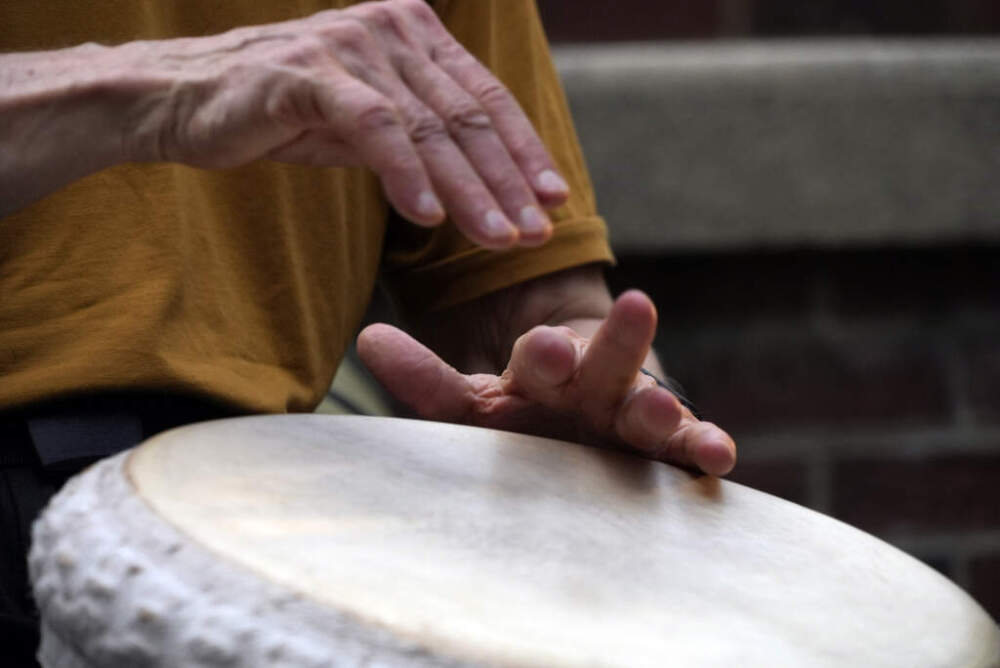
Rhythm. It’s so much more than the backbone of music – it’s essential to how our brains function. Whether you think you’ve got it or not, why rhythm is a fundamental part of your everyday life.
Guests
Susan Rogers, Professor of Neuroscience and Psychoacoustics at Berklee College of Music Online.
Also Featured
Jerry Leake, Professor of World Percussion at New England Conservatory and Berklee College of Music.
Billy Martin, Faculty at the New School, Percussionist and composer.
Transcript
Part I
JERRY LEAKE: Okay my name is Jerry Leake and I’m a world percussionist. I started on drum set, moved to vibraphone, and when I came to Boston, I discovered African percussion and began that long extended journey and took decades. But I’m currently a faculty member and Professor at Berklee College of Music and Faculty here at the New England Conservatory.
Where you are now is inside the New England Conservatory. This is a lovely rehearsal room, JH 358. I walk in and I’m just in awe that I’m even here. It’s just for me is like the heart of the ensemble rooms. It’s got a good sound too. When we move to the bigger halls, the sound actually changes which is something we have to keep an eye on.
That’s why we’re going to try to be very tight together as a group.
There’ll be no cue to get to my soul. He’s just going to hand it off to me … and then when you hear me play. Alright, everybody come in strong. But there, as you can tell, it’s a pretty loud drum. So at this point, it’s like maximum capacity and I’ll give you the cue when we go into the pattern.
Okay?
But there’s no microphones for our music. There’s no amplification. It’s all acoustic. You saw me bringing things down and up and directing people in and out to build the arrangement. Normally traditional music, it would all begin at once. The master drum … in the item we played, they would cue and everybody comes in.
For our group, we did one part at a time to really reveal the growing, the deeper the roots, the taller the tree metaphor. So it starts to take on this new meaning as you realize what the next part adds, and it’s dramatic. Five other people waiting to come in, what are they going to do? So there’s storytelling involved in the music and the arrangement.
Pretty tight, but last eight bars, again, 1, 2, 3, 4.
That is a take. That’s it. Let’s take a break.
LEAKE: Now rhythm, actually, it’s interesting because when you think about the two aspects, the universe is vibration and the earth is sound because we have atmosphere, it’s all around us. Rhythm and melody is throughout the world, and we hear it and it gravitates toward us.
You all have rhythm. You’ve probably been singing songs on your own right from the radio. There’s a lot of lovely rhythm in the songs. You may not be analyzing what’s happening, but you feel it. There’s a language compelled to reach you as well. Or just tapping on a table. So rhythm is this universal component.
We all share how we walk, how we move, there’s a choreography to how we move, how we step. So the dance part becomes part of it too. It’s not just rhythm, but the dance component really speaks to me. So the definition of rhythm, somebody might say an organized sequence of attacks and rest and whatever, and that’s true.
Very organically I can just start to sing and the rhythm is there. Okay. Are you feeling comfortable on these parts? Your part will come in next. And then I think the bell. Your bell. Okay. Do you remember that?
LEAKE: So as we hear a rhythm, that thing, it’s, we’re raising questions like, what is it? Where is it? How do I feel it? Where’s the beat? Where’s the down beat? All these mysterious questions come to mind. We spent the first hour in the ensemble, literally just doing that.
And they would start tapping their foot maybe where they thought it was and it wasn’t correct, but I was not going to scold them. I’m saying, feel it where you want. Because in African music you can feel things so many ways, you can feel the pulse in all these different feels.
What did you think? How did it feel?
Felt good. Felt good? Yes. We ready to dance in your seats? I think so.
LEAKE: So there’s a difference between having the, getting the mechanics right? And actually the feel, the space between the sounds, the breath, the air, and that’s really true in all music. There’s this we hear some, we feel some, we hear it, but what we’re feeling is this, the space, the air inside it.
And in my work, I’m constantly trying to fix things that are always there, especially on drumming on the tabla, for example. That’s a high demanding instrument. It’s very much on the micro side of rhythm, the details. Here in the African, it’s more the macro. How are we feeling It. The parts themselves, not terribly difficult, but the cohesion is. And I’m blessed with really eight very good drummers. So they’re starting to get the idea of playing individual parts for extended periods like 20 minutes or more. Usually as jazz drummers like in the swing world, they’re doing a lot of ornamentation and embellishment.
But this world, they get it. They’re playing assigned parts, and then they get freedom to find the music there. It’s taken a while to let it breathe and to feel, I keep looking at them and bringing in movement, move your body, don’t be so stiff and tense, and then the hand lightens up and loosens, and then there’s just this pocket that starts to reveal itself, and that’s when you get outta your head in hearing it.
And you feel it in your body. That’s the real indicator. Either it sounds like they’re thinking it, I can see when somebody’s thinking the music. Versus they’re almost dancing with it and feeling it and the elegance of it.
LEAKE: But it takes discipline to really focus on that one part and not be rushing.
Sometimes I’m trying to have them settle down a little bit. I’ll look at somebody and say a little less, and to build our arrangement, you saw me periodically pointing to somebody, and that would be a cue if you’re playing, dropout.
And if you’re not playing, fade back in.
So I’m conducting the arrangement as it goes. So there is that drama. So not everything’s going out all at once. Suddenly the main bell drops out. It’s what just happened. Groove is continued, it’s sustained and we can trust it. And the students know not to rely on it, because now they feel it internally.
So there’s that engine inside that sort of explains it all so they can just be trusting of it. And every bit of repertoire that I have I teach it like that, language and movement. Students who don’t know how to play complicated instruments, they come for me for this what I call harmonic time.
They discover that I am the instrument. You don’t need the ankle bells, you don’t need the rhythm sticks. You can do it by stepping and clapping, but it’s such a beautiful way to learn anywhere at any time. And that’s mostly where I’m thinking, I’m feeling combinations through movement and, so anyway, it’s so many ways to approach rhythm, but I feel it in the movement too, in the dance, in the choreography.
The two of those combined allows me to get out of my head. The mind and feel it in my body by way of total immersion. I’m just swimming in it, and students in the beginning, it’s very awkward. They’re tripping. They’re bumping into each other. We have a little fun. Even if it’s not working for them, they’re laughing.
They’re having, it’s like recess, it’s a game. Then after so much exhaustion, they sit down, they’re catching their breath. Oh my God. It wasn’t that tiring, I’m thinking. But then we talk about it. What did you experience? What did you discover? And they all share the same observations.
LEAKE: In the post office, there’s a very famous recording of them stamping mail. And it becomes this looping rhythm and they sing to it.
So when they’re all in check, and it’s joy. Music is joy. So it helps the day go by. It is a connection and throughout, oh my goodness. And there’s so many other examples. I hear it wherever I am, really, when I’m on the train, there’s a rhythm to that.
It may not be a looping one, but everything is rhythm, everything is song, the bird songs, it’s all around us so much. It’s a matter of opening our eyes and ears and recognizing that as a moment.
CHAKRABARTI: Jerry Leake teaches percussion and rhythm theory at New England Conservatory. You also heard NEC African Drum Ensemble there playing, and also NEC Jazz Lab faculty, Mike Tucker and Peter Moffett. And by the way, when Jerry talked about at the post office, he was talking about the Ghanaian post office or a post office in Ghana.
And frankly, that was the moment in which I could not stop my fingers from tapping on the table. And I bet something similar happened to you. Did you at any time in the past 12 minutes, nod your head, tap your toes, tap your fingers, or even just feel a little different?
That’s the rhythm speaking to you, that’s the rhythm in your body, but what’s going on in your brain that makes it nearly impossible not to tap to the beat. That’s what we’re going to learn when we come back.
Part II
CHAKRABARTI: Today we’re talking about your brain on rhythm, and I’m joined today by Susan Rogers. She’s a professor of neuroscience and psychoacoustics at Berklee College of Music Online. She’s also author of This Is What It Sounds Like: What the Music You Love Says About You.
Professor Rogers, welcome to On Point.
SUSAN ROGERS: Hello, Meghna. Nice to be here with you. So I gotta say that your Berklee College of Music accolades are well deserved, but the coolest, if I might say the coolest thing about you, how many years, were you actually a record producer and audio engineer in New York and LA.
ROGERS: 22 years.
CHAKRABARTI: Okay. And in those 22 years, who are some of the people you worked with?
ROGERS: I was Prince’s engineer in the 1980s from Purple Rain through Sign of the Times and the Black Album. I’ve worked with David Byrne, and Geggy Tah, Rusted Root, and Robben Ford and Barenaked Ladies, quite a lot of artists. I cannot help but just smile because you are literally listing my musical heroes from when I was a kid.
What was it like to work with Prince?
ROGERS: Oh gosh. That could take up a whole show. But we all, those of us who were close to him in those days, we loved and admired him because he was a singular talent, a singular genius. He was so driven, had such a profound work ethic, and sitting next to him while he made music was an experience unlike sitting next to any other artist that I know of, he was extraordinary.
CHAKRABARTI: And his music is genuinely timeless. Because just a couple of weeks ago through some random Spotify decision that the algo made, my daughter heard a Prince song and she was immediately like, who is this? This guy’s amazing.
ROGERS: Holy moly. That makes me happy. That makes me really happy because that’s so hard to do. That’s so hard, to be timeless as a pop star is exceptionally difficult.
CHAKRABARTI: Let’s bring these worlds of yours together. Because you said you were producing with Prince when The Sign of the Times came out.
That was 1987 and no, go ahead.
ROGERS: Please, I think that there’d be a thunderbolt in the sky if I let that one slip. I was not producing Prince.
CHAKRABARTI: Oh, okay.
ROGERS: He was his own producer. I was his engineer at that time. I produced for other artists. But just want to make that crystal clear.
CHAKRABARTI: No, that’s a very important point. So I appreciate the correction. Okay. So you were his audio engineer. And what I’d love to do is play one of the songs off of Sign of the Times. We’re going to do Ballad of Dorothy Parker. And then let’s talk about what’s actually happening in this song regarding this question.
We’re exploring this hour about rhythm. So here it is.
(SONG PLAYS)
CHAKRABARTI: I love it so much to this day, Professor Rogers, first of all, as a side observation, no pop song anymore allows such a long introductory musical introduction before we hear the first lyrics. Just the space that intro gives me as a listener is incredible.
ROGERS: Yeah. Yeah, I agree.
CHAKRABARTI: So talk to me a little bit about what you heard Prince trying to achieve with that very rhythmic drum-based intro.
ROGERS: Prince was a genius with melody, and he was also a genius with rhythm. This is evident by what a great drummer he was, but also how original he was in programming a drum machine.
And as you hear on this particular track, this one has, as we would say in the music business, this one has hips, it has syncopation, which means that some energy happens in the offbeats. It’s not a straight beat of 1, 2, 3, 4. But it’s 1 and 2, and 3 and 4 and a lot of variation in between, but consistent variation.
So when we have a little bit of syncopation, what that does is it puts some rotation into our dance moves, and it gives a track hips. Now, in this particular song, the lyric is talking about a woman he’s dreamt about. And we want, here I am overextending a little bit, but we want a little bit of femininity and a feminine perspective in this track.
So when we add syncopation, we get some rotation, we get some hips. It’s not a driving rhythm, it’s a swaying rotational rhythm and on a subconscious level, I think Prince was well aware of that.
CHAKRABARTI: It works though. I actually haven’t heard that song in quite some time. But even just here in the studio, listening to it, like in the beginning segment where it was the African drumming that we heard, I was, my body was reacting with like a tap, a tapping of my hands.
But then when we played Dorothy, my reaction, innate reaction was different. I was like swinging my head almost.
ROGERS: Good, good. Yeah.
CHAKRABARTI: Just like into the beat, into that interval that you’re talking about. Go ahead.
ROGERS: That’s a little bit of glide, you can, when we notate rhythm in a score we are suggesting here is how the record makers, the music makers, want to accent these beats. So for example, if you’ve got a straight rhythm, that’s 1, 2, 3, 4. Kick, snare. You can go long, short, long, short, kick snare, or the other way around. Kick, snare. Kick, snare. And also you can use the dynamics. It can be loud, soft, loud, soft or the other way around.
Soft, loud. These gestures that we put into recorded and live music suggest to the audience, if you are moving, here’s how you might move and join in with this piece of music. These accents are suggestions.
CHAKRABARTI: Interesting. Okay, so let’s listen to another one off Sign of the Times as well.
This is Forever in my Life, again, by Prince.
(SONG PLAYS)
CHAKRABARTI: I really don’t want to fade down. … (LAUGHS) How does Forever in my Life differ from what we heard in the Ballad of Dorothy Parker?
ROGERS: It’s remarkable, isn’t it, that we humans can pick up on these suggestions, but this is a straight rhythm. It’s a longer snare, shorter kick drum, boom, ba, boom, boom, ba boom.
And the suggestion is determination, straightforwardness, dedication. This is a man declaring his love for a woman and he is saying, I’m ready to settle down with you. So the rhythm is insistent and it’s straight, and it’s not embellished, as we would use our voices when we’re trying to convey something serious to someone.
Alright, pay attention to me now. Because this is what I need to tell you. I need you to focus. Rhythm is somewhat a proxy for our vocal prosody. It’s suggesting through the tempo and through the time signature and through the accents, Here is the subtext in the message I want to deliver to you right now.
CHAKRABARTI: So this is really important, because it starts helping, for me, to help me understand what’s going on in the brain. Rhythm is communication, as you’re saying, at least one aspect of rhythm. The other thing that I always find so remarkable about is like when you hear a beat that just speaks to you for whatever reason.
It almost feels like your brain gets hijacked. But in a good way. And so what exactly is happening in our brains when we’re so immediately responsive to different kinds of rhythms?
ROGERS: Alright, let me get professorial on you right now. But this is such cool stuff. So our nervous system has a lot of activity going on. That’s a huge understatement. We’ve got our local circuits that have their little rhythms going on from our five senses, and we’ve got our digestive system and our circulatory system and all that kind of stuff.
And so there’s a general, let’s call it an orchestra conductor, that’s mediating and controlling all these little local circuits to give the nervous system one sort of overarching oscillation. I can’t say that it’s an internal clock, because there’s more than one internal clock, but there are all these rhythms going on. Now, what our nervous system is intended to do is to help us predict the future. Interpret the present and predict the future.
So when we hear a steady synchronous pulse, it becomes really tempting to take all that little bit of chaos that’s going on in our nervous system and allow that more chaotic system to synchronize itself with a more stable system. Especially if that tempo is right in the sweet spot of around 100 beats per minute.
So when we hear a steady rhythm in that sweet spot, it makes it really easy for our nervous system to say, oh, I could take a little break now. Something else external to me is going to keep time for me and that feels good.
CHAKRABARTI: Okay. Can I just jump in here? 100 beats a minute being the sweet spot.
Any theories?
ROGERS: 100 to 120.
CHAKRABARTI: Any theories about that? About why that is?
ROGERS: Yeah. It’s the rhythm that feels good to walk to. We’ve got our two arms and our two legs, and it’s not too fast and not too slow. There are different frequency bands of neural oscillations throughout the system, but the particular band that feels really good to us is called the beta band.
Oscillations between 15 and 30 hertz, music at that tempo would be very slow. But beta band oscillations get amplified when we are in that zone of feeling really good. Not too sleepy, not too hyper, music is shown to amplify activity in that beta band, and in particular, music that’s in that sweet spot.
100 to 120 beats per minute is really good at amplifying nervous system activity in the beta band, and it feels good.
CHAKRABARTI: Okay. This is a common theme in a lot of shows that we do about how the brain works, is that we are pattern seeking organisms, right? And that when we’re able to find some kind of pattern that helps us more easily make predictions, as you said, it puts us in a better brain space.
And so you’re saying rhythm does that for us. It helps make the world more predictable.
ROGERS: Yes, rhythm serves in music as the timekeeper and it’s the primary mechanism for focusing our attention. For example, we humans have these thick, bi-directional neural tracks between our auditory region and our motor region.
Rhythm serves in music as the timekeeper and it’s the primary mechanism for focusing our attention.
Susan Rogers
So what happens is, and this is really cool, when you hear a piece of music that you’ve never heard before, your auditory system is keeping track of kick, snare. Kick, snare. Or if there are no drums in there, it might be classical music, keeping track of the pulse. And the auditory system is going to tell the motor system, all right, here’s what I’ve got coming in.
The motor system is going to listen for that. And then timing circuitry is going to take note and say, okay, I got you. I see what the rhythm is. I see what the groove is, I see what the tempo is, and the motor system then reports back to the auditory system and says, I’m going to let you know when to expect a change.
You can go ahead and move your focus of attention to the lyrics or the melody, or the counter melody. I’ll let you know when to expect another important event. So in pop music, you might drift your attention off and then subliminally, the motor system is counting 7, 2, 3, 4.
8, 2, 3, 4, and your spotlight of attention swings back around and you expect, I’ll probably get a chord change here.
I might go to a new chorus. So rhythm between our auditory system and our motor system is telling us where to put our attention in music.
CHAKRABARTI: But then a musician might throw in, they might just drop the beat to really pull your attention back in.
ROGERS: Yes, and it feels good. So if we’re expecting that this chorus is going to repeat and all of a sudden, it goes to a breakdown, you get a little bit of a release of dopamine that feels so good.
Now you have to mentally keep time until those drums come back in. The reverse is also true. If it goes to a drum break, the whole top line goes out, and we just hear the drummer for a little bit. That also feels great.
CHAKRABARTI: Okay, so you’re talking about neural responses that are both conscious and unconscious.
And you actually, Jerry Leake said this earlier, that rhythm is innate in human beings. But is it consistent in its innateness? I imagine there are strong cultural influence as well in terms of what kinds of rhythm human beings around the world respond to.
ROGERS: There are, and this studied increasingly these days because music cognition researchers are more interested in world music and in other cultures. A recent, very large study looked at music in many countries around the world, and this was a super cool study. What they did was they were interested in rhythmic biases and the researchers had listeners sit with headphones and listen to something very boring.
Tick, tick, rest, tick, tick, rest. And what the participants had to do is tap along with it tick, tick, stop, tick, and so on. But what happened was each iteration, each presentation of this rhythm caused the tappers to insert just a little bit of inflection so that some participants in some countries of the world went tick, tick, rest, tick, tick, rest, or tick, tick, rest.
Anyway, that bias built up over repeated iterations so that we got to see the biases of rhythm perception throughout the world. For example, in some countries when there are four beats to a measure, persons prefer tick, tick, pause, tick, pause. Whereas other countries might prefer pause, tick, pause, tick, tick.
This has to do with the rhythms of our speech and it’s hypothesized maybe the environmental noises in our culture, but that’s not fully determined at this point.
CHAKRABARTI: Interesting. So is that why you’ve written that the language of rhythm is time, it’s really a way for us to mediate how we’re experiencing time?
ROGERS: Yeah, rhythm is the language of time in a certain sense. It tells us how much time has passed.
Part III
CHAKRABARTI: Now, Professor Rogers, if I may, we turn to another musician to learn from him how rhythm works in his music and in his life.
BILLY MARTIN: Hi, I am Billy Martin. Most people know me as the drummer with Medeski Martin & Wood. I’m a composer, visual artist.
Rhythm to me is like a universal language, at least on this planet, and it can be very sophisticated or very simple. We could follow a pulse just naturally. By hearing it and feeling it.
When I’m teaching a class or an ensemble or a group, I tell them, feel it. Don’t think about it. Don’t think what you’re doing. Because often it’s a code, right? It’s a code, it’s a language. So let go and just feel. Feel the rhythm.
So it’s like walking is a perfect example of feeling the rhythm, but actually we don’t feel it often because it’s such an automatic thing, voluntary thing we do when we walk. Some people walk a little faster than others. Some people have a swagger and they have a certain shuffle when they walk. It’s beautiful. It’s individual. All those things. Vibration is beyond the eardrum. The body can feel it.
Like the first band I played in, I was in high school here in New Jersey, and my friend David’s sister Lana was a bass player and he said, yeah, we’re gonna come over. We like your drumming. Let’s start a band, and I didn’t know Lana was deaf from birth. I felt great playing with Lana. I didn’t understand how Lana could feel our music, but she did.
And then when we would listen to recordings, she would put her bare feet on the console of the board and she would hear the music.
But the idea that we’re settling into some kind of a groove or rhythm, there’s something comforting about it, I think. And I think in ritual and healing ceremonies, recessions, everybody is synchronized. And I think there’s the synchronicity of nature. When you think about lightning bugs, fireflies, they communicate with light and the light has a rhythm to it.
But what happens, I learned is that over time they will naturally synchronize and pulse all at the same time. So you could see hundreds of fireflies and if you pay attention, you’ll start to see this linking up. And I just think there’s a deeper sense of connectivity. And I think that just people respond to that.
I use this term rhythmic harmony. It’s not something I invented, but I caught it somewhere. My idea of rhythmic harmony is that it really is just basically two or more sounds.
Now there’s going to be a relationship and you’re going to feel something when you hear it. It may feel good, it may not feel good, but the idea that you have two cycling pulses that are static, meaning that they stay at 120 and the other one stays at 97. And what does that feel like?
That combination just there, just two pulses that don’t have a shape, that they’re just pulsing along.
And so to me that idea that two or more sounds can have a feeling to them. No matter whether there is a pitch or not, two things ticking away has a feeling. Now we’re going to shift one of those. We’re going to slow one down and keep the other one where it was. That’s going to be a different feeling. Now we’re going to add a third rhythm and we’re going to add a fourth rhythm or pulse, and now you’ve got even more to feed off of or to listen to and feel.
And it’s really up to the individual to really determine whether that feels good to them or not. When people tell me I don’t have rhythm, I immediately tell them, that’s crazy. You have rhythm. Everybody has rhythm. You’re born with it. And just think about sitting in a chair and listening to music.
And all of a sudden, your head starts bobbing, your foot starts tapping. You get off of your seat, and you start dancing. Whatever one of those things you do or all of them, that’s your rhythm. That’s your connection to, and your response to understanding rhythm. So that’s the basic thing that I tell everybody.
It’s everybody has rhythm. It’s just innate.
Everybody has rhythm. It’s just innate.
Billy Martin
CHAKRABARTI: Billy Martin from Medeski Martin & Wood. Professor Susan Rogers, is rhythm innate, as Billy says?
ROGERS: In nearly all of us it is, there are some persons who have beat deafness and they have difficulty organizing individual beats into a time signature, into a meter.
It’s a little bit like tone deafness, but for rhythm. But it’s relatively rare.
CHAKRABARTI: Okay. Both you and Billy Martin there and Jerry Leake before uses, you’ve all used the word feel, right? Some rhythms feel good or you have to get a feel for what works for you. That implies that not all rhythms feel good, that some of them are bad.
Why?
ROGERS: That’s the wonderful mystery. You’re absolutely right. There are certain grooves, certain feels that just seem to match our inner physiology and others that don’t. And that’s still explored. We still don’t know why we would have rhythmic preferences, but we do. There’s a word called tactus.
And Tactus was used by music scholars centuries ago to refer to the beat, but now it refers to where you feel the beat. So for example, we could play any sort of rhythm for a group of us, and we can instruct people, go ahead and tap along with that rhythm. Some people would tap on the quarter notes and some on the eighth notes and some people might tap on the 16th notes. Where we feel the beat is much more individual than where we hear the rhythm or how we interpret the lyrics.
CHAKRABARTI: Okay. That’s really interesting. Does that help us understand? There’s a phrase I only recently learned through preparing for this show called the resting arousal rate. What is that?
ROGERS: Oh, so I mentioned the nervous system earlier and how it oscillates throughout the day. When we’re very young, we’re nervous little nerves, and we’ve got a pretty fast resting arousal rate.
When you ask little children to just sit there at the desk and just tap their fingers just spontaneously at a pace that feels good, they’ll tap at around 150 beats per minute. Little kids have a really fast resting arousal rate, as I suppose any parent knows. Most adults will tap around 100 beats per minute, and then elderly people will tap around 80 beats per minute. That’s called our spontaneous motor tempo. And it just, it does shift a little bit throughout the day. It’s a little bit faster at night than it is in the morning, but generally we’re right there around 100 beats per minute. It’s one of the reasons why we like music at that pace.
It just feels good with our human nervous system.
CHAKRABARTI: Why does it change as we age?
ROGERS: Oh, everything slows down, it just, it takes a little longer to get the engine going.
CHAKRABARTI: Okay. So we have been talking about rhythm almost exclusively through music. But you had said earlier about speech, I’d love to hear a little bit more about that, about how rhythm and language are also very intertwined even in how we learn to speak.
ROGERS: Yeah, that’s very true. The studies of newborn infants is extremely fascinating. You may have heard of the work of Kathleen Wermke and how she went around the world and recorded infant cries. And she showed that newborn infants cry with a different pitch prosody and a different rhythm depending on their native language.
So when we are in the womb, in the final trimester of pregnancy, we can hear it’s a liquid environment and the auditory system is developed enough that it carries sound. So we’re born with a sense of the melody and the rhythms of our cultures. Now we’re not sophisticated enough to be able to make predictions about melody just yet, but we are sophisticated enough to be able to predict rhythms and to be able to show neural entrainment.
To a steady pulse. So I think I drifted off topic there, but it’s interesting.
CHAKRABARTI: … But also, it also takes me back to what Billy Martin said about his friend’s sister who was deaf but was part of their group when he was growing up. So there is there also whether you’re able to hear or not, this sort of a rhythm and pattern seeking aspect of the human brain is consistent, whether your ears work or they don’t.
ROGERS: Yes, exactly. Okay. And Billy was correct in that our physiology does conduct sound waves or waves in the sonic band, so you don’t necessarily have to receive sound through your ears. When I worked for Prince, our operations manager had a son who was 13 years old at the time, and his son had been born deaf.
We would be at rehearsal at Paisley Park Studios. Big rehearsal space, 55-foot ceiling where you could hang concert lights and PA. And I remember Tristan was his name, Tristan standing there in the rehearsal space as the band was rehearsing and putting his hands over his ears and saying to his dad, too loud.
It wasn’t too loud to his ears, it was too loud to his body.
CHAKRABARTI: Wow.
ROGERS: So yeah, we feel that pulse, of course, in our chest and in our bones. And through bone conduction.
CHAKRABARTI: Okay. One more thing about rhythm and speech, right? Not just in terms of language acquisition, but how we respond to it. So I’m going to read a sentence here off the page, and then we’re going to hear how it was delivered by the person who wrote it.
Okay? So the sentence is, I am happy to join with you today in what will go down in history as the greatest demonstration for freedom in the history of our nation.
MARTIN LUTHER KING JR.: I am happy to join with you today in what will go down in history as the greatest demonstration for freedom in the history of our nation.
CHAKRABARTI: Of course, that’s Dr. King in 1963, the very first lines of his I Have a Dream speech. Tell me how the rhythm is working there in his oration.
ROGERS: That wonderful rhythm is setting us up to pay attention to his speech. I mentioned neural oscillations earlier. We’ve got a very fast oscillation that’s keeping track of a fast auditory stream.
That’s the phonemes and the vowels and the consonants in the speech, so that we can pay attention to the individual words and anticipate what the speaker is going to say. We also have a much slower rhythm. That is keeping track of the phrasing, the individual phrases and the sentence boundaries.
So it’s that slow rhythm that lets us know, okay, he’s mid-sentence here. Soon he’s going to drop down his pitch and he’s going to pause, because he’s going to reach the end of a sentence. And now I anticipate he’s going to continue speaking. So those slower rhythms work in speech, just the same way they work in music, they prepare us for paying attention to the small details and also the larger sections, like a chorus or like a paragraph in speech.
CHAKRABARTI: What about the animal kingdom? There’s evidence that some species, at least, I don’t know if they have intrinsic rhythm, but they’re communicating or singing in a way that seems like rhythm to human ears.
ROGERS: Yeah. The great Ani Patel, at Tufts University published with John Iversen of UCLA, he published a thesis on rhythm perception in non-human animals called the Action Simulation for Auditory Perception. The (ASAP) Theory. And what they posited, and it’s since been supported, is that those of us who are vocal learners have musical rhythm perception, and what that means is in order to be able to extract a rhythmic pulse from music, you have to have very thick.
Bi-directional tracks, bi-directional neural tracks between your auditory region and your motor region. As I was saying earlier, your auditory region has to say to the motor region, here’s the temple. Here’s the time signature that I’m feeling right now, and then the motor system has to take over.
And then say back to the auditory system, All right, I’ll let you know when a section’s about to change. The reason that we and members of the Parrot family have these thick bidirectional tracks is because we’re vocal learners, we use our voices to imitate the sounds that we hear. So little babies are compelled to use their muscles to imitate sounds, and this is why toddlers and young humans enjoy marching and clapping in time to a rhythm.
It’s a social signal that says, I am a member of this tribe, and I want to join in. The other species that are also vocal learners are parrots, members of the parrot family, like cockatoos and things like that, they are shown to spontaneously dance to human music. Now apes and monkeys don’t have those thick bidirectional tracks and they cannot dance.
They can perform entrainment, which is moving in time to a metronome. But actually, performing beat perception and synchronization, that’s a sophisticated skill.
The first draft of this transcript was created by Descript, an AI transcription tool. An On Point producer then thoroughly reviewed, corrected, and reformatted the transcript before publication. The use of this AI tool creates the capacity to provide these transcripts.