
The project, spanning land between Bendigo and Ophir, is now moving through the Government’s fast-track approvals process, with a decision due by October 29, 2026, under a 140 working-day statutory timeframe.
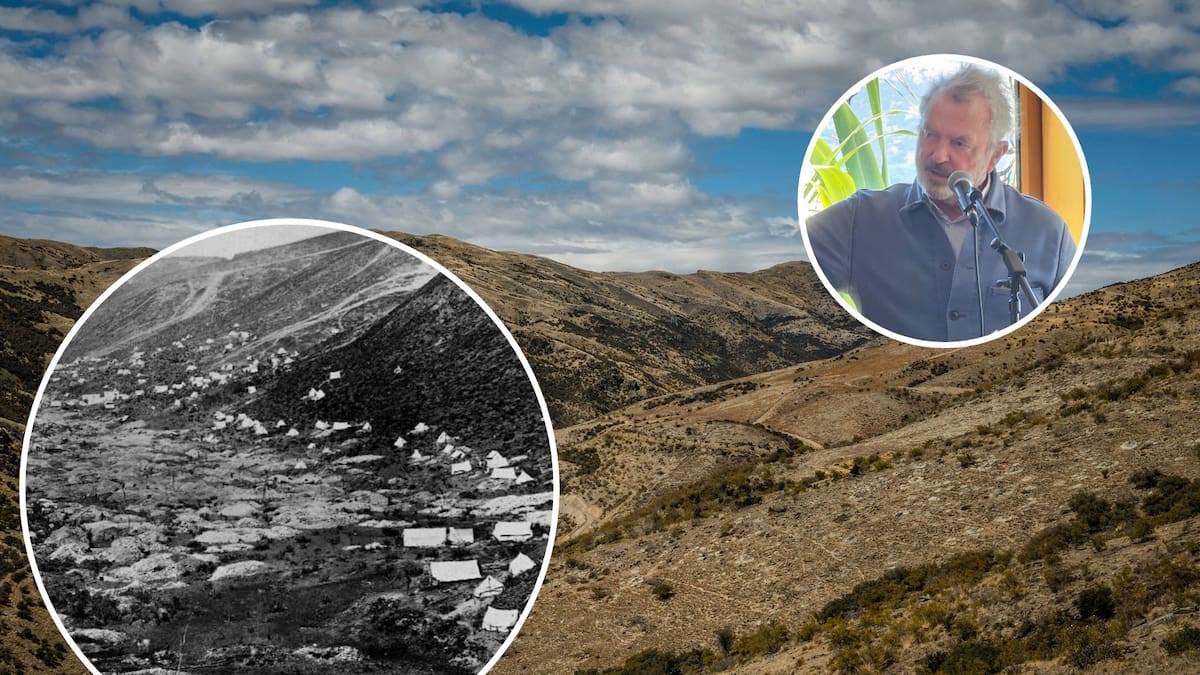
Gabriels Gully, where the Otago gold rush began in 1861, is about 60km southeast of the Old Man Range. Photo / Alexander Turnbull Library
The compressed timeline has only intensified scrutiny of a proposal already drawing national attention.
A pre-feasibility study updated last July outlines an initial 14-year mine life and peak production of 120,000 ounces of gold a year, placing it among the more significant gold developments currently under consideration in New Zealand.
At its core is a large-scale open-cast operation – a far cry from the pick-and-shovel mining that once defined the region.
Santana plans four open pits, including one stretching up to 1km long, 800m wide and 200m deep, alongside a processing plant and tailings storage facility.
The scale of the proposal has sharpened a debate that extends well beyond the project site, with critics have reporting personal abuse and threats from the mine’s supporters.
Santana Minerals chief executive Damian Spring said the project had been designed to meet modern environmental and engineering standards, a sharp contrast to its historic roots.
The Dunstan Mountains could be home to a large gold mine between Bendigo and Ophir. Photo / Simon Williams, Santana Minerals
“The project includes a fully engineered Tailings Storage Facility meeting modern international standards,” Spring said.
“Safeguards include cyanide detoxification, seepage capture, clean-water diversion, sediment controls and water treatment post-closure. The system ensures downstream water quality, including sulfate levels, stays within strict consent limits.”
Spring said climate resilience had been factored into early design work.
“The tailings facility is designed to handle a 748mm extreme rainfall event, and we’ve completed seismic and settlement modelling to ensure the site performs under wetter, more variable conditions.”
He said a full emissions assessment would be completed at the detailed design stage.
“Climate change and emissions will be formally assessed once the Bendigo Project moves into detailed design, when we confirm final plant configuration, energy demand and equipment choices.”
The Bendigo-Ophir project is Australian mining company Santana Mineral’s core focus. Photo / Supplied
Supporters say the project would bring jobs, higher wages and economic activity to the region.
An active Facebook group, Santana Mine Supporters, has more than 7500 members – the Herald reached out to several.
John Cossens, a Central Otago resident, said he was “an absolute 110%” supporter of the project. “The country needs it,” he says. “The region needs employment. Absolutely.”
Cossens said critics misunderstood modern mining, pointing to the industry’s heavy regulations.
“How dare they [critics] poke their nose into something that is so heavily monitored, heavily metered. You can’t just go in and raid and pillage today. They [critics] have no idea.”
He said the mine would drive infrastructure and growth of the region’s economy in order to support a project of such a size.
Another local supporter, John Allison, said the mine could help bring younger generations back.
Damian Spring, executive director and CEO of Santana Minerals. Photo / Santana Minerals
“I have three children in Australia … one of whom works in a mine in Western Australia … They would all love to come back here and live and work in Central Otago,” he said.
“But the reality is there are just not the high-paying jobs for them to do that.
“There’s a lot of talk about tourism and horticulture being the industries of Central Otago, but they are just low-paying jobs. They’re not going to allow people to buy homes or rent in Central Otago, an area which has probably the highest house prices and rental prices in the country.”
According to realestate.co.nz, Central Otago Lakes District is the priciest place to rent in New Zealand, with the average weekly price hitting $891 – more than $200 above Auckland.
Business owner Paul Bright said the project highlighted wider economic issues.
“Mining is the smallest sector in the entire economy at roughly 0.75% of GDP in 2023,” he said.
“In Australia, mining contributes around 14.3% of national GDP.
“You need roughly 19 low-paid tourism or hospitality jobs to generate the same economic value as a single mining job.”
Gold mines have been a critical feature of Central Otago’s past. Photo / Santana Minerals
He said the roles created would be long-term and higher-paid.
“These are not casual seasonal roles but long-term, higher-paid positions in operations, maintenance, engineering, transport and professional services.”
Opposition group Sustainable Tarras said the project posed significant environmental and long-term risks.
“We are concerned about key local and regional issues: The quality and availability of water, the impacts of seismic activity and natural hazards, including climate change, the highly valued tranquility of the area, the value of our landscapes, the long term impacts on our natural environment and impacts on the prosperity of Central Otago communities, to name a few,” a spokesperson said.
“We are also very concerned about the level of long-term risk this project brings to the people of Central Otago, despite the benefits of jobs in the short term.”
The group said it was reviewing a large volume of material under time pressure.
Central Otago. Photo / 123RF
“Keeping in mind that there are over 9400 pages of reports … we are now focused on analysing what we can in a very short timeframe.”
It also criticised the fast-track process.
“For a project of this complexity and scale … it is totally inappropriate to push through a fast-track process with reduced community input and involvement.”
The proposal has drawn national attention and high-profile involvement.
Figures including Sir Sam Neill, Sir Grahame Sydney and former prime minister Helen Clark have been vocal in their opposition to the mine, with iwi also raising “significant” concerns about potential Treaty impacts.
A recent fundraising event hosted by Neill and Sydney drew around 150 participants.
In a January opinion piece in the Otago Daily Times, Santana Minerals non-executive chairman Peter Cook criticised opposition to the project, taking aim at what he described as “celebrity-hosted fundraisers with curated wine lists” and arguing the mine had the backing of “more than 15,000 current New Zealand shareholders”.
Cook also defended the safety and regulation of modern mining, pointing to long-running operations in New Zealand and Australia and claiming such projects operate with minimal incident.
Neill responded in a subsequent opinion piece in the Otago Daily Times, rejecting Cook’s characterisation of the fundraiser and the broader project.
“Our Australian friend seems offended by a fundraiser lunch. Well, you need funds to fight a powerful, wealthy, rapacious company like Santana,” he wrote.
“We are just the little guys, fighting as best we can for the survival of our landscape, our jobs, our freshwater, our livelihoods, our future, our grandchildren, our completely unique Central Otago.
“Because make no mistake: A vast, opencast mine in the middle of where we live would be utterly and permanently ruinous for all of these.
“I have been to the Australian mines that he refers to, ‘where nothing goes wrong’. Really?
“Here is just one salient difference. The mines in Pilbara are some 1500km from Perth. This filthy mine would be only 30km from Cromwell, Wānaka and Alexandra. Too toxically close by far.”
Community division has also been noted by Central Otago Environmental Society member Matthew Sole, who said: “There’s a lot of tension in the community.”
The debate is set to escalate further.
Earlier this month, it was reported that Resources Minister Shane Jones and businessman Sir Ian Taylor will face off in a public debate in Dunedin on April 8.
“The narrative is that Otago, in many respects, generated its early momentum from the extractive sector,” Jones said.
Taylor said he wanted the discussion to remain measured.
“I’ve made it clear that from my perspective, I don’t want it turning into a shouting, screaming circus.”
The fast-track panel is expected to weigh environmental, economic and community impacts before making its decision in October.
Ben Tomsett is a multimedia journalist based in Dunedin. He joined the Herald in 2023.