
I walk to work. Partly for health reasons and partly for environmental ones. But also because the thought of getting on Auckland’s motorways every morning and evening feels like a gamble I would rather avoid.
Of course, not everyone has that choice. Thousands of hardworking Aucklanders rely on those motorways every day to get to work, deliver goods, collect children and simply get through their lives. They do it because they have to.
And increasingly they do it knowing that one crash can bring the entire system to a halt.
We have all been there: sitting in a queue of traffic on the motorway, watching the minutes of our lives tick by while emergency lights flash somewhere ahead. You can see and feel the frustration building, drivers checking their watches, phoning work, drumming their fingers on the steering wheel.
The longer it goes on, the more the irritation spreads.
Any politician who stood up and said they were going to fix this, that they would change the law and procedures so Aucklanders were not sitting for hours stewing in traffic behind minor crashes, would probably get elected in a heartbeat.
Because the cost of these delays is not trivial.
Research commissioned by Auckland Transport has estimated a single serious crash on a motorway can impose congestion costs in the millions of dollars as tens of thousands of drivers are delayed and traffic ripples across the network. Across Auckland, crash-related delays are estimated to cost hundreds of millions of dollars each year in lost time.
And even those figures probably underestimate the real impact.
Traditional crash-cost calculations measure vehicle damage, medical costs and insurance claims. What they struggle to capture is the economic value of thousands of people sitting immobilised in cars unable to work, unable to deliver goods, unable even to get home.
So how did we end up here?
Part of the answer lies in the way New Zealand investigates crashes.
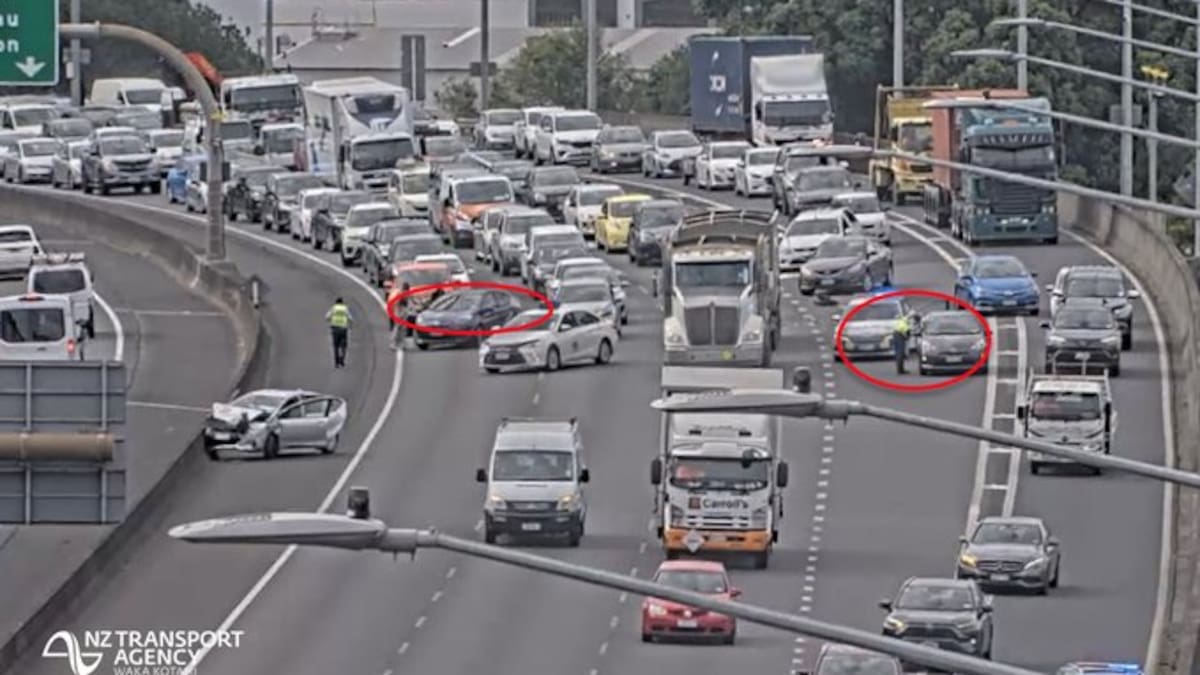
A crash on Auckland’s Northern Motorway, State Highway 1 delays motorists and comes at a substantial cost to the country. Photo / NZTA
Beginning in the late 1990s and early 2000s, police developed specialist Serious Crash Units trained in forensic crash reconstruction. Their job is not simply to clear the road but to determine what happened – measuring skid marks, mapping debris fields, recording vehicle positions and analysing road conditions and damage.
This approach has an obvious purpose. If someone is to be prosecuted for dangerous or careless driving or in the most serious cases manslaughter, the prosecution must prove the case beyond reasonable doubt.
Judges properly insist that fault cannot simply be assumed because a crash occurred. The court must be satisfied about the manner of driving and the cause of the collision. It would be a nightmare to be wrongly convicted of a serious driving charge when in fact it was the other bugger.
That means investigators often gather detailed evidence before the scene is disturbed.
In serious cases, particularly where someone has died, that level of investigation is entirely justified.
But the practical consequence is that large sections of motorway can remain closed while the scene is documented and measured.
Other countries face the same legal standard but manage incidents differently.
In many parts of the United States, “quick clearance” laws encourage drivers involved in minor crashes to move vehicles off the roadway if they can do so safely. Police may photograph the scene quickly, record basic information and reopen the road while responsibility is resolved later.
Across much of Europe the principle is similar. Minor collisions are often handled through insurance processes rather than lengthy on-road investigations. The priority is simple: clear the road and keep traffic moving.
New Zealand, by contrast, often follows a more traditional approach: investigate first, reopen later.
None of this is because our legal system is unusual. Criminal traffic offences in countries such as Britain, Australia and the United States must also be proved beyond reasonable doubt.
But there is no reason why every crash on an Auckland motorway should be treated as if it might end in a criminal trial.
Many incidents involve minor collisions, simple mistakes or everyday driving errors. These are not acts of criminal recklessness; they are the ordinary mishaps that occur whenever millions of journeys are made on busy roads. And judges cannot consider traffic management implications of the criminal burden of proof. Instead, they look at the miserable unfortunate defendant staring up at them hoping to be acquitted.
Motorists, especially those who travel into cities, feel they are being hit from every direction. Photo / Getty Images
At times it feels as if the system has drifted into a form of procedural overkill “Rolls-Roycing” the proof of relatively minor incidents while thousands of people sit immobilised in traffic.
Rolls-Roycing is something New Zealand does rather well. We see it in many areas of public administration: elaborate systems, complex processes and gold-plated solutions where a simpler approach might do.
And here Parliament cannot escape responsibility.
Other countries have changed their laws to allow quicker road clearance and faster incident management. Yet in New Zealand the legal framework and operational approach have remained largely unchanged for years.
That is exasperating. We are a small country with a relatively simple legislative system. In theory, we should be able to respond more quickly to practical problems like this.
We should be leading. But we are not even following close behind the leaders. We are at the back of the field with our measuring tapes.
Technology already exists that could help change this. We should be the first adopter of new technologies. We are well-educated capable people. We should not be the last like the last Neanderthal dragging their knuckles along the motorway.
Drones and rapid digital imaging can document crash scenes in minutes rather than hours. Photographs and GPS mapping can preserve the evidence needed for later analysis while allowing roads to reopen much sooner.
For minor collisions and lower-level driving errors, the law could also move towards a more administrative approach, where responsibility is determined later on the lower level of the balance of probabilities through insurance or regulatory processes with fines rather than requiring immediate criminal-level proof. After all we’re talking about a moment of inadvertence: nobody has held up a dairy with a shotgun.
The full forensic investigation and the standard of beyond reasonable doubt would remain exactly where it belongs: in cases involving death, serious injury or genuinely dangerous conduct.
But for the everyday motorway fender-bender, the priority should be getting Auckland moving again. Time is our most precious commodity. Why do the traffic planners think their preference of bringing a bulldozer to plant a daisy should take precedence over thousands of Aucklanders’ time?
Because every time thousands of people sit trapped on a motorway behind a minor crash, it exposes a deeper problem. The technology exists. The solutions exist. Other countries have shown how it can be done.
What appears to be missing is the urgency to make fairly simple changes.
And until those responsible for designing and running the system recognise that the human and financial cost of immobilising tens of thousands of Aucklanders is simply unacceptable, the queues will keep growing – and so will the public’s impatience with a system that refuses to move as quickly as the city it is supposed to serve. Bring on quick clearance and bring it on quick.
Catch up on the debates that dominated the week by signing up to our Opinion newsletter – a weekly round-up of our best commentary.