
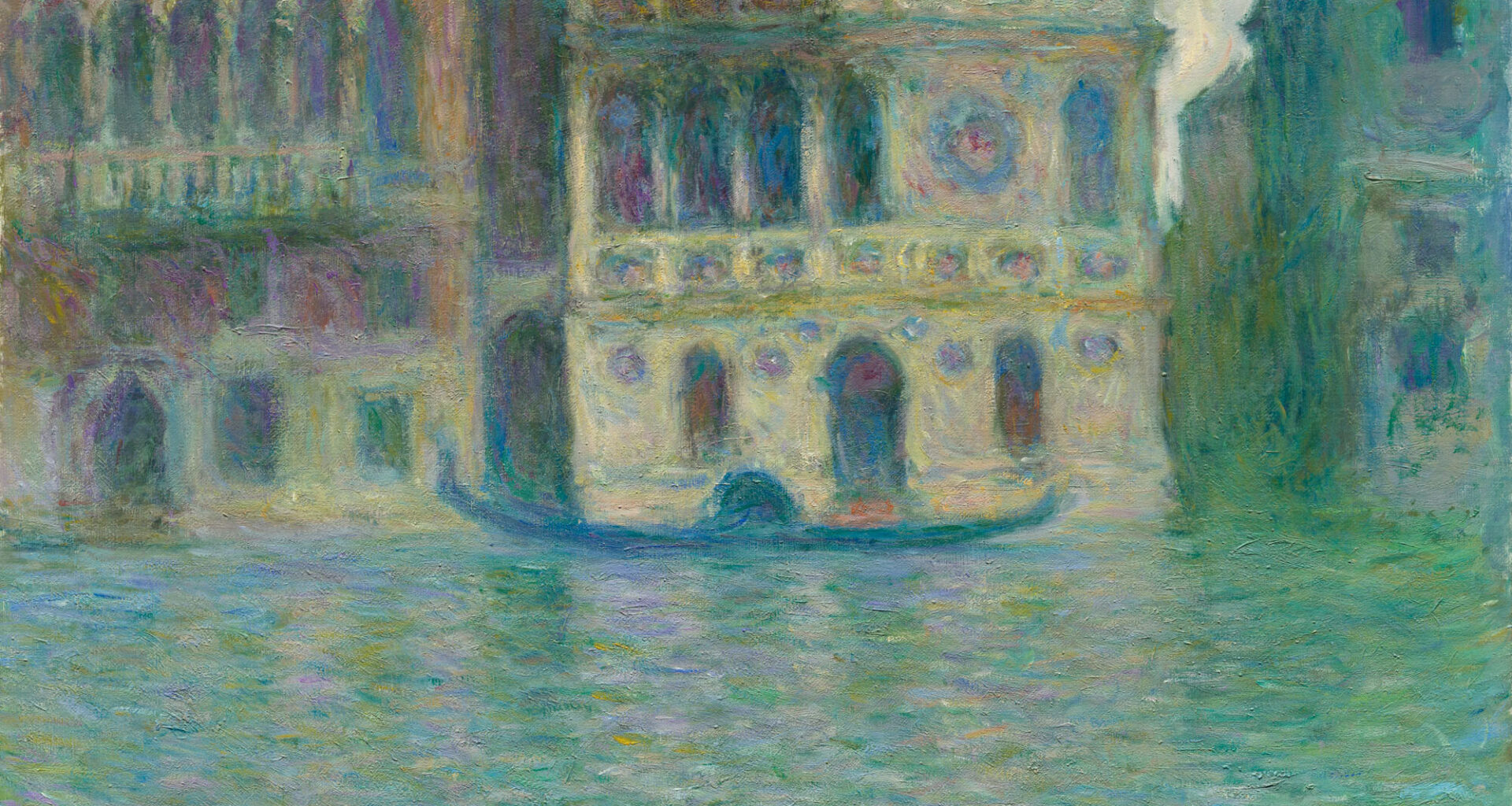
Claude Monet is one of those artists we all think we know.
Yes, that Monet of the ubiquitous “Water Lilies” — the ones often plastered on classroom walls and in doctor’s offices or on tote bags.
In the century since his death in 1926, the man who for many came to define the Impressionist movement in France in the late 19th century with his transcendent abstract views of flowers, water and light, has been chronicled and reproduced extensively.
Article continues below this ad
Claude Monet, “The Doge’s Palace Seen from San Giorgio Maggiore” (1908) by Claude Monet. “Monet and Venice” at the de Young Museum is a worthy exhibition that offers a fresh look at the famed Impressionist artist.
© The Metropolitan Museum of Art./Art Resource, NY
Still, curator Melissa Buron had compelling reasons to explore the painter with the Fine Arts Museums of San Francisco’s latest exhibition, “Monet and Venice.” Chief among them: creating the largest reunion of the painter’s works created on his 1908 trip to Venice since 1912.
“Monet and Venice”: Painting, works on paper. 9:30 a.m.-5:15 p.m. Tuesday-Sunday. Through July 26. $11-$20; free for children age 17 and younger. De Young Museum, 50 Hagiwara Tea Garden Drive, S.F. www.famsf.org
Organized with the Brooklyn Museum, the show at the de Young offers so much more than just Monet’s radiant Venetian paintings, which have never been the subject of an exhibition. Visitors may also leave with a deeper understanding of one of Monet’s signature themes, which he continued to explore throughout his life.
San Francisco Chronicle Logo
Make us a Preferred Source to get more of our news when you search.
Add Preferred Source
Buron, currently the director of collections and chief curator of the Victoria and Albert Museum in London, was a curator at the Fine Arts Museums of San Francisco, which includes the de Young and Legion of Honor museums, for 16 years.. It was during that period her desire to explore this late period of Monet’s career began, sparked by a painting in the FAMSF permanent collection, “The Grand Canal, Venice.”
Article continues below this ad
Claude Monet, left, and his wife Alice at St. Mark’s Square in Venice, Italy, in October 1908.
Musee Marmottan Monet, Paris, France/Bridgeman Images
In 1908 at age 68, the painter and his wife Alice undertook what was intended to be a two week visit to the city.
“The trip comes at an interesting time for Monet right after he canceled his second attempt at showing the water lilies in 1907,” explained Buron. “His dealer is under the spell of Fauvism and thinks they’re too big, bright and bold. So Monet throws in the towel and says he’s renouncing the water lilies once and for all.”
The Monets stayed at the famed Palazzo Barbero (setting of the 1888 Henry James novella “The Aspern Papers”) and extended their trip to two months. Initially, Buron said, Monet felt that the city was “too beautiful to paint.”
He eventually came to produce 37 works while in Venice.
Article continues below this ad
“Venice, Palazzo Dario” (1908) by Claude Monet.
The Art Institute of Chicago/Art Resource, NY
To set the historical stage, “Monet and Venice” includes two magnificent Canaletto paintings, “Venice, the Grand Canal looking East With Santa Maria della Salute” (1749-50), usually on view at the Legion of Honor, and “Venice, the Bucintoro at the Molo on Ascension Day” (circa 1745) from the Philadelphia Museum of Art. Those works join a series of 1741 engravings of the city by Michele Giovanni Marieschi.
The exhibition also features work by Monet’s contemporaries John Singer Sargent (depicting the interior of the Palazzo Barbaro), J.M.W. Turner and a stunning painting by pointalist Paul Signac, “The Lagoon of Saint Mark, Venice” (1905), showing how his peers were depicting the city.
The 22 Monet paintings of the city are arranged according to Venice’s geography, with depictions of palazzi and other landmarks hung in their real-life sequence. Monet’s Venice quickly emerges as unlike any other artist’s. Painted from inside gondolas, the works offer a cruising view of the city rather than views from above. That’s especially evident in works like “The Grand Canal, Venice,” where he captures the play of light on the water as it shimmers and reflects in ways that feel heightened yet completely true to life.
“The Church of San Giorgio Maggiore, Venice” (1908) by Claude Monet.
Indianapolis Museum of Art at Newfields, The Lockton Collection.
That effect carries through in the almost vaporous qualities that seem to envelop works like his views of San Giorgio Maggiore with its 16th century Benedictine basilica. It’s as though sunshine, water and air have combined into a luminous mist.
Article continues below this ad
There is a similar, dreamy haze over “The Palazzo Ducale Seen From San Giorgio Maggiore,” which shows the Doge’s Palace from the island. In the paintings, the air and water seem to interact, revealing an almost purple depth to the canal.
It’s almost as though Venice and Monet were waiting for each other. His understanding of nature and light bring new life to even the most brooding architectural depictions, like “The Palazzo du Mula.” That painting carries both a sense of verdant abundance and the slight stench of decay that water often brings.
In the final room of the exhibition we see two depictions of his signature water lilies created after the Venice trip that were part of the 48 water lilies he presented in 1909. “The water becomes a character in its own right in these later paintings,” noted Buron.
“Water Lilies” (circa 1914-17) by Claude Monet.
Randy Dodson/Fine Arts Museums of San Francisco
After viewing the Venice paintings, it’s clear Venice — and what it taught him late in his career — stayed with Monet.
Article continues below this ad
“Instead of death in Venice, this is an artist’s rebirth in Venice,” said Buron.
For those seeking to learn more about the works, the exhibition’s primary sponsor, Anthropic, includes a text-only dialogue experience with a modern-day Claude, the company’s artificial intelligence chatbot.
“Monet and Venice” is the another spectacular reexamination of an Impressionist master by FAMSF following recent successes with Mary Cassatt, Edouard Manet and Berthe Morisot. Much like Venice did for Monet, Buron offers a new view that will make us reexamine what we think we know about the painter.