
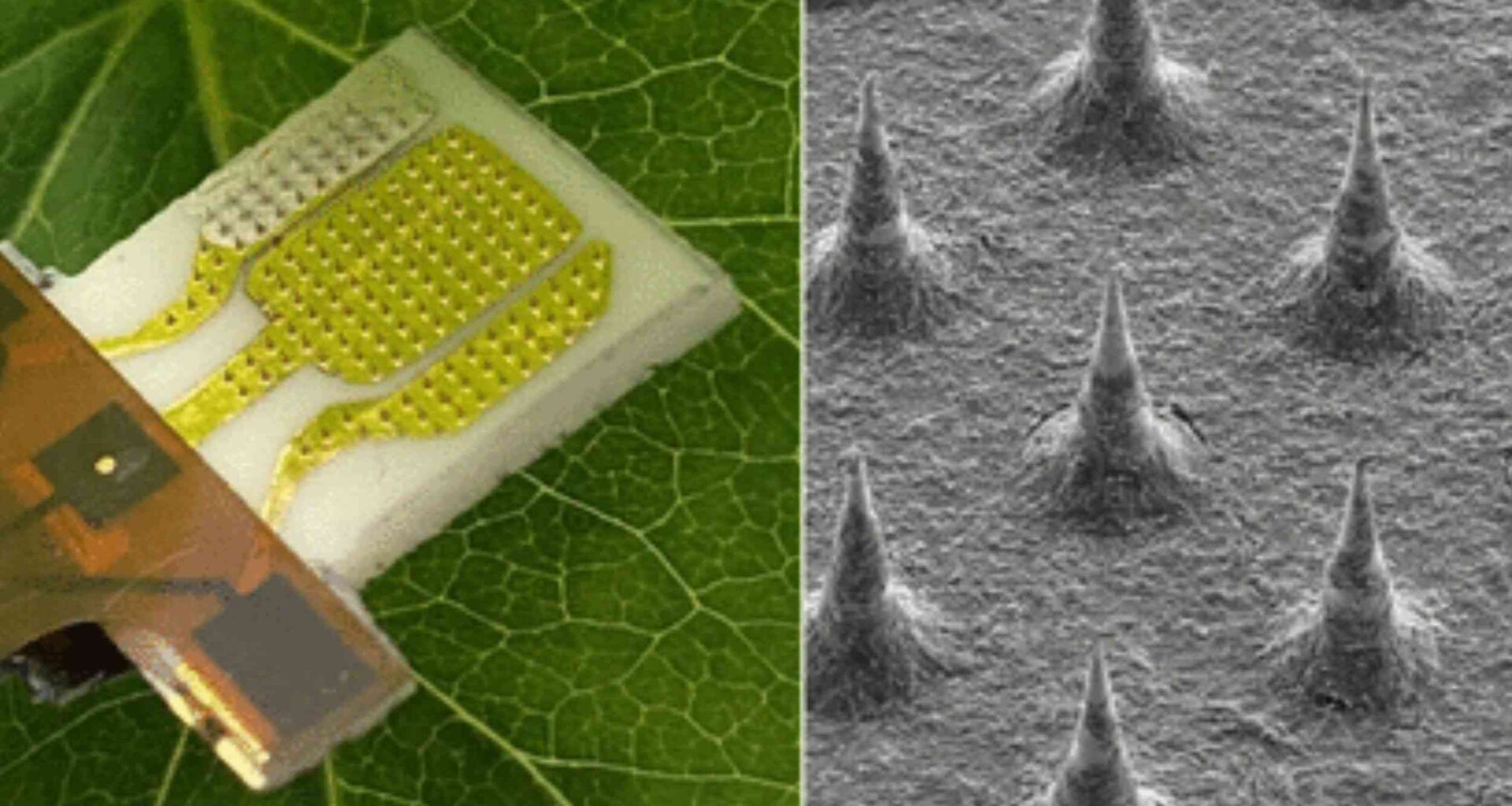
Researchers have found that a leaf-worn patch can detect hidden stress in living soybean and tobacco plants before visible damage appears.
That advance turns one of a plant’s earliest internal warning signals into something growers could catch soon enough to limit wider loss.
Inside the leaf

On the undersides of infected soybean and tobacco leaves, the patch registered a stronger current than it did on healthy tissue.
Working at Iowa State University, Liang Dong and colleagues tied that rising current directly to the stress signal building inside the leaf.
Across both crops, the reading stayed low in controls and climbed after bacterial infection pushed the plants into defense mode.
That pattern showed the device was capturing a real early warning, while leaving open the larger question of what kind of stress set the signal off.
A signal for early stress detection
The patch tracks hydrogen peroxide, a reactive molecule plants build quickly inside cells when stress disturbs normal chemistry.
Cells also use it as part of reactive oxygen species, unstable oxygen-based chemicals that help start wider defensive responses.
Because those levels rise early, the sensor can catch trouble before a grower sees spots, wilt, or slowed growth.
That advantage has a limit, since the signal reveals stress itself but not the exact cause behind it.
Monitoring chemistry inside the leaf
Beneath the reading surface sits an array of microneedles, tiny spikes that reach leaf tissue without removing samples.
A soft coating on those tips held an enzyme that reacts with hydrogen peroxide and releases electrons on contact.
The team formed that coating as a hydrogel, a water-rich material that holds the chemistry, and added graphene to carry the charge.
As the current rises, the device turns chemistry inside the leaf into a number a grower can read.
How infected plants respond
When leaves were exposed to a common plant-infecting bacterium, the patch quickly showed a much stronger signal than it did on healthy plants.
In tobacco, that signal rose sharply after infection, marking a clear shift from calm to stressed conditions inside the leaf.
Soybean showed the same pattern, with readings climbing after infection even though the increase was smaller than in tobacco.
Despite natural differences between individual plants, the device still clearly separated stressed leaves from healthy ones in both crops.
Confirmation in the lab
Brown stain tests darkened infected leaves, matching the sensor’s higher readings instead of pointing to a different story.
A fluorescent lab assay on tobacco returned similar values during live tests, which supported the patch’s accuracy in leaves.
That assay ran slightly higher, likely because leaf pigments create background light that can muddy fluorescence measurements.
Agreement mattered here, because speed alone would mean little if the patch failed to mirror trusted lab results.
Faster tests for detecting plant stress
Older checks often needed crushed tissue, staining steps, or optical gear before anyone could judge a plant’s condition.
By contrast, this patch delivered direct leaf readings on attached plants, with no sample preparation at all.
Earlier plant-worn sensors had already tracked gases from leaves, but this design read an internal alarm molecule.
That change trimmed away extra handling, which also reduced chances of altering the very signal the patch needed to measure.
What farmers gain
“We can achieve direct measurements in under a minute for less than a dollar per test,” said Dong.
That kind of speed could help farmers inspect suspicious rows sooner, isolate disease, or change care before losses spread.
Home gardeners might also benefit, though the study stayed with research crops rather than backyard vegetables or flower beds.
Limitations of the patch
The patch is not yet a universal stress meter, because the trials covered only soybean and tobacco leaves.
Each reading tracked hydrogen peroxide, but that rise can follow drought, heat, pests, or infection in the same leaves.
Reuse also has a ceiling, since the tiny needles held their shape through six insertions and failed by nine.
Those limits keep the results honest while showing where more engineering still has to happen before field use.
Potential beyond one chemical
The same platform could eventually watch more than one plant alarm at once within the same patch, making diagnoses much sharper.
Different enzymes can be tuned to different molecules, so one patch might monitor several stress pathways together.
“Our next step is to refine the technology and enhance its reusability,” said Dong, describing the team’s next engineering target.
If that happens, a single leaf patch could join wider field networks watching disease, nutrients, and water.
The device turns an invisible chemical warning into a fast electrical readout in the field, linking plant biology to practical decisions.
Its promise rests on timing, because earlier knowledge gives growers a chance to act before stress becomes visible loss.
The study is published in the journal ACS Sensors.
—–
Like what you read? Subscribe to our newsletter for engaging articles, exclusive content, and the latest updates.
Check us out on EarthSnap, a free app brought to you by Eric Ralls and Earth.com.
—–