
The company accepted that it put Bayram in unnecessary danger by failing to have an emergency water rescue craft with trained staff on standby – and had no similar arrangement with rescue services – in case of an inadvertent water landing.
It faces a fine of up to $100,000 when it is sentenced in North Shore District Court later this year.
Speaking from the UK, Bayram’s father Andrew said the family was relieved the company had admitted fault, avoiding the need for a trial, which meant the three-year process was coming to an end.
He hoped the prosecution and reparation payment would “put a line under it all, which is what the family here are after”.
The summary says the sunset jump was the final descent on the first day of a recreational parachuting event called Mad King Boogie 3 held at Skydive Auckland’s Parakai base.
The company’s ZK-SDF aircraft took off from Parakai Airport after a safety briefing and several “dirt dives” in which the parachutists practised the formation jump on land.
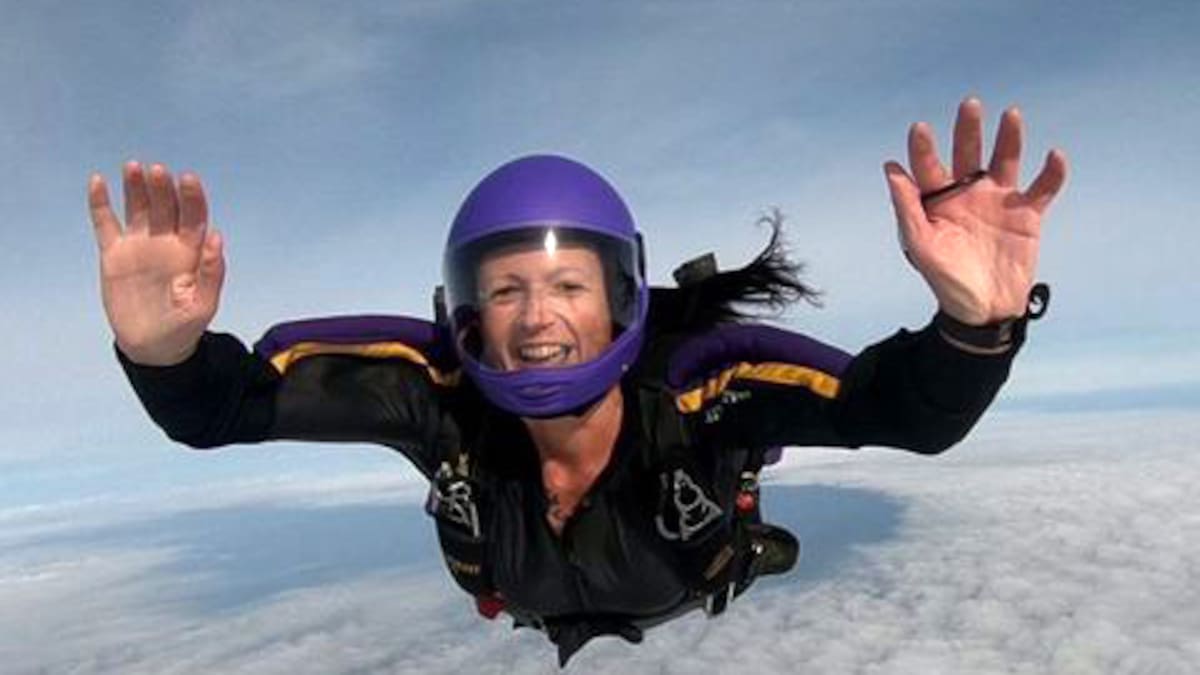
British skydiver Sarah-Jane Bayram died after a parachuting accident over Muriwai Beach. Photo / Supplied
Six of the skydivers had not participated in a nine-person speed-star formation jump before, but all had requisite qualifications, the summary says.
While friends of Bayram say she voiced concerns about the wind, the document says conditions were “favourable” with reasonable visibility.
The aircraft ascended to 13,000ft and the pilot signalled to the skydivers they were at the exit spot at 7.35pm.
The group exited the plane and began plummeting towards earth.
During the descent, the final jumper collided with Bayram’s left side at about 11,000ft, about 15 seconds after he exited the plane.
“The collision knocked Ms Bayram unconscious.”
About 30 seconds later – still in freefall – a fellow jumper managed to deploy Bayram’s parachute. The rest of the group landed on Muriwai Beach three to four minutes later.
Unable to control her descent, Bayram drifted out to sea in the prevailing offshore breeze before landing in the ocean about 2km from the waterline.
A pathologist was unable to confirm whether Bayram’s death happened during the mid-air collision, or if she perished in combination with landing in the ocean.
Skydive Auckland safety officer Fiona McLaren was on the beach monitoring the skydivers’ descent. She noticed Bayram travelling out to sea and another jumper raised the alarm when he landed.
McLaren activated an emergency action response plan. She radioed the pilot and instructed him to return to the area and circle the location where Bayram had landed from about 7.46pm.
A skydiving plane circles over the ocean off Muriwai Beach where Sarah-Jane Bayram died after colliding with another skydiver during a formation jump in March 2022.
She also called Search and Rescue then 111 at 7.40pm and 7.41pm respectively.
Fire and police personnel arrived at the beach at 7.53pm and 8pm.
Two locals who had noticed Bayram being blown out to sea rescued her on a jet ski. They provided CPR after retrieving her from the water and brought her back to shore at 8.18pm.
Bayram – a 42-year-old University of Auckland worker who had completed nearly 400 jumps since taking up skydiving four years earlier – was declared dead at 8.30pm.
Company admits fault after reaching plea deal
A year after the accident, the CAA filed two charges against Skydive Auckland, and two against the company’s director, Tony Green.
The charges were laid under the Health and Safety at Work Act, and Civil Aviation Act.
The most serious charge carried a maximum fine of $1.5 million for a company or $300,000 for an individual.
Skydive Auckland was also issued a safety improvement notice by the regulator, requiring it to ensure standby rescue craft were in place for any future jumps over or near water, and that parachutists were “competent” swimmers.
The CAA dropped charges against Skydive Auckland CEO and director Tony Green following a plea deal in which his company agreed to pay $100,000 to Bayram’s family.
The case was set to go to trial this month before the company pleaded guilty to one CAA charge of operating a skydiving activity in a manner which caused unnecessary danger to Bayram “in the form of drowning if they landed in the significant body of water and were not able to be promptly retrieved”.
The three other charges were dropped but Skydive Auckland agreed to pay the Bayram family $100,000 in reparation. It’s understood the payment is in addition to any fine handed down by the court.
Green declined to comment, saying he had been instructed not to make any statement until after sentencing.
A CAA spokeswoman declined to comment on why the agency dropped the most serious charges or what bearing the company’s reparation agreement had on the plea deal, saying it could not discuss details ahead of sentencing.
‘Extreme consequences’
The summary also discusses regulatory settings and what precautionary measures Skydive Auckland had taken on the day.
The company undertook a risk assessment for using Muriwai Beach as a parachute landing area.
This noted that water landing was a hazard with “potential consequences of drowning”. If uncontrolled, the risk was assessed as “likely, with extreme consequences, and a very high-risk level”. But after implementing controls, the risk was assessed as unlikely.
Though Skydive Auckland made no provision for a water rescue craft or rescue services at the beach, this aligned with the company’s emergency action plan, which did not require such steps.
Sarah-Jane Bayram died in a skydiving accident on March 10, 2022 off Muriwai. Photo / Instagram
The following controls to mitigate water landing risks had been implemented, however:
*Instructing parachutists not to fly over or land in water.
*Ensuring skydivers had proper endorsements.
*Providing life jackets and instructions on how to inflate them.
*Creating main chute deployment altitude safety margin.
*Planning the jump run and exit to be over land and moving the exit spot further inland to build further margin.
*Providing instructions for an emergency response plan if needed in the event of a water landing.
The summary notes that at the time, the New Zealand Parachute Industry Association (NZPIA) standards and procedures manual stated that where the intended landing spot was within one nautical mile of a significant body of water, parachutists (as opposed to the operator) were responsible for ensuring an appropriate safety plan.
Following the incident, the NZPIA circulated a draft amendment saying it “strongly recommended” having a recovery craft and trained rescue personnel on hand during all descents over water and onto beaches.
CAA launched sector review after Herald probe
Sarah-Jane Bayram and father Andrew. Photo / Supplied
A Herald investigation revealed that Bayram’s death was the third in three years linked to the Parakai skydiving and training operation – all involving recent graduates of the New Zealand Skydiving School.
Irish national Jack Creane, 27, died in March 2019 after crash-landing at Parakai shortly after graduating from the school.
Theo Williams, 21, died in March 2021 after a hard landing in Tauranga. He had trained at Parakai and recently graduated.
And Bayram died in March 2022. The young man involved in the collision with her at more than 200km/h was also a recent graduate.
After the Herald’s coverage, the CAA launched an investigation into the skydiving industry, citing “concerning trends” that required “further investigation”.
The watchdog said it was “actively monitoring the sector” and promised to utilise all available regulatory tools, including prosecution.
Green defended the company’s safety record after Bayram’s accident and said there was only a “one in a million chance of death” from parachuting.
He said the three fatalities all involved certified parachutists who were responsible for observing aviation safety rules.
Lane Nichols is Auckland desk editor for the New Zealand Herald with more than 20 years’ experience in the industry.