
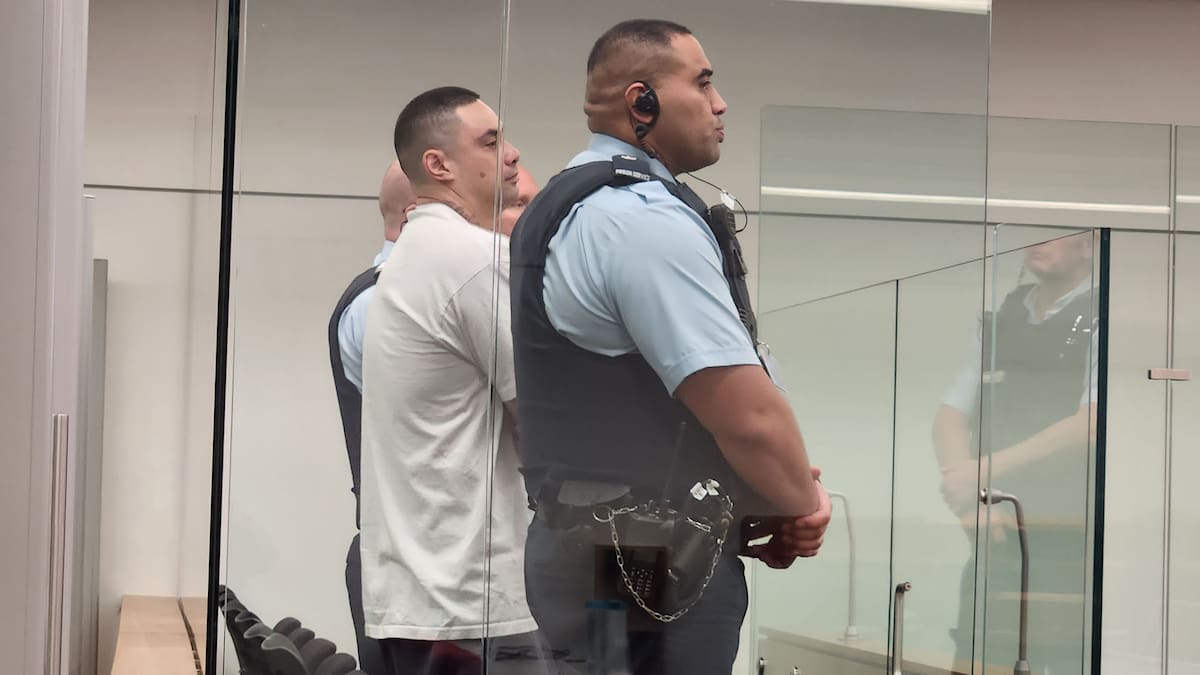
“You were responsible for ordering the drugs and directing them to lower-level associates, or catchers, for collection,” Justice David Boldt said.
The court heard Daveron began importing the drugs in August 2021 and continued to do so until July 2024. He was jailed several months after the drug enterprise began, meaning that for all but the three or four months before his incarceration, Daveron was behind bars.
According to the 19-page summary of facts, Daveron used mobile phones smuggled into jail to arrange the importation of drugs inside various items, including meth-soaked book pages, hockey balls, the inside of car seats, a washing machine drum and truck mirrors, and were destined for various parts of the country.
The summary explained that Daveron was in cellphone contact with an overseas associate identified as “Blakman”, from whom he’d ordered the drugs, providing addresses to which they could be delivered.
The mixture of class A and B drugs originated in countries including Namibia, India, Afghanistan and the United Arab Emirates.
Knowing the drugs were en route, Daveron would direct the catchers to collect the packages from the addresses, or they delivered cash to other criminals on Daveron’s behalf, Justice Boldt said.
“This was a major commercial operation, you were a critical part in it … you were a critical link in the operation,” Justice Boldt said, adding that Daveron had successfully imported 35kg of methamphetamine, valued at approximately $13m, with the other drugs valued at approximately $2m.
His offending came to light after two police operations, during which Customs intercepted some of the packages.
Justice David Boldt. Photo / George Heard
In April last year, Daveron accepted a sentencing indication of 21 years’ jail.
But since then, he has sought to vacate his guilty pleas, with hearings in November and again on Friday, when the judge finally dismissed his application.
Daveron claimed he only pleaded guilty because his lawyer at the time told him the 23 charges were being reduced to five. He maintained he wasn’t told that the five charges would be representative, despite telling the court in November that he was studying law through the Open Polytechnic.
At Friday’s hearing, he once again tried to tell Justice Boldt that he didn’t know what a representative charge was.
But the judge wasn’t buying it, telling Daveron he could file further submissions at the Court of Appeal and seemed unimpressed by his stalling tactics.
“Now, after months of seeking to have your pleas set aside, it is apparent that you have not pleaded guilty because you have generally accepted responsibility, let alone shown remorse or rehabilitation.”
Daveron, the court heard, had refused to engage with a pre-sentence report writer, but in an earlier report, when asked to describe his childhood, said it was “pretty f***** up”.
His father died when he was 7 years old. His mother didn’t work, and life was a struggle. He began selling drugs at primary school to provide for his family. He was drinking by the age of 9 years old and using cannabis by the age of 12.
Life imprisonment
On Friday, Justice Boldt explained that because of the seriousness of the offending, he’d adopted a starting point of life in prison – relatively unusual for methamphetamine offending.
But the judge noted the sheer volume of drugs, and the fact that it had occurred behind bars as aggravating factors.
Justice Boldt acknowledged that Daveron was significantly disadvantaged as a child, and this, along with his guilty pleas, reduced the starting point of 21 years jail to an end sentence of 18 years and 8 months jail, which he imposed for the representative charge of importing methamphetamine.
He ordered that this be served cumulatively on his current sentence of nine years and four months. On the other charges, Daveron was jailed for seven years, to be served concurrently.
That brings Daveron’s total jail sentence to 28 years.
Justice Boldt estimated that with the time he has already spent in custody, Daveron will be eligible for parole in about five years, having served a third of his sentence.
“There is a real opportunity for you to embrace the opportunities in prison for rehabilitation.
“It is your commitment to rehabilitation which will now determine how long you serve,” he said.
Justice Boldt also ordered the forfeiture of $15,000 cash and the destruction of the drugs, phones and SIM cards.
Catherine Hutton is an Open Justice reporter, based in Wellington. She has worked as a journalist at the Waikato Times and RNZ. Most recently she was working as a media adviser at the Ministry of Justice.