
This is a guest post by Darren Davis. It originally appeared on his excellent blog, Adventures in Transitland, which we encourage you to check out. It is shared by kind permission.
And is even more relevant as we are reminded by events just how important more travel options between cities beyond flying and driving really are.
There have been three recent developments of note:
Te Huia Trial Extension. The New Zealand Transport Agency Waka Kotahi board agreed at its meeting on 19th February 2026 to a one-year extension of its trial to 30th June 2027 at its current national share funding assistance rate of 60 per cent.Waikato endorsement. Waikato Regional Council at its meeting on 25th February 2026 agreed to this extension, meaning that full engagement on the future of Te Huia will occur as part of the council’s 2027-2037 Long Term Plan process.Rolling stock business case. In addition, the Waikato Regional Council’s budget includes $550,000 for a business case to investigate options for the replacement of rolling stock for Te Huia. The current rolling stock are twice refurbished 1970s ex-British Rail mark 2 carriages near the end of their expected life. Some councillors expressed concern over the spend when the future of Te Huia beyond the end of the trial in June 2027 is uncertain. Further options around the business case will be considered by Waikato Regional Council prior to the budget being finalised.
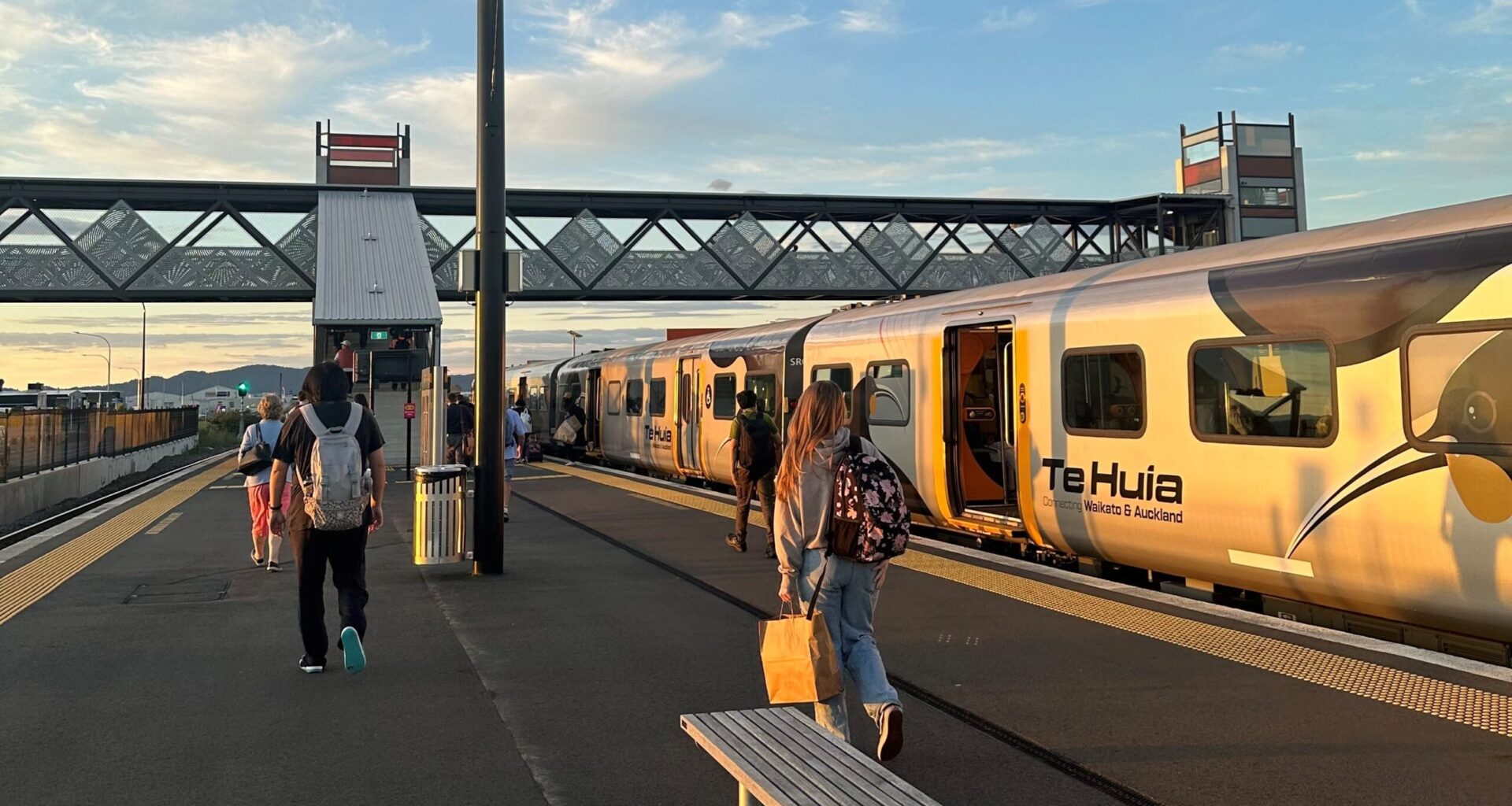
Te Huia early morning at Hamilton Frankton Station. Image credit: Darren Davis
These decisions give Te Huia a small window of opportunity to grow patronage. As the Waikako Regional Council stated in its media release:
Waikato Regional Council Chair Warren Maher said the extension of the service would give Te Huia time to prove its success.
“While the service is generally tracking well against its performance measures, councillors agree that it’s critically important for Te Huia passenger numbers to grow. We need to see more bums on seats.” (my emphasis)
Waikato Regional Council elected members are also keen to increase Te Huia fare revenue for the final year of the trial through a combination of increased patronage and higher ticket prices. A report on fare pricing is due to be presented to council before the final Annual Plan budget is approved. Of course, as any economics 101 student will tell you, the interaction between supply and demand curves means that any increase in price will lead to a decrease in demand, a principle that we seem to fail to understand also applies to roads.
The pressure is to increase fare revenue is because the difference between fare revenue and operating costs is split between Waikato Regional Council and Waka Kotahi New Zealand transport agency. The local share funded by Waikato Regional Council will increase if Te Huia becomes permanent.
Current split: Waikato Regional Council – 40%; Waka Kotahi NZTA – 60%Future split: Waikato Regional Council – 49%; Waka Kotahi NZTA – 51%
Hence, the Waikato politicians focus on increasing fare revenue.
Te Huia’s patronage growth has stalled, largely as a result of the impact of frequent Auckland rail network closures for its Rail Network Rebuild and City Rail Link works as well as some impact from fare increases. And the disruptions are not yet over. While City Rail Link is scheduled to open in the second half of 2026, there are still quite a number of network disruptions to come over the next five months. These are:
Easter Weekend – Four day closure – Friday 3rd April to Monday 6th April 2026April – three day closure – Saturday 25th April to Monday 27th April 2026King’s Birthday – three day closure – Saturday 30th May to Monday 1st June 2026Matariki weekend – three day closure – Friday 10th July to Sunday 12th July 2026
The good news is that KiwiRail has promised that, after numerous years of lengthy Christmas New Year rail network shutdowns, that full network shutdowns will no longer be required once Auckland’s City Rail Link opens in the second half of 2026.
Put simply, because the New Zealand Transport Agency Waka Kotahi review process will kick off in earnest before the end of 2026 and decisions on whether or not Te Huia is to become a permanent service will be made by April 2027. And City Rail Link is only due to open sometime in the second half of 2026.
This is important because the City Rail Link means two things:
An end to lengthy and hugely disruptive shutdowns of the Auckland rail networkAnd City Rail Link itself, as Aotearoa’s first underground metro-style railway, will be a big incentive in of itself to visit Auckland
My crystal ball is a bit hazy at present but there is often an interesting confluence between election dates and major openings of infrastructure. The national election is scheduled for Saturday 7th November 2026. So I’m leaning towards a September 2026 opening date for City Rail Link. But that, of course, is dependent on the successful completion of the numerous testing and commissioning activities as well as stable operation of full simulations of the City Rail Link day one timetable.
And Waka Kotahi/ NZTA will be keen to see a stable higher business as usual patronage base for Te Huia once the initial sugar hit of City Rail Link induced journeys has settled down.
There is some good news here. Auckland’s hugely disruptive rail network rebuild came to an end in January 2026 and this year’s shutdowns are by-and-large the usual public holiday long weekends shutdowns during which Te Huia has never operated anyway. But of course, the Labour Weekend long weekend, Saturday 24th to Monday 26th October 2026 will be two weeks out from the national election and when, fingers crossed, City Rail Link will be operational. It will be interesting to see if Te Huia operates over Labour Weekend. As a leisure oriented service, not running on public holiday weekends and over the Christmas New Year break has been a significant barrier to growth. Reliability, such as a service actually operating stably and reliably every day of the year, including public holiday long weekends and over the Christmas New Year break, is the indispensable pre-requisite for building this stable and growing market of loyal customers.
So here’s hoping Auckland breaks with tradition and actually has an operational rail network over the Christmas New Year break. And maybe even some extended train service to get people home after New Year’s celebrations in the city centre. That way, with the Auckland rail network open and (hopefully) Te Huia operating over the holiday break, Aucklanders would have one congestion-free way of getting out of the city rather than the usual summer queues on the Southern Motorway.
But a note of caution is worthwhile here. A lot of expectation has been piled on Te Huia to achieve both significant increases in patronage and increased farebox revenue in a short space of time. No such expectations are placed on new roads when they open, where uncongested journeys on an empty road is seen as a sign of success, not failure. Te Huia has established a solid core of loyal users in spite of all of the challenges put in its path – from pandemics to enforced shutdowns and a whole pile besides. This in itself is a sign of success, not failure.
The time between when hugely disruptive Auckland rail network shutdowns become a distant past nightmare; when City Rail Link opens and when decisions on Te Huia’s potential future as a permanent service are made is vanishingly thin.
And as I noted above, any increase in fares will have some negative impact on patronage. But exactly how much of an impact is an inexact science. For example, Ōtautahi/ Christchurch’s population increased by one per cent in 2025, adult fare increased by 50% from $2 to $3 while patronage went down by less than one per cent. While this is a modest drop, price sensitive customer segments are likely to experience more significant declines in patronage in response to fare increases. My personal observations on board Te Huia is that many customers only top up their Bee Cards by the exact amount of the Bee Card fare. Which is some indication that money is too tight to mention.
While great that Te Huia will now run until at least mid-2027, the spotlight is firmly on it to build patronage. At the same time, we are still a few months away from Auckland’s City Rail Link opening with the usual public holiday service shutdowns in the meantime. But the decision about Te Huia is likely to come down to how its patronage tracks against its business case and key performance indicators. So if you want to see Te Huia continue, I suggest that you ride, baby, ride!
Greater Auckland’s work is made possible by generous donations from our readers and fans. We’re now a registered charity, so your donations are tax-deductible. If you’d like to support our work you can join our circle of supporters here.
Share this