
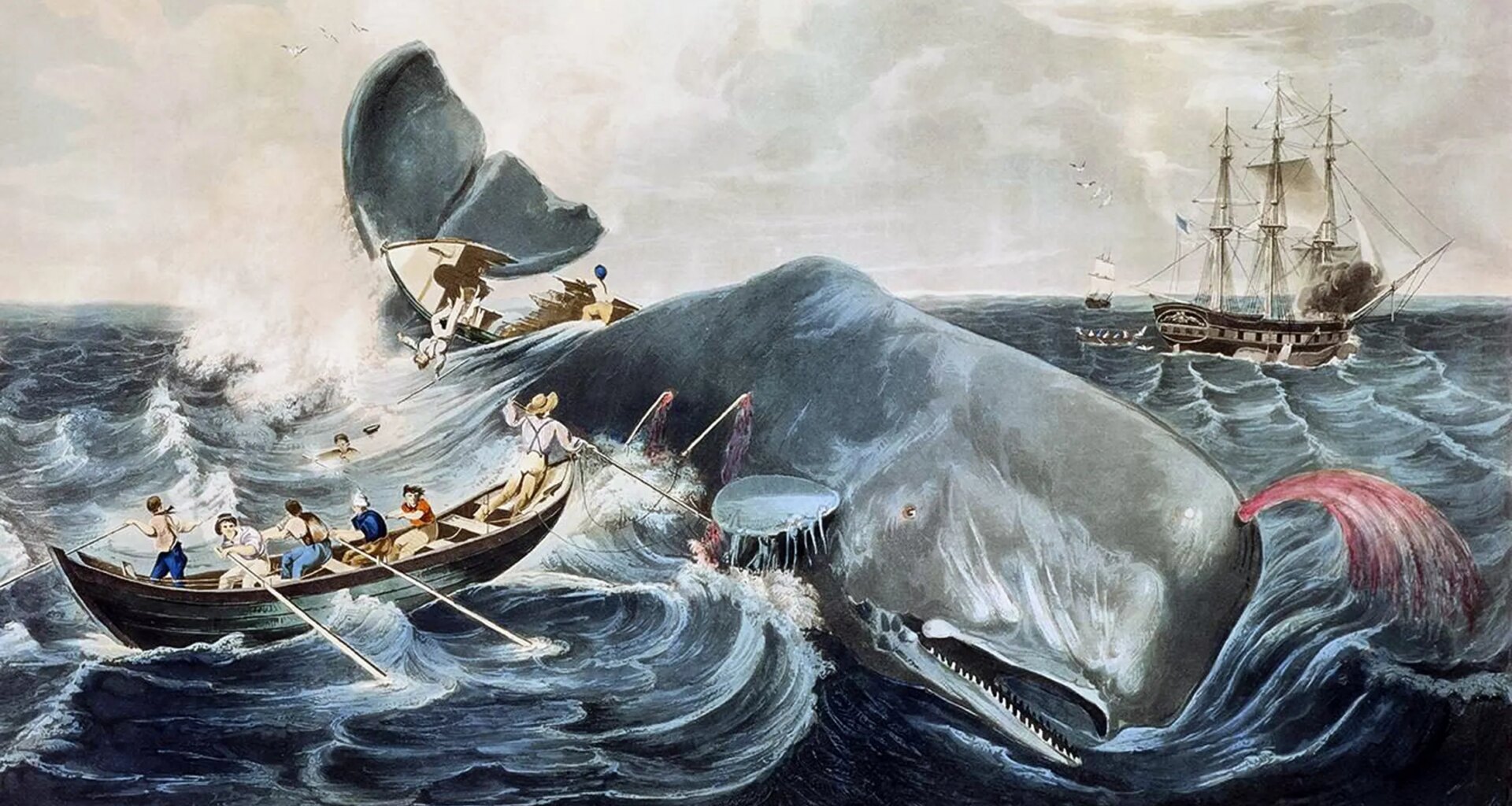
“The surf flew in all directions about him with the continual violent thrashing of his tail. His head about half out of the water, and in that way he came upon us, and again struck the ship.”
So wrote Owen Chase, first mate of The Essex, after the whaler was sunk a thousand miles west of the Galapagos Islands in 1820 by two head-on strikes from a huge sperm whale.
The episode helped to inspire the novel Moby-Dick. But for generations such tales were treated with large doses of scepticism.
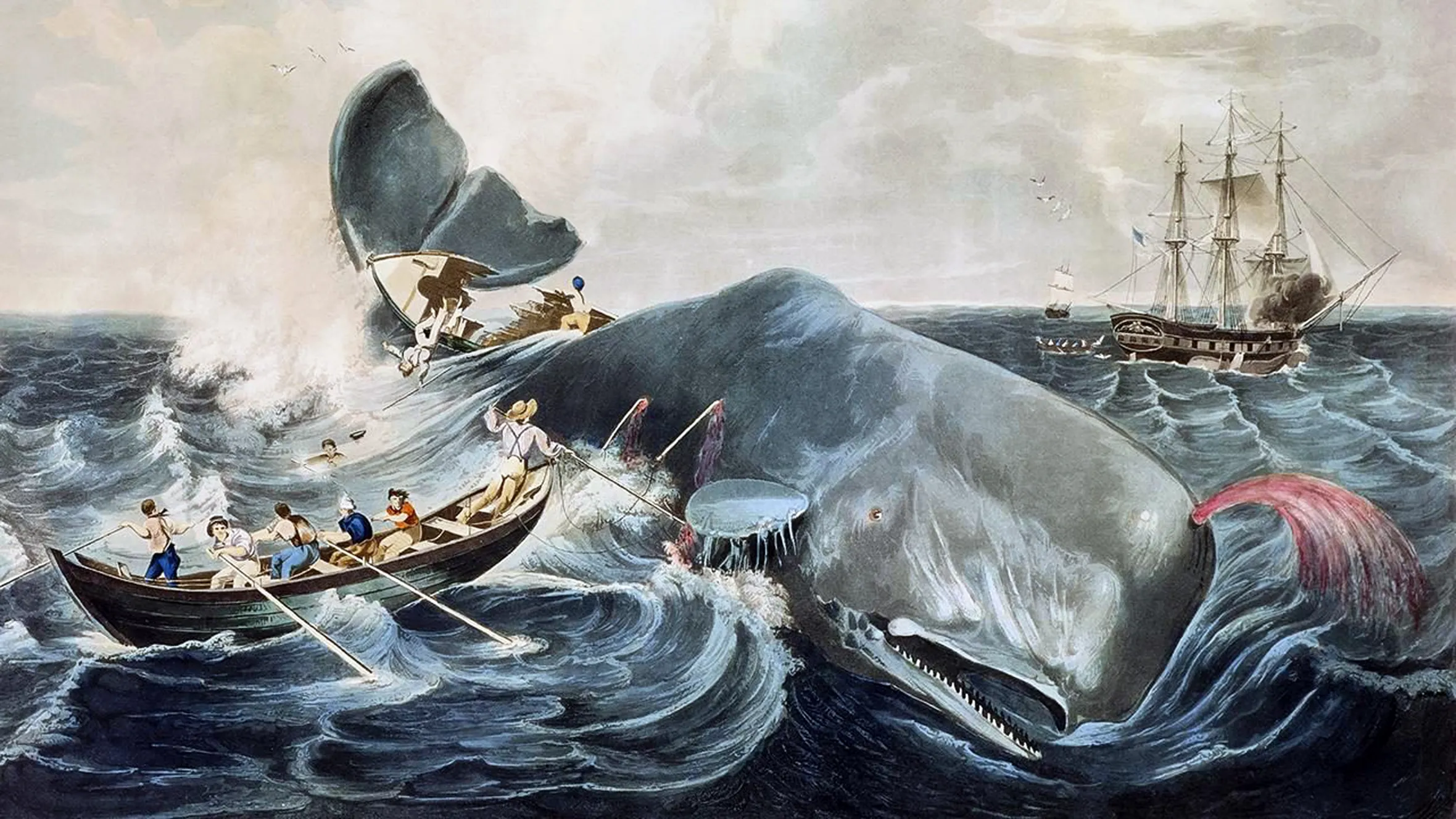 An 1835 depiction of whalers harpooning a sperm whaleHistory/Universal Images Group/Getty Images
Now researchers have, for the first time, documented behaviour that appears to vindicate Chase’s account, by filming the whales deliberately head-butting one another in the wild.
Using drones to observe the animals around the Azores and the Balearic Islands, the team captured three incidents in which sperm whales collided head-first or used their heads to strike another whale’s body.
In one case, the force of impact was estimated at about 200 kilonewtons, strong enough to lend plausibility to centuries-old reports of whales using their colossal foreheads as battering rams.
Sperm whales are the largest toothed whales on Earth, with the very largest bulls stretching to about 24 metres and weighing in excess of 50 tonnes.
They possess one of the most peculiar heads in the animal kingdom, much of it occupied by the spermaceti organ, a huge oil-filled chamber that plays a role in shaping the sounds used for echolocation and communication.
 Drones have offered new ways of studying whale behaviour
Some researchers had argued that ramming would be too dangerous: why would an animal weaponise a body part on which it relies to communicate and navigate? Others, citing the architecture of the skull, suspected the opposite: that the head might be adapted to absorb violent impact. Direct evidence, however, had been missing.
The drone footage fills that gap. Rather than showing giant adult bulls smashing into one another in testosterone-fuelled clashes, it features younger whales.
In one sequence, two animals of similar size swam towards each other and collided head-to-head. In another, one young male broke course to strike a smaller female.
A third showed whales repeatedly striking head-first, while also rolling, opening their mouths and hitting each other with their tails.
Head-butting, the researchers suggest, could represent aggression, competition or rough play — or possibly all three at different times. Among land-living mammals, rough-and-tumble play often serves as rehearsal for adult rivalry and courtship; young sperm whales may be doing something similar at sea.
All three episodes were captured by chance, after drones had been launched for other purposes such as measuring individual whales. It may be, then, that head-butting is more common than was realised, but hard to spot from a boat.
Dr Alec Burslem, who carried out the research while at the University of St Andrews, said: “It was really exciting to observe this behaviour, which we knew had been hypothesised for such a long time, but not yet documented and described systematically”.
Other accounts of whaling ships being sunk by sperm whales include the Ann Alexander and the Kathleen in the 19th century.
Burslem, now based at the University of Hawaii, added: “This unique overhead perspective for observing and documenting near-surface behaviour is just one of the ways drone technology is transforming the study of wildlife biology.
“It’s exciting to think about what as-yet unseen behaviours we may soon uncover, as well how more head-butting observations may help us to shed light on the functions the behaviour may serve. If there are people out there with similar footage, we would be very keen to hear from them”.
The results have been published in the journal Marine Mammal Science.