
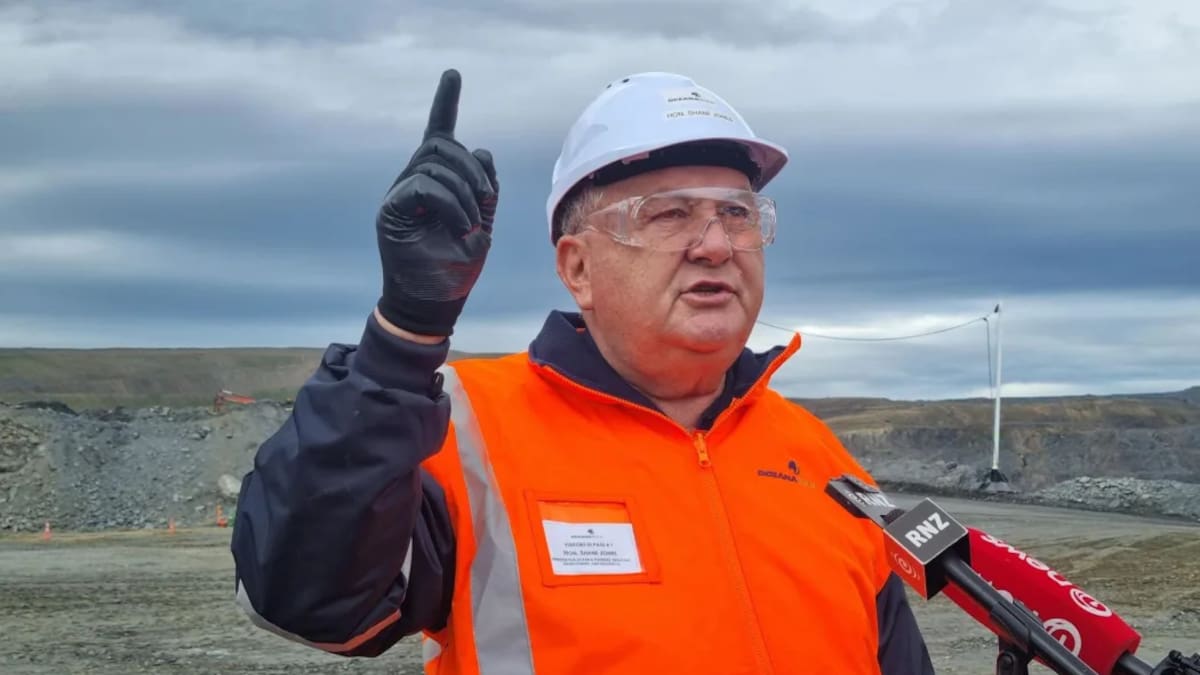
Speaking to the Herald, Regional Development Minister Shane Jones insisted that the financial health of such investments – where they are made through loans – cannot be the measure of success.
Indeed, success would likely be dim if it was; recent figures show that over half of the Government’s $433m in regional and economic development and support loans are considered to be at some heightened risk of default or are in default.
The team at Kinleith Mill’s Paper Machine 6 on their final shift in 2025. Japanese-owned Oji Fibre Solutions closed paper-making at the mill last year; Regional Development Minister Shane Jones said he wants to prevent the company’s pulp operations from closing too. Photo / Brian Loveday
The vast majority of Regional Infrastructure Fund (RIF) investments announced to date have been made in public assets – stopbanks and spillways for flood mitigation, regional airport runways, tarmacked roads, wharves and marinas, port and harbour upgrades.
These are typically made in grants to owners that are overwhelmingly non-private, primarily local and regional councils and their commercial entities, and also to iwi and charitable or community trusts.
Of the individual investments confirmed to date, some $120m will flow, through loans, to privately held companies, though in several instances ownership is spread beyond private shareholders, and is mixed, including some portion of trust, council or university ownership.
The Herald has focused on the private company recipients of RIF money because the benefits of investing public funds – borrowed through the current years of deficit spending – are heavily private in such instances.
Kānoa, the regional economic development unit within MBIE, is responsible for administering the RIF.
Brent Chalmers, general manager investment management, refused to release details of these loans to private companies, and even to disclose whether the companies have been given concessionary or commercial terms. The Herald has requested the information under the Official Information Act but a response has not yet been provided.
OpenStar Technologies founder and chief executive Ratu Mataira at the company’s Ngauranga Gorge site, in the Wellington area. The company’s work isn’t considered regional but the firm is the recipient of the largest sum of Regional Infrastructure Fund money yet to go to a privately held firm.
The largest private company investment, not regional
The fund’s largest investment in a private company was announced in early February: a loan of up to $35m to Wellington’s OpenStar Technologies.
The early-stage technology company is working to harness nuclear fusion for electricity generation and it’s attracted a lot of praise; the hitch for the RIF is that OpenStar’s not regional.
The fund’s criteria expressly exclude investments in Wellington, including Lower Hutt, Upper Hutt and Porirua, as well as the Auckland region and Christchurch.
The decision went to Cabinet, and it decided to approve the loan anyway.
Chalmers emphasised to the Herald that the company’s plans line up with the fund’s overarching objectives in many other ways, including through its potential to improve productivity and resilience in regional New Zealand and to help provide energy security.
Jones said it was a matter of avoiding “lawyerism”: “I’m not going to dance on the head of a pin…They might take a facility in the regions [this is not a requirement of the loan], but look, this is a company that we want to keep in New Zealand…I’d compare it to Rocket Lab, which Steven Joyce funded [as Minister for Science and Innovation in 2014]. We knocked it around at Cabinet and in the end, is this really a company we want to lose?”
Horticulturist LeaderBrand is a part-owner of Makauri Aquifer Recharge Ltd, the recipient of a $3m loan from the Regional Infrastructure Fund. Photo / Supplied
$60m for water storage
Where RIF money is invested in private businesses, the eligibility criteria requires that the benefits extend to the wider community, and the business’ primary focus should be in one of the following areas: energy security, water security, food security, connectivity (transport or digital), or the growth of a locally important Māori-owned business.
Four of the projects owned by private, or largely private, interests are for irrigation and water storage and all relate to food production.
Two of these companies are co-operative companies: Opuha Water, approved for a $20.8m loan, and Waimakariri Irrigation, approved for a $15.6m loan.
Both companies have hundreds of farmer shareholders in South and Central Canterbury respectively.
Amuri Irrigation Company is also owned by Canterbury farmers and is approved for a $20m loan; the company held largely by farming companies. The largest shareholder is iwi-owned Ngāi Tahu Farming (9%).
Gisborne-based Makauri Aquifer Recharge is also down for a $3m loan.
Shareholders include: MyFarm KiwiFruit Fund (20%), owned by wholesale and institutional investors; Leaderbrand Holdings (20%), controlled by horticultural businessman and rich-lister Murray McPhail; Kaiaponi Farms (20%), half-owned by the family of horticulturalist Cedric Witters; and the Te Aitanga a Mahaki Trust (20%), which is iwi-owned.
Opuha Water Ltd has 260 mainly farmer shareholders. The dam is 17km northeast of Fairlie and will be upgraded through a $20.8m loan from the Regional Infrastructure Fund. Photo / Lindsay Anderson (ECS)
A public-private venture
The Southern Link Logistics Park project planned for Mosgiel, near Dunedin, is described as an “inland port”, to be linked by rail to Port Chalmers. Southern Edge Hub Farms is approved for an $8.2m RIF loan for the park’s first stage; the money is to fund a three-track rail siding at the site.
While Ministers Jones and Rail Minister Winston Peters announced the $8.2m loan in May last year, the necessary consents for the siding have not yet been issued and the loan details are still not finalised with the Government, Kevin Winders, chief executive of Port Otago, confirmed.
Southern Edge is half owned by Port Otago, owned by the regional council, and half privately owned by Dynes Transport Tapanui, a partnership between businessman Peter Dynes and HW Richardson Group (the latter is majority owned and controlled by Scott O’Donnell and family members).
Dynes Transport donated $20,000 to NZ First in July 2024.
Jones is one of eight NZ First MPs and was one of the five members of the Regional Development Ministerial Group that approved the Southern Edge loan.
A spokeswoman said he wasn’t required to recuse himself from the decision; the donation was to the party.
Robert Brand, chief executive and managing director of Taiko Critical Minerals, at the site of the company’s planned West Coast mineral separation plant. The company applied for regional infrastructure funding in early 2025. Photo / Kate MacNamara
Aquaculture, a lab and an airline
Bluff Ltd is approved for a $2.2m loan towards an upgrade to its site for aquaculture and tourism at Ocean Beach, near Bluff.
The single largest shareholder is FNG, a company that does “financial asset investing” according to the Companies Register and is owned 50/50 by Blair and Anita Wolfgram, of Auckland, and Insight Assets, in turn owned by Dale Smith, also of Auckland.
Novolabs, of Palmerston North, was approved for a loan of $2.775m last year to help improve its production facilities and equipment used to produce the ultraviolet technology for disinfecting water, wastewater and industrial liquids.
The company’s largest shareholders are Andy and Bettina Shilton; Andy Shilton founded the company and Massey University, his former employer, owns 22%.
Tākaka-based Golden Bay Air is also signed off for a concessionary loan for $1.1m, the first funds approved from the ring-fenced airlines pot. The money is intended to help safeguard regular airline connections to the regions.
The company is owned by Richard Molloy and Jane Sheppard.
Last week, Jones’ announced $20m in loans for two early-stage geothermal projects in the Bay of Plenty. Eastland Generation appears to be the recipient, though, at the time of writing, the projects were not yet included in Kānoa’s published list of funded projects.
The Companies Register shows that Eastland is owned 50/50 by Obayashi Clean Energy New Zealand, in turn owned by the Obayashi Corporation of Japan, and by Māori trust interests.
Juvenile pāua at the Bluff Ltd farm at Ocean Beach in Southland. The company received a $2.2m Regional Infrastructure Fund loan to develop the site, including to increase tank capacity for seawater storage. Photo / Supplied
Other investment decisions pending
“Yes,” Jones said, the fund will be spent by the time the election rolls around: “we’re chewing through the dough”.
And indeed there are a number of candidates waiting to hear how their applications have fared.
Among them is Japanese-owned Oji Fibre Solutions. Kānoa’s Chalmers confirmed that ”ministers have directed MBIE to consider options to support Kinleith Mill” and the company confirmed to the Herald that it has applied to the RIF to help keep its pulp mill operating.
The project up for funding aims to make electricity from surplus steam, available since the company shuttered paper-making operations at the site last year. It cited crippling electricity prices as a factor.
“This steam is generated in an existing biomass boiler, so the project would provide about 20 megawatts of renewable electricity to the national grid, which would offset the mill’s energy costs and, just as importantly, help ease energy risks,” Oji’s group manager environment and external relations Philip Millichamp said.
He called the cost of energy an ongoing “existential issue” and, while the project wouldn’t revive paper making, it would support the pulp mill and the 255 staff it employs.
Also hopeful of loans are two West Coast Minerals companies – Taiko Critical Minerals and Westland Minerals Sands, both privately held.
Earlier this month, Minister Jones announced the addition of an $80m ring-fenced pot within the RIF for critical minerals. With the stroke of a pen, the case for approving the companies’ applications to the RIF improved enormously.
Ministers’ emerging priorities have been far more wide-reaching (and costly) than originally anticipated when the fund opened in July 2024.
At that juncture, just $60m was earmarked for these priorities. Shortly thereafter, ministers encircled $60m for “supercritical geothermal”, aiming to push past the current limits of technology.
In 2025, ministers set another $30m aside for concessionary loans to struggling regional airlines. An undisclosed sum has been set aside in recent months, at ministers’ request, for the effort to help Oji.
Some $80m for critical minerals’ funding, linked to an effort spearheaded by the United States to develop and stockpile strategic resources, was ring-fenced by ministers only in February, while the conventional geothermal funding was ring-fenced more recently still.
Jones said he’s aware of the accusation that such evolving decision-making is financially undisciplined – it would almost undoubtedly be harder for each project to win government funding through the annual Budget process, competing for limited discretionary spending.
But he cast that as a feature of the fund, not a bug; “the regions are neglected, are we to accept that they should fill up with people without opportunity, just sitting on the benefit, to let the Japanese just close up at Tokoroa (nearby Kinleith), or are to actually try to do something about it?”
Standby, Jones said, for NZ First’s announcement on the new funding plans for regional development it will take to the November election.
Stay ahead with the latest market moves, corporate updates, and economic insights by subscribing to our Business newsletter – your essential weekly round-up of all the business news you need.