
“It’s less that Kiwis suddenly fear one entirely new scenario, and instead that a much broader group of people now recognise how dependent everyday life is on systems that are vulnerable to disruption.”
In the middle of a bunker instillation. Photo / Supplied
He suggests situations like supply chain and power grid failures, pandemics, terrorism, extreme weather events and cyber attacks, along with a broader geopolitical uncertainty are becoming more commonly feared, making “resilience planning” a more mainstream conversation.
“What has changed most is public awareness; people are thinking more practically about food, water, backup power, logistics, physical security and what sensible contingency planning looks like for their household.”
A Perth-based civil engineer by trade, Clarke says despite the increased interest in the shadow of what is happening in Iran, the rationale behind building a bunker isn’t the post-apocalyptic hysteria you see in the movies.
Quite simply, it’s just civil defence. “It’s not cool or sensationalist, it’s just engineering, right?”
Albert Corbi, founder of US-based company Strategically Armoured & Fortified Environments (Safe), and who has built a large-scale “underground shelter” in New Zealand, agrees.
“The individuals I’ve engaged with from New Zealand tend to share a common mindset: they are not preparing for a single event, but for systemic uncertainty. They are thinking in terms of continuity, not crisis.”
Corbi says the number of enquiries his company is receiving to build in New Zealand “remains steady”, and he expects them to increase.
“The requests are sophisticated ranging from discreet, architecturally invisible safe rooms to fully autonomous, hardened estates designed to function independently of external systems. This is not fear-driven demand. It is strategic preparation.
“New Zealand occupies a rare position in the world today. It is geographically removed from most major conflict vectors, politically stable, and rich in natural resources. That combination makes it one of the few places globally where security is not just about protection, it’s about continuity of lifestyle and governance. As global uncertainty increases, locations with those characteristics become exponentially more valuable. I fully expect interest in Safe environments in New Zealand to rise accordingly.”
US-company SAFE which supplies underground shelters has confirmed that it has built a bunker in New Zealand for a client – the first time such a project has been confirmed. Photo / Supplied
The median cost of the bunker systems Clarke’s company has helped construct in New Zealand is between $400,000-$600,000. A mid-range system features three rooms – one 12sq m common room and two 8sq m residential rooms.
Smaller-scale systems, which are still certified “all-hazard” protection, just with less space, come in under $200k installed, but there is essentially no upper limit.
Basic models are able to withstand chemical, biological, radiological and nuclear threats, and have special air filtration systems and blast fittings, or components designed to maintain structural integrity and safety of the shelter during an explosion.
“It’s roughly the same price as a new 300 series Land Cruiser or a big American Ute,” Clarke says.
“And I don’t know about you, but certainly [in Australia], there are so many of the big RAMs and Chevys and F250s and 350s driving around. Each one of those would have been a family bunker.”
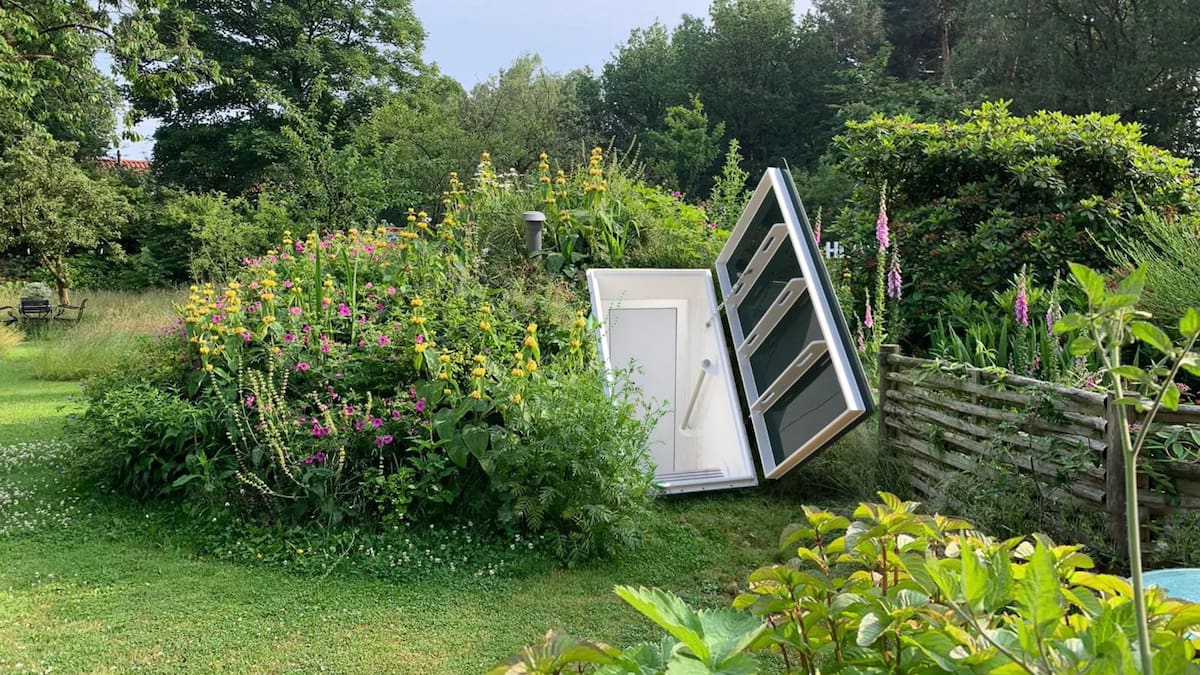
An example of one of Hardened Technology’s underground bunkers. Photo / Supplied
The profile of the average client has broadened considerably, but discretion remains key in the bunker business and client privacy is valued, Clarke says.
The company also works with a number of high-net-worth clients.
This includes “Golden Visa” holders, the common term for the government’s Active Investor Plus visa. This visa offers New Zealand residence to high-net-worth individuals investing a minimum of $5 million to $10m, depending on the asset type, into the local economy. As of March 11, Immigration New Zealand has received 609 applications since the investment process was simplified in April last year.
Clarke says his customers are rarely “seeking a status symbol or crystal chandelier in an underground mansion”. Many are professionals, business owners, rural property owners and families taking a “measured, practical approach to preparedness”.
“They are typically focused on realistic contingencies such as bushfire, storms, supply chain failures, prolonged outages and periods of civil disruption, rather than sensational scenarios.”
That extends to the way he talks about the structures; Clarke prefers to think of them as engineered civil defence shelters and resilience infrastructure rather than the pop-culture stereotype of a “bunker”.
“Our approach is always grounded in credible hazards and layered resilience, not fear or sensationalism,” he says.
“We often advise clients that the biggest gains come from layered steps: contingency plans for food, water and power, bushfire planning and property security.”
A bunker should always have a dual purpose. Photo / Supplied
And when your bunker is not being used as a source of shelter? Clarke recommends they should always have a practical, day-to-day purpose, like a cellar, wine storage or (wo)man cave.
“Otherwise, you’re sinking a lot of money into something that you hopefully never use in anger.”
If he had one public service announcement, it would be this: “For the love of God, do not bury a shipping container. Don’t do it.”
In fact, Clarke often advises clients not to build a bunker at all. It’s always, in his eyes, the last line of defence.
“Where appropriate, an engineered shelter can be an additional layer of protection against a broad spectrum of threats, but it’s not a silver bullet for every scenario.
“A hardened structure is only applicable to a very niche subset of risk and potential scenarios. And I would always urge people to have a broad, rational approach to considering resilience and self-sufficiency.”