
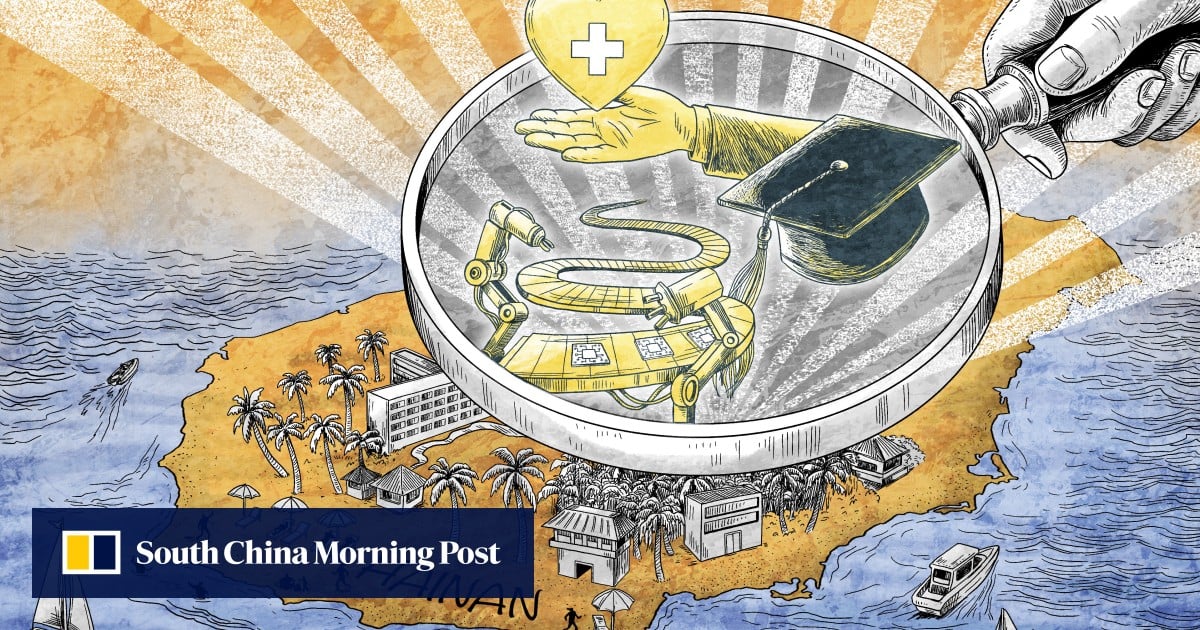
As China undergoes a sweeping economic transition, its regions are also in the process of embracing change. The powerhouses of yesteryear must adapt or risk falling behind, as traditional industries become less reliable growth drivers and new sectors take prominence. In this series, we explore three representative areas of the country as they attempt to navigate this rapidly changing environment.
After Joyce Wu moved from Hainan province to Hong Kong in 2013, she marvelled for years at the increasingly crowded skyline of Haikou on visits home. The gleaming high-rises continued to spring up across the southern island’s capital as an economic boom, driven by property values, reshaped the city.
Around 2020, that momentum began to fade. In place of cranes and concrete, Wu noticed a quieter shift: more professionals and foreign academics arriving through university partnerships, and growing business interest from outside the province.
“They were clearly not tourists,” she said. “They were professionals or researchers.”
Her observation mirrors Hainan’s broader transformation – after the bursting of three speculative booms that were driven by policy windfalls, the province’s previously tourism-centred economy is moving towards a more sustainable growth pattern revolving around its new status as a free-trade port, even as long-standing structural constraints remain a challenge.
On December 18, the island – with more than 10 million people and a slightly larger surface area than Belgium – became a customs territory separate from the rest of mainland China.
The move exempted around 6,600 categories of goods from tariffs – about 74 per cent of taxable imports.