
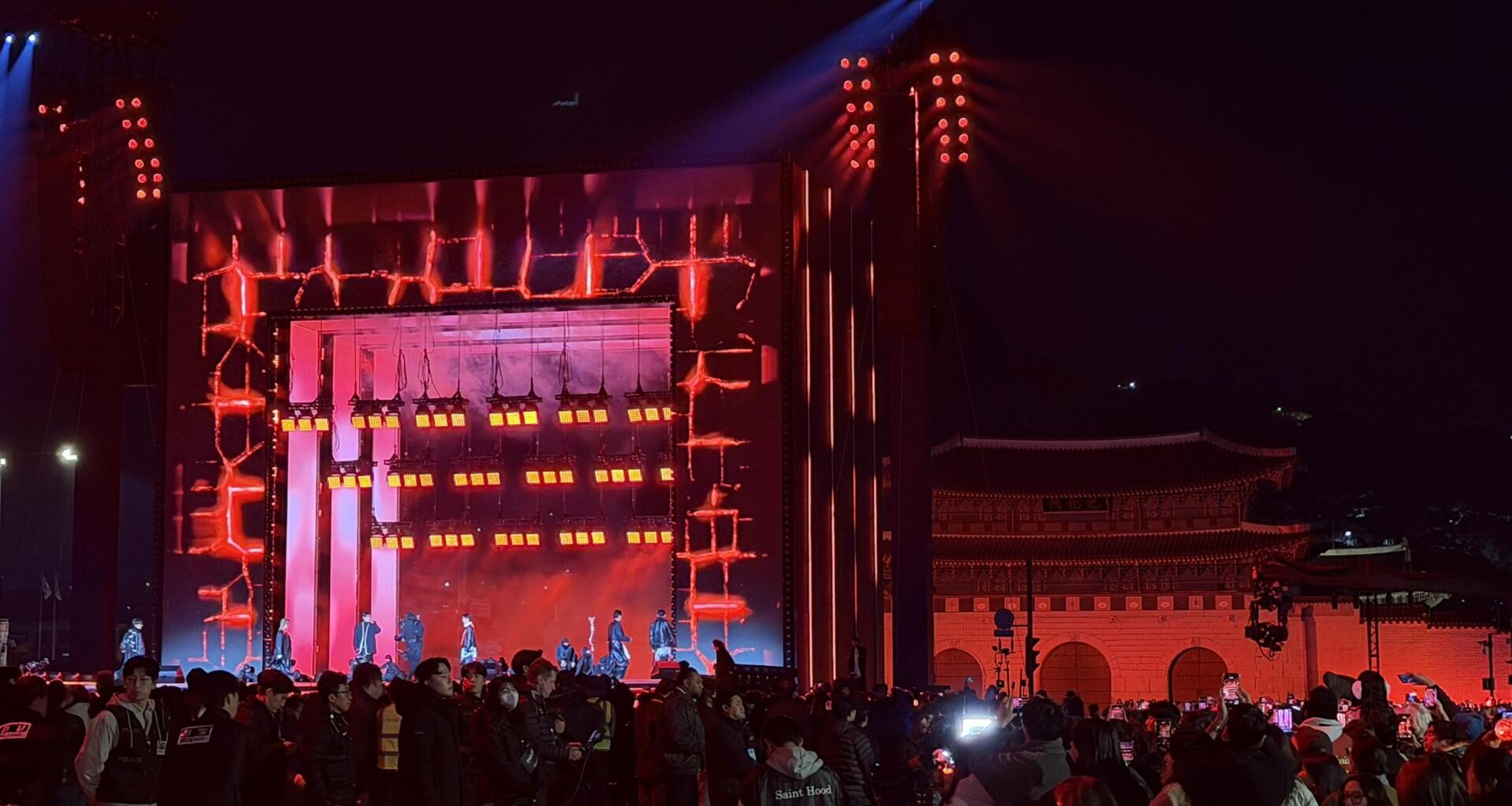
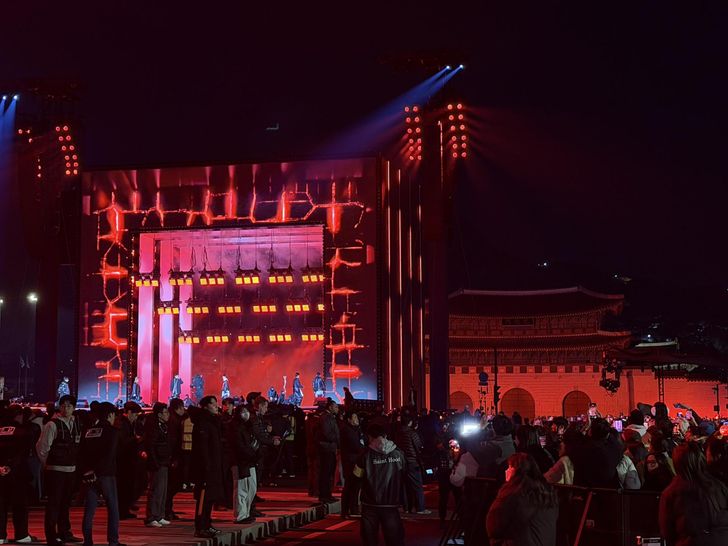
K-pop boy band BTS during its comback concert at Gwanghwamun Square in central Seoul, Saturday, filmed with Samsung’s latest Galaxy S26 Ultra / Korea Times photo by Pyo Kyung-min
As dusk fell over Gwanghwamun Square last Saturday night, the crowd moved in rippling waves of purple, all gathering to celebrate the return of global K-pop giant BTS to the stage.
Thousands of smartphones were raised toward the stage, their cameras zooming in on the BTS members even before the first note rang out.
In today’s K-pop concert landscape, capturing the moment has become nearly as important as experiencing it. For many fans, filming a performance has turned more into a carefully planned mission than a spontaneous decision.
That mission is now shaped as much by technology as by the fandom itself.
Samsung’s Galaxy Ultra series has emerged as a favorite among a segment of K-pop concertgoers and using the newly released Galaxy S26 Ultra during BTS’ recent Gwanghwamun show offered an insight to why.
At first glance, the device’s overall video quality did not feel radically different from footage captured on the latest iPhone models. Colors appeared vivid without looking overly processed and baseline sharpness under bright stage lighting felt broadly comparable.
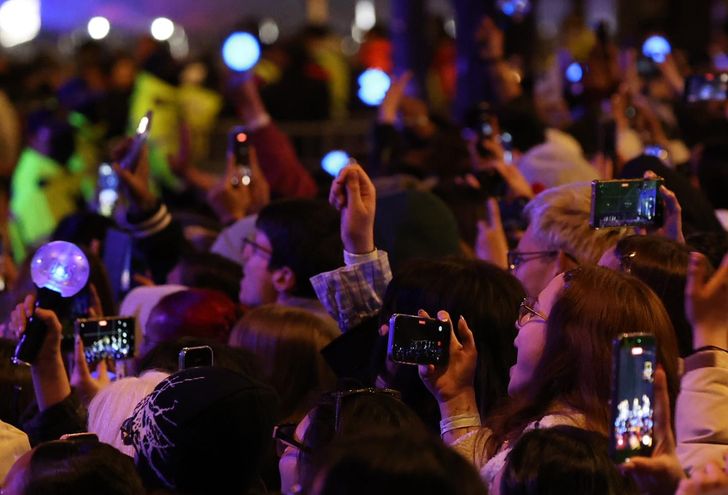
Fans of K-pop boy band BTS film the group with their mobile phones during the “BTS THE COMEBACK LIVE: ARIRANG” at Gwanghwamun Square in Seoul, Saturday. Yonhap
Concerts, however, are rarely shot under ideal conditions.
Once distance, crowd movement and dramatic lighting shifts are factored in, the Galaxy’s hardware strengths became more noticeable.
Its extended optical zoom — a feature that enables the phone to zoom up to 100 times — allows fans even from mid-range viewing areas to capture their favorite singers’ expressions and subtle choreography details. For fans accustomed to seeing idols appear like small silhouettes against expansive LED backdrops, the difference was striking.
Stabilization also played a significant role. Large outdoor concerts require constant movement, with viewers often needing to reposition themselves. In such environments, filming at long focal lengths can easily result in shaky footage.
The S26 Ultra, nevertheless, was able to produce relatively smooth handheld shots during high-energy sequences. The feature felt less like a luxury and more like a practical necessity for those looking to shoot the perfect “fancam.”
These technical advantages help explain a broader shift in the concert culture within K-pop fandoms.
Clips circulate rapidly across social media platforms, shape online discussions about performances and sometimes influence how fans remember an idol’s stage presence.
This is why dedicated fansite operators often treat concert filming as a specialized craft. They fine-tune camera settings and plan shooting strategies in pursuit of the clearest possible frame.
In such a culture, zoom reach and stabilization are not simply marketing specifications. They function as competitive tools.
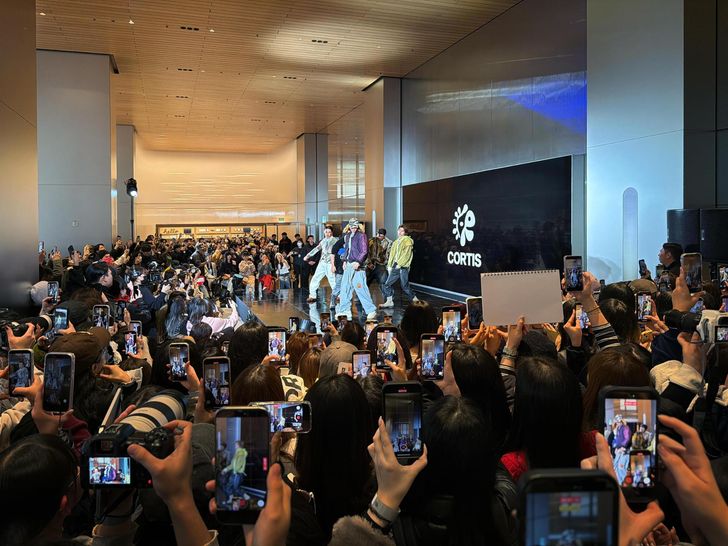
Members of K-pop group CORTIS perform during a special stage at a “Today at Apple” session marking Apple’s 50th anniversary at Apple Myeong-dong in Seoul, March 18. Courtesy of BigHit Music
The preference for Samsung devices, however, is not entirely universal.
Some concertgoers continue to rely on iPhones, whose camera systems offer dependable exposure balance and natural color rendering that require minimal technical adjustment.
For fans who prioritize documenting the concert atmosphere, such as sweeping crowd scenes or collective sing-along moments, an iPhone’s consistency can feel more reassuring than the pursuit of extreme close-up shots.
The divide reflects differing philosophies in watching concerts. Some attend primarily to immerse themselves with shared emotions and memories. Others approach the experience with the mindset of a documentary filmmaker, who seeks precise visual records of their favorite member.
In this context, smartphones function less as everyday lifestyle accessories and more as purpose-driven tools.
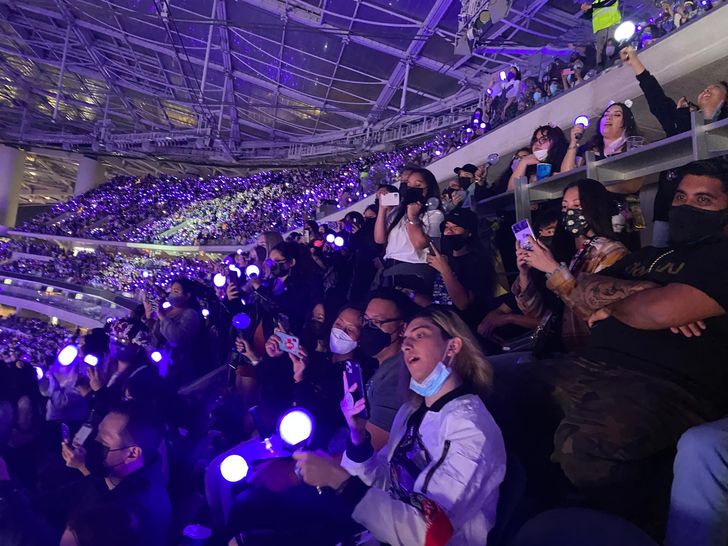
People take photos of K-pop group BTS during the boy band’s first non-virtual concert since 2019 at SoFi Stadium in Los Angeles, Nov. 27, 2021. Yonhap
K-pop’s expansion into large urban venues has further intensified this dynamic. Stages designed to dominate vast public spaces inevitably place performers farther from much of the audience, heightening the role of camera technology in narrowing that distance. Concerts now function as informal testing grounds where smartphone capabilities face real-world conditions. Stark lighting contrasts, fast choreography and constant crowd movement all add to the challenge.
BTS’ Gwanghwamun concert highlighted a subtle but significant evolution in fandom culture. Seat selection is no longer the only calculation fans make. More and more, they are also choosing how they want to see the performance and through which lens.
As the show’s encore echoed across Gwanghwamun Square, the crowd dispersed with thousands of newly captured memories stored in their pockets. Some would later share sweeping panoramas of the sea of purple lights while others would upload tightly framed close-ups measured in pixels.
In the quiet competition between these perspectives, the future of concert technology may already be unfolding.