

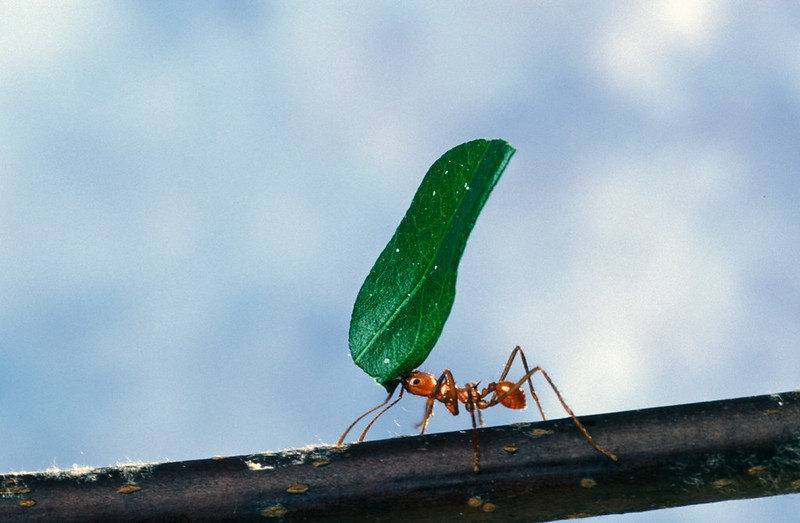
A leafcutter ant carrying a leaf back to its nest. There are as many as 20 quadrillion individual ants believed to be in the Earth’s biosphere. Photo: U.S. Department of Agriculture/Scott Bauer via Flickr Creative Commons (CC BY 2.0)
Backgrounder: Insect Decline Poses Foundational Ecological Hazards
By Joseph A. Davis
During the Great Permian Extinction 250 million years ago, 70% of all land species went extinct. But not cockroaches.
Actually, some 99% of all species that ever lived on Earth have gone extinct. But, again, not cockroaches. (It is believed they could survive a nuclear Armageddon.)
OK, forget the cockroaches. But journalists covering the so-called “insect decline” observed in recent decades need first to get clear on how they feel about it.
For instance, we humans absolutely love monarch butterflies. Pulitzer Prize-winner Dan Fagin, a journalism professor (and former Society of Environmental Journalists president), is currently writing a book on them.
And the media can’t get enough. Every year, monarchs fly a gauntlet of human-caused hazards, and their continued existence is a suspense story, bringing us awe and joy.
Decline a major challenge to measure
Meanwhile, entomologists have, in the last several decades, observed what they think is a global decline in insect populations, one that’s drastic and new.
There are at least 1 million
insect species that have been
identified — and maybe 10 million
when including unnamed species.
Problem is: It’s hard to get a firm grip on what may be happening. That’s because, at the moment, there are at least 1 million insect species that have been identified — and maybe 10 million when we include species they haven’t named. In fact, insects make up the bulk of terrestrial species.
Scientists do think they know some causes of the decline. Those could include agriculture, pesticides, habitat destruction and even climate change. They have a pretty persuasive case.
But it’s hard to know for sure — if only because proportional statistical sampling is murderously hard for one-million-plus insect species spread all over the planet.
So journalists writing about insect decline too often end up pointing to their windshields, which seem less bug-splattered today than years ago. Is that valid evidence?
‘What do insects do for us humans?’
The issue matters enormously. Some bird-lovers worry because the putative insect decline could be one factor in the reported decline in bird populations. And ultimately, it matters because the same things that threaten insects (e.g., pesticides and climate change) could threaten human health as well.
In our anthropocentric world, we immediately want to ask, “What do insects do for us humans?”
Actually, they do a lot. They are the busiest pollinators of many plants that feed us. They give us honey. Some 2 billion people worldwide regularly eat insects as part of their diet.
There’s more. They clean up and recycle the dead and decayed organic material that befouls our environment. They build soil and help rot our compost piles. Gardeners use certain insect-killing wasps and ladybugs to get rid of some pests.
They also feed the trout that fly-fishers catch. They give us silk, natural dyes and varnish. And every June, the fireflies delight the kids who capture them in jars.
Insects existed for epochs before
we evolved — and provide
a valuable foundation
for many ecosystems.
It’s worth remembering that we humans are really latecomers to the biosphere we live in. Insects existed for epochs before we evolved — and provide a valuable foundation for many ecosystems.
They support anteaters and termite-eating aardvarks, not to mention lizards, frogs, spiders and birds like woodpeckers and sparrows. When the 17-year locusts come out, the birds have a feeding festival.
The case of bee colony collapse disorder
But are they declining? We will probably get more useful answers if we narrow the question down to specific species and genera.
Some years back, beekeepers were losing a big fraction of their hives to what was called “colony collapse disorder.” The peak years were 2006-2008, and scientists still don’t know for sure what caused it.
Suspects include varroa mites (they are arachnids, not insects), insecticides, habitat loss and beekeeping practices. Some blame it all on neonicotinoids. And that’s just the short list.
Turns out, there are more honeybees alive today than ever in history (may require subscription). Commercial beekeepers are really good at replacing stricken hives.
But that’s not the end of it. Worldwide, there are some 20,000 bee species in seven families. These wild bees provide many different ecological services, and many are threatened by habitat loss, because humans are indeed destroying nature.
So there are a vast number of reasons for bee declines. Simplifying the issue does not enlighten our audiences.
Survival and adaptation strategies
Or look at ants — one of many kinds of social insects. They, too, have many different survival and adaptation strategies. Experts estimate that Earth’s biosphere contains as many as 20 quadrillion individual ants.
You may be frantically trying to keep them out of your kitchen or backyard. And those pesky, painful fire ants are steadily invading parts of the southern U.S. They do significant economic damage, prompting many people to respond with insecticides.
Mosquitoes are the deadliest
animal (to humans) in the world.
Never mind that humans may
be the second deadliest.
Mosquitoes are insects. They are also the deadliest animal (to humans) in the world. Never mind that humans may be the second deadliest. Mosquitoes kill people by transmitting diseases like malaria, dengue, etc. Efforts to chemically eradicate them have not really succeeded.
Ticks, meanwhile (technically arachnids, not insects), are harming people by transmitting Lyme disease, ehrlichiosis, babesiosis and Rocky Mountain spotted fever, among other diseases. Tsetse flies transmit sleeping sickness. Kissing bugs transmit Chagas disease.
The problem with how we control ‘pests’
Some say the modern environmental movement began with Rachel Carson’s “Silent Spring.” There are many lessons there for our relationship with insects.
Most obviously, the insecticide DDT generally does more harm than good, along with its chemical cousins aldrin, dieldrin, lindane, chlordane and others. These pesticides persist in the environment, bioaccumulate in animal and human tissue, and can cause serious toxic effects.
Consequently, most are drastically restricted by law and regulation for most uses today. Yet current pesticide regulations may not be enough.
Another important lesson was the chemical industry’s response to “Silent Spring”: a massive, aggressive public relations counterattack, attempting to discredit her as unscientific, hysterical and a communist. It didn’t work.
But the U.S. Environmental Protection Agency didn’t even exist in 1962, when Carson’s book came out. The EPA didn’t ban DDT until 1972. The chemical industry continues to promote toxic pesticides even today.
We have devised crop-dusting airplanes to drench farm fields — and anything or anyone nearby — with chemicals invented to kill living things. They don’t all distinguish between target and nontarget species. Just ask the farmworkers or the kids in schools nearby.
Too often we just “flood the zone” with toxic and persistent chemicals. But we have also invented a range of weed- and insect-control technologies that are safer and less indiscriminate. There are safer chemicals than DDT (for example, synthetic pyrethroids).
There are also nonchemical methods that don’t poison insects or people (like beneficial insects). These smarter, more discriminating techniques are often collectively called “integrated pest management.” Rotating your crops doesn’t kill insects, but it can render them less destructive.
There are even effective nonchemical methods of getting rid of cockroaches and kitchen ants.
Using them means we may be protecting our own health as much as that of the lightning bugs — or even cockroaches.
[Editor’s Note: For more on insect decline, read our Q&A on the topic with an award-winning journalist, plus a recent story on shifting the journalistic narrative on insects. We’ve also got reports on insects’ role in crashing bird populations, insects as disease vectors, the impacts of chemical pesticides and ecological alternatives, as well as pollinator gardens and honeybees. Plus, get the latest headlines on insects from EJToday.]
Joseph A. Davis is a freelance writer/editor in Washington, D.C. who has been writing about the environment since 1976. He writes SEJournal Online’s TipSheet, Reporter’s Toolbox and Issue Backgrounder, and curates SEJ’s weekday news headlines service EJToday and @EJTodayNews. Davis also directs SEJ’s Freedom of Information Project and writes the WatchDog opinion column.
* From the weekly news magazine SEJournal Online, Vol. 11, No. 12. Content from each new issue of SEJournal Online is available to the public via the SEJournal Online main page. Subscribe to the e-newsletter here. And see past issues of the SEJournal archived here.