
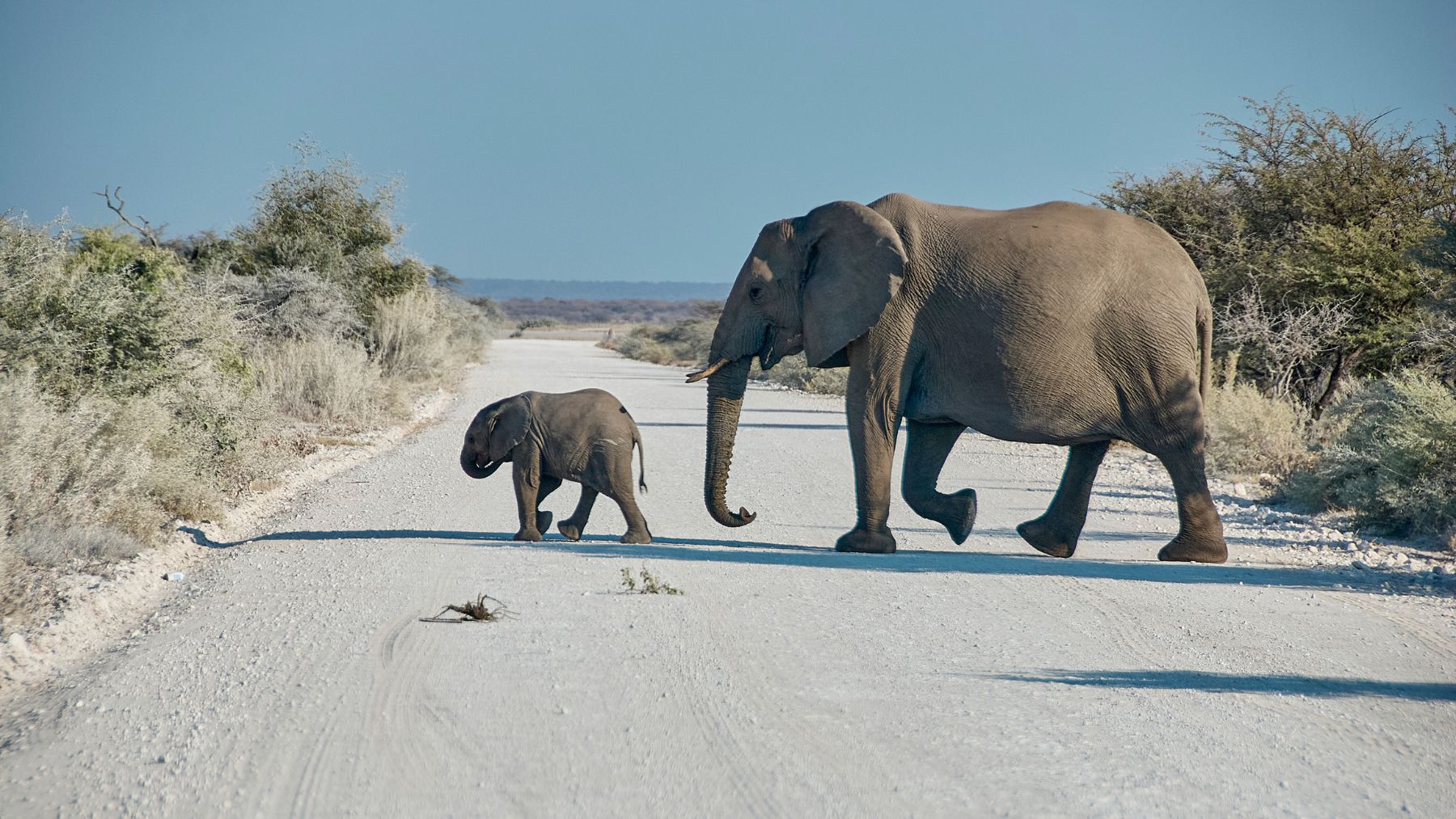
It starts like something out of a dream. A quiet road. A car slowing down. Then, out of nowhere, a herd of elephants appears, calmly making their way across. You stop, of course. Anyone would. Not just because it’s the right thing to do, but because moments like this don’t happen twice.
At first, it feels like a rare but natural encounter—humans pausing, wildlife passing. But then, just as the last elephant reaches the other side, something unexpected happens. A single figure lingers behind. She turns. And in that brief moment, what seemed like an ordinary wildlife sighting becomes something far more powerful.
A Moment That Felt Almost Human
The video, shared by Wildlife Rescuers, shows a full elephant herd crossing a road together. There are adults, young calves, and tiny babies, all moving as one. It’s quick, coordinated, almost rehearsed.
Drivers wait patiently, watching in silence as the massive animals pass just a few meters away. No horns. No rush. Just stillness and respect.
Then comes the moment that changed everything.
At the very end of the crossing, an older elephant—likely the matriarch—pauses. She doesn’t follow immediately. Instead, she turns slightly toward the people who had stopped for her family.
What she does next is subtle, but unforgettable. A small gesture. A movement that feels almost like acknowledgment.
Viewers online quickly described it as a “thank you”—a quiet, emotional exchange between humans and animals that needed no words.
The Hidden Intelligence Of Elephant Families
Moments like this aren’t as random as they might seem. Elephant herds are among the most intelligent and socially complex groups in the animal kingdom.
Most herds are matriarchal, led by the oldest and most experienced female. She decides where the group goes, how it avoids danger, and when it’s safe to move. Her memory—of water sources, migration paths, and threats—can determine whether the herd survives.
A typical herd is made up of related females and their young, while males leave as they grow older. In some cases, herds can grow to up to 100 individuals, although they often split into smaller groups when needed.
But what truly sets elephants apart is how deeply they care for one another. Calves are protected not just by their mothers, but by the entire group. Communication happens constantly—through touch, sound, and even low-frequency vibrations that travel through the ground.
And perhaps most importantly, elephants show something that looks remarkably like respect. Younger members greet elders, touch trunks, and follow their lead without question.
So when that older elephant paused at the road, it may not have been random at all.
Why That Final Gesture Matters
Scientists have long studied elephant behavior and found evidence of empathy, memory, and even mourning. Elephants have been observed revisiting the bones of deceased herd members, helping injured individuals, and showing signs of emotional awareness that go far beyond instinct.
That’s why moments like this resonate so strongly.
The idea that an elephant might recognize a situation—humans stopping, allowing safe passage—and respond in some way isn’t as far-fetched as it once sounded.
Of course, we can’t say for certain what the elephant “meant.” But what we do know is this: elephants are highly aware of their surroundings, and they are capable of complex social responses.
What viewers saw wasn’t just a crossing. It was an interaction. A shared moment between two very different worlds.
The Detail Most People Missed
What makes this story even more powerful is what happens beneath the surface.
That elephant likely wasn’t just any member of the herd. Based on behavior and position, it was probably the matriarch—the one responsible for guiding and protecting the entire group.
She would have been the last to cross on purpose, ensuring every calf and adult made it safely. Only then would she allow herself to follow.
That pause at the end wasn’t hesitation. It was control. Awareness. Leadership.
And in that brief second, as she turned back, it created a moment that people watching will remember for the rest of their lives.
It’s easy to think of wildlife encounters as one-sided—humans observing animals. But sometimes, it feels like the opposite is also true.
Sometimes, it feels like they’re observing us too.
And every once in a while, those two perspectives meet—if only for a second—on a quiet road, in a moment that doesn’t need explanation to be understood.
Click here to see the TikTok video from @Wildlife_Rescuers