
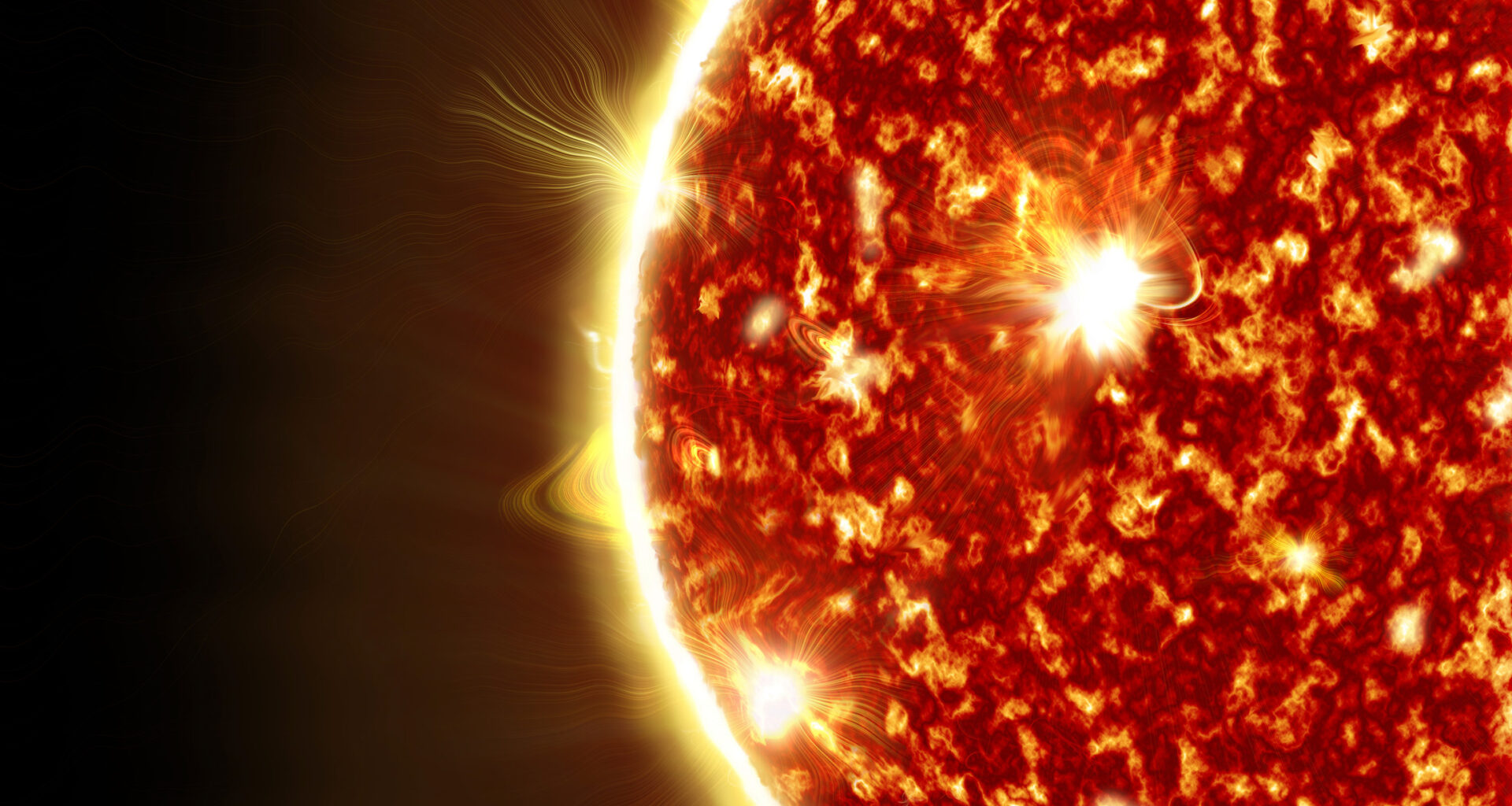
Astronomers have assembled the biggest ground-based record of sudden eruptions from small red stars, catching 1,229 flares in a single survey.
The result turns fleeting flashes into a population study, showing which stars erupt most often and how stellar aging seems to quiet them.
Tracking flare signals

Inside the Zwicky Transient Facility (ZTF), these flares kept appearing and vanishing within minutes across repeated passes.
There, the Sternberg Astronomical Institute (SAI) and A. D. Lavrukhina helped build a search that pulled the catalog from billions of measurements.
Because the SAI group returned to the same fields again and again, the catalog caught rise, peak, and fade instead of single flashes.
That detail mattered, because quick bursts can mimic other strange blips, and SAI’s pipeline had to keep rejecting them.
Why these stars erupt
Among the smallest stars – M dwarfs – small cool stars common across the galaxy, can store intense magnetic stress in their outer layers.
When tangled fields snap and rejoin through magnetic reconnection – a sudden rewiring of magnetic lines – energy blasts outward from the star.
That burst can brighten a star across wavelengths, with some events lasting minutes and others stretching for hours.
Any nearby planet may endure repeated radiation hits, which is why flare statistics matter beyond stellar physics.
Simulated flare training
To find rare flashes, the team first narrowed the data to 93 million variable brightness records and 4.1 billion measurements.
They then trained software with 620,755 simulated flares built from NASA TESS templates dropped into real ZTF noise.
Post-filtering removed asteroid passes, bad focus, and frame-edge problems that could fake a sharp brightening and fool the software.
Only after that sieve did human inspection become practical, turning an impossible data pile into a manageable final list.
Strongest flare stars
Later subclasses, especially around M4 and M5, flared more often than earlier ones in the cleaned sample.
That increase appears near full convection, when hot gas churns through the whole star, which may strengthen magnetic field generation.
A second comparison using only stars with good Gaia distances showed the pattern most clearly, while dust blurred color-only estimates.
This strengthens the case that the rise was astrophysical, not just a bookkeeping trick from noisy classifications.
Stellar aging effects
Farther from the Galactic plane, the crowded midline of the Milky Way, flaring stars became less common.
That pattern fits a long-held idea that stars high above the disk are typically older and magnetically quieter.
Using 680 stars with reliable positions, the team found flare odds dropped by about threefold for each tenfold height increase.
Instead of one dramatic cutoff, the catalog points to a steady fading of activity as stellar populations age.
Measuring flare energy
For 655 events with solid distances, the team estimated bolometric energy – total energy across all wavelengths rather than brightness alone.
Those flares ranged from modest bursts to some of the most powerful eruptions ever recorded for stars of this type.
Longer flares also tended to be more energetic, a pattern that suggests the biggest outbursts keep dumping power for longer.
Because many eruptions were only partly sampled, the energy estimates rest on the cleanest light profiles, not every candidate.
What fooled the code
Some of the brightest impostors were not stars at all, but asteroids, focus problems, or detector-edge glitches.
A passing minor planet alone accounted for 7,582 candidates, about 15 percent of the software’s initial flare picks.
Crowded fields caused extra trouble because a slight blur can leak a neighbor’s light into the target and fake a spike.
That messy reality explains why astronomers still checked candidates by eye after the algorithms had already done the heavy lifting.
Filling observation gaps
Space telescopes excel at continuous watching, but ground surveys cover far more sky and catch rarer bright eruptions.
ZTF’s camera can sweep vast areas quickly, letting astronomers search for fast events across territory that space missions sample differently.
That broad reach filled a gap between close-up space missions and smaller ground projects that had found dozens, not thousands, of flares.
Such a catalog can train future searches at Rubin’s Legacy Survey of Space and Time (LSST).
Beyond the parent star
Around many red dwarfs, planets orbit much closer than Earth does to the Sun, placing them nearer frequent blasts.
A flare can dump ultraviolet and X-ray radiation into an atmosphere, heating gases and helping them escape.
This catalog does not measure planetary damage, yet it gives planet researchers a stronger map of when to worry most. That broader use is one reason a flare census on distant stars can matter close to home.
New flare framework
By turning those flashes into a coherent sample, the new catalog links flare shape, stellar type, energy, and stellar age.
As wider surveys ramp up, that framework should speed the hunt for real outbursts while keeping the flood of false alarms in check.
The study is published in Monthly Notices of the Royal Astronomical Society.
—–
Like what you read? Subscribe to our newsletter for engaging articles, exclusive content, and the latest updates.
Check us out on EarthSnap, a free app brought to you by Eric Ralls and Earth.com.
—–