
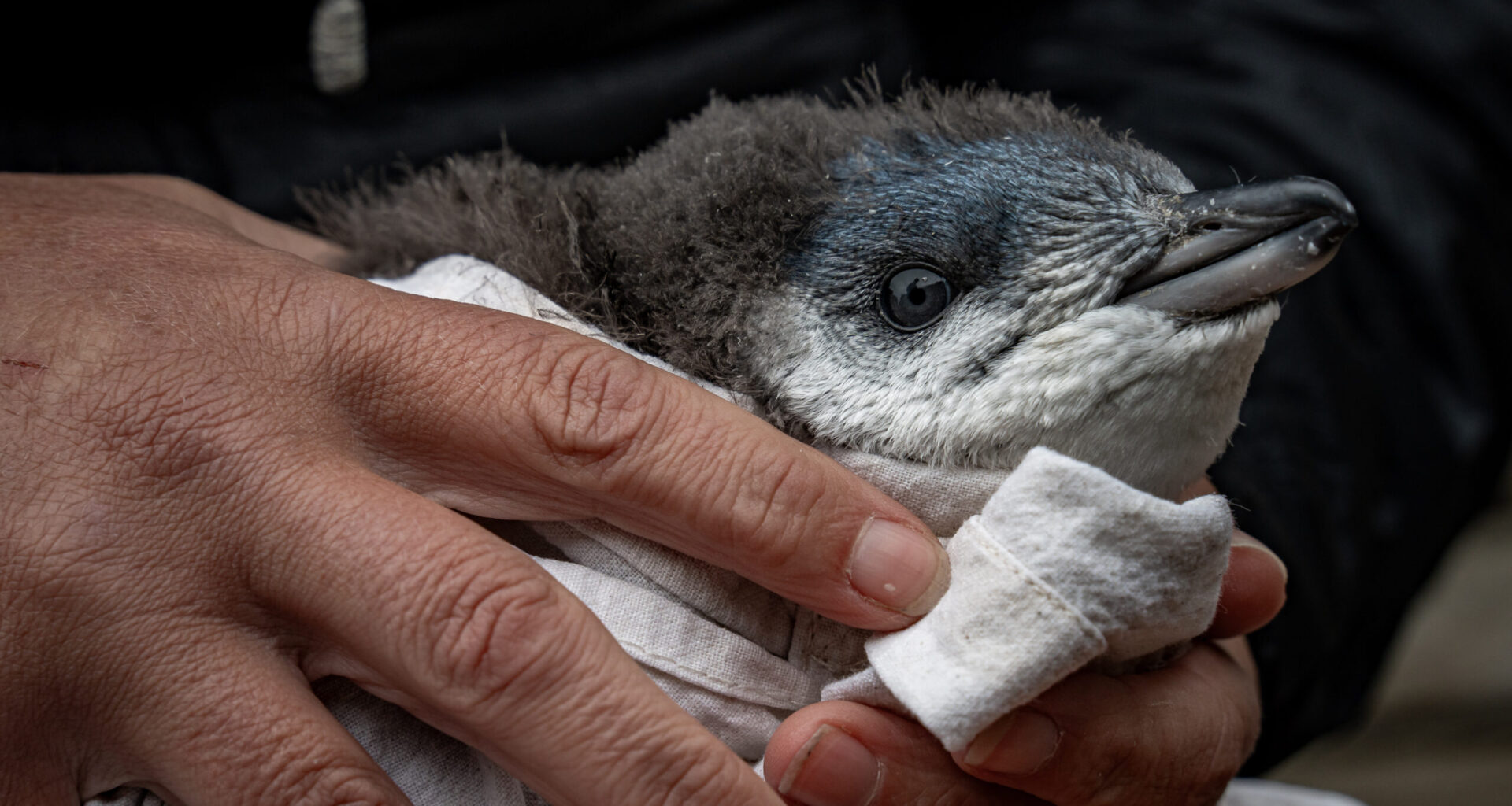
When Dr. Hickcox and her team approach a nest box, the first step is to understand which birds were there last week and what changes (if any) have occurred. If the box is occupied, they take a quick photo of its contents, then scan for microchips embedded just beneath the skin at the back of the neck, identifying each adult or chick. If it’s a new bird or an unchipped juvenile, the microchipping process begins. It’s a multi-person job, ideally done with a team of three or four: one to lift the lid, one to handle the bird, another to record data, and a fourth to prepare the tools. The penguin is gently placed in a reusable cloth bag – dark and soft to reduce stress. Then comes the biometric work: weight, beak length and depth (used to estimate sex), followed by a flipper photo.
The white-flippered penguins here have distinctive patterns – some with a double stripe, some with markings that form a connected patch or “thumbprint.” These patterns are photographed and assigned a rating for future reference, helping researchers identify individuals visually as a backup to their microchip. Next comes the chip itself.
The team sanitises the site, inserts the needle, and ensures the chip reads correctly with a quick scan. Then, before releasing the bird, they collect a small feather sample – another piece of data that might aid in future studies.
All this, Dr. Hickcox explained, is part of both a monitoring effort and a long-term research program. The monitoring provides crucial population data: who’s breeding with whom, how many chicks are fledging, and whether those chicks return in future years to reproduce. This known-age population, which is rare for wild seabirds, helps uncover survival rates, breeding age, and colony growth over time.
Rachel’s background in spatial ecology adds another dimension. For the past three seasons, she’s outfitted penguins with GPS trackers to study their foraging behaviour at sea – tracking 64 birds during key phases like pre-breeding and chick-rearing. This gives insights into how far penguins must travel for food and whether that distance is changing year to year.
Combined with dietary studies and land movement tracking by her students, the data is beginning to paint a much fuller picture of little penguin’s lives across land and sea.
The long-term monitoring effort at Pōhatu is still in its early phases, but the data already shows how quickly conditions can change. The first season of intensive tracking coincided with the end of a three-year La Niña event and a marine heatwave – and this unusual timing made it hard to gauge what “normal” even looked like. But now, with two more stable years for comparison, patterns are beginning to emerge.
The research team has observed stark contrasts in chick survival and fledging rates between years. During difficult seasons, adult penguins prioritize their own survival over feeding chicks – a harsh but necessary biological choice. A healthy adult can breed again. A starving one can’t. That trade-off has major implications for long-term population stability, especially in a warming, increasingly unpredictable climate.