
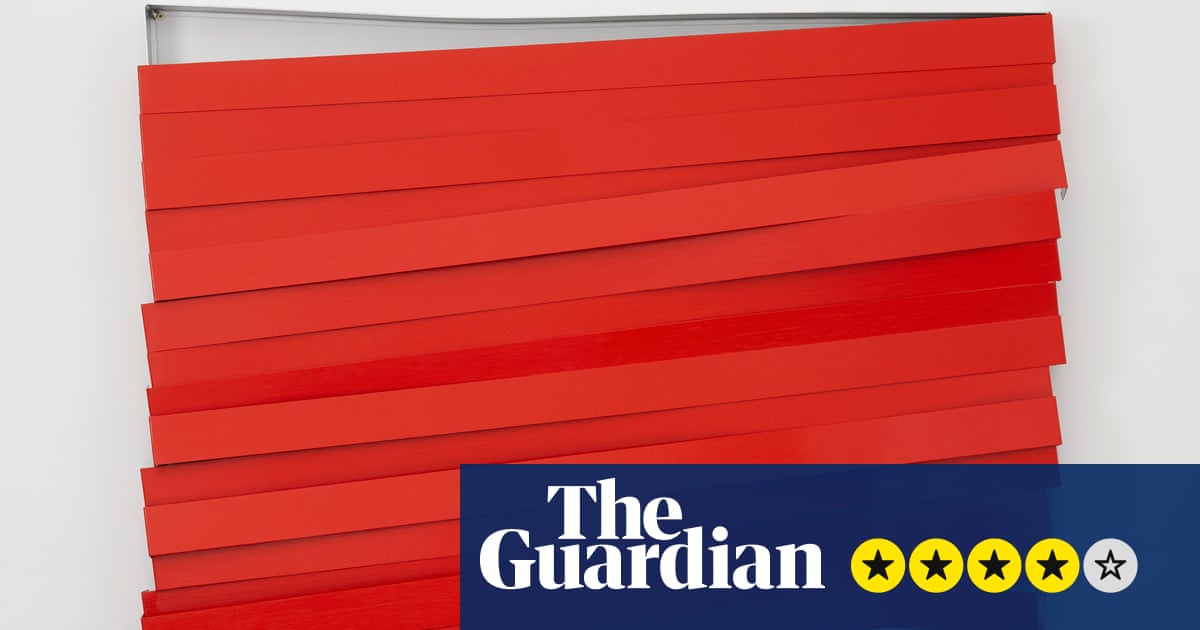
Crumpled and crumbling, Angela de la Cruz’s artworks are all on the verge of collapse. Her canvases are broken and folded in on themselves, her sculptures are barely assembled junk, and look as if they might turn right back into rubbish if there’s a strong breeze.
Just as you walk into this quiet, sparse show of the London-based Spanish artist’s work at Birmingham’s Ikon – her first UK solo show outside London despite being nominated for the Turner prize in 2010 and generally being one of the biggest art names in the country – there’s a black-painted canvas wrapped around an old two-legged table (which once belonged to Guardian art critic Adrian Searle). Next to it sits a painting in thick, brown gunk – a fecal monochrome, its bottom corner snapped off but gaffer taped back on, the whole thing wedged upright. It looks and feels like a body that doesn’t work, faulty and leaky, patched up and forced back to the vertical.
Propped back up, mended, brought back to life … Angela de la Cruz: Upright at Ikon, Birmingham. Photograph: Tom Bird/Courtesy Ikon
And then it clicks: none of the artworks here are actually on the verge of collapse, they’ve already collapsed, this is them all repaired, propped back up, mended, brought back to life.
Angela de la Cruz’s own body is in a similar state. She uses a wheelchair after a stroke left her unable to walk. Her body isn’t as functional as it used to be, but it still works.
Something resembling form and function … Three Legged Chair on Stool. Photograph: © Angela de la Cruz. Courtesy Lisson Gallery
And her art reflects that sense of mending, patching and bodging together. A white plinth is balanced on a white leather sofa, a wobbly three-legged chair is plonked on a stool, a piano is whacked on top of another piano so it can be played standing up, a red painting is teetered on top of another collapsed canvas. Everything is broken, but cobbled together into something resembling form and function.
That double upright piano was made for a performance of The Nutcracker in collaboration with the Birmingham Royal Ballet. In the way the nutcracker doll gets broken and fixed, or ballet dancers’ pointe shoes get snapped in half to function, everything here is about repairing the seemingly irreparable and getting on with the job.
The piano works as a sculpture, but falls a bit flat when you see it being played. Making a pianist stand isn’t that radical or limiting in terms of performance (hey, Billy Joel’s been doing it for decades).
But that work does change the whole feel of the show. It makes the paintings and sculptures suddenly feel like a cast of broken ballerinas, somehow still twirling and plié-ing.
The work’s reliance on the tropes of modernism – monochromes, minimalism, etc – makes it all feel a bit formal and cold on a surface level. Which is a shame, because emotionally and conceptually it’s none of those things, really. These are funny, humorous artworks, filled with frustration – paintings angrily smashed to reflect the destruction of the body, then quickly repaired as tempers cooled. They’re deeply frail, properly human paintings and sculptures – and they tell a powerful story, one of staying strong in the face of adversity, one of getting back up, no matter how hard you fall. Because you might be limping or hobbled, but you’ve got to keep moving.