
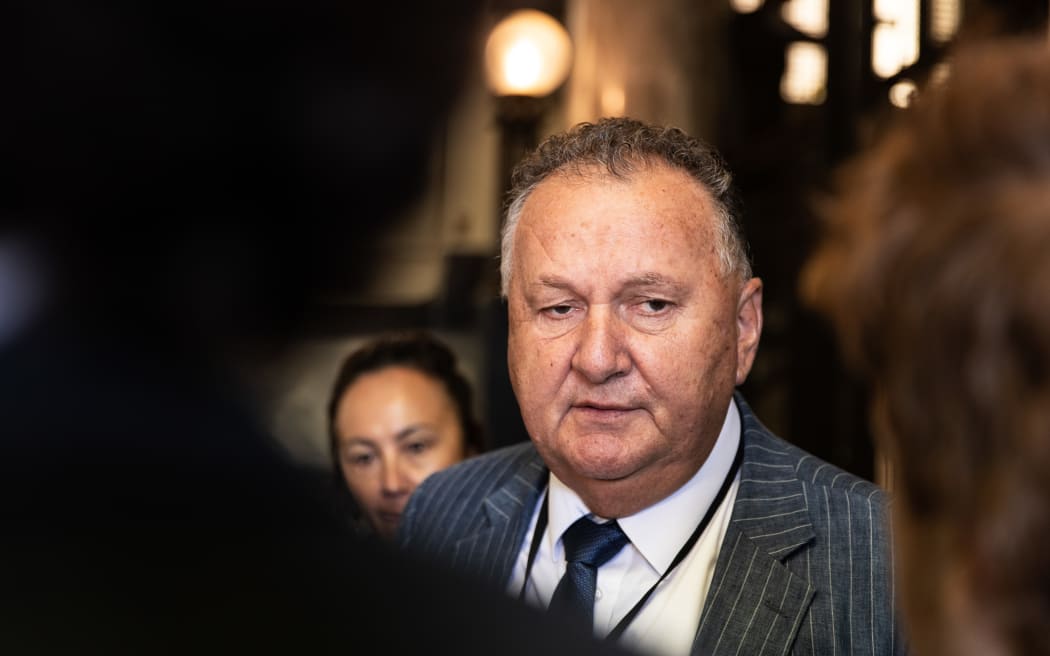
Jones told reporters the ultimate decision was the result of conversations with Winston Peters.
Photo: RNZ / Samuel Rillstone
Fisheries Minister Shane Jones has been forced into a major U-turn over his plans to scrap most minimum size limits for commercial fishers.
As recently as Monday, he was entirely unapologetic about the change, describing critics as just “noisy voices”.
But on Wednesday, coalition parties announced on social media that they had listened to public feedback and would no longer proceed.
Prime Minister Christopher Luxon said the backdown came after he spoke to Jones on Wednesday morning. The ACT party said it had also made its opposition known within the coalition.
But Jones told reporters the ultimate decision was the result of conversations with NZ First leader Winston Peters, who did not want the wider legislation to be “tainted” by “one relatively small issue”.
“There’s only one person that’s capable of instructing the Matua, and that’s the rangatira Winston.”
Jones said he had earlier taken the full proposal to his Cabinet colleagues, but: “you know these fishing issues, they’re so obscure and finicky”.
In an social media post earlier on Wednesday, Luxon said the National Party backed recreational fishers and had listened to their concerns.
“That’s why this morning I spoke to New Zealand First Minister Shane Jones and he agreed to take out the sections of the Fisheries Amendment Bill that removes the minimum size limits,” Luxon wrote.
Luxon later told reporters that he had a “good, constructive conversation” with Jones: “What’s important is we’ve got rid of the most egregious part of the bill”.
Asked how the “egregious” proposal had made its way through the Cabinet process, Luxon said the issue had not been as clear then as it was now.
“[Jones] took it to Cabinet. Recreational fishers quite rightly raised concerns about it. National Party people were very concerned about it as well, and as a result, it’s not happening.”
Winston Peters: ‘I’d already made the call’
New Zealand First has received a lot of feedback from recreational fishers about the current legislation going through parliament – in particular about the proposed catch size limit changes for commercial companies and how that would affect a large number of ordinary kiwis.
I…
— Winston Peters (@winstonpeters) March 25, 2026
Speaking to reporters separately, Peters took umbrage with the suggestion the prime minister had intervened. He said he had already had a long conversation with Jones before then.
“We decided to fix it and then told the prime minister. That’s the sequence,” he said. “I’d already made the call”.
Peters went on: “If anything was to come up with one of my ministers, it comes to me first, and then the prime minister. That’s how coalitions work.”
He said his party had heard recreational fishers out and they had made some very strong points
After a long back-and-forth with reporters, an exasperated Peters exhorted reporters: “Why don’t you go and read the Old Man and the Sea?”
Asked for his assessment, ACT leader David Seymour said his party had “signalled pretty clearly” to its coalition partners that it opposed the proposal. He said the details about scrapping size limits had earlier been “hidden” in the legislation.
“It’s a great day for very small snapper and recreational anglers alike to see this backdown from Shane Jones,” Seymour said. “It shows the government can listen. We’re extremely pleased to see it, and I’m sure we won’t be the only one.”
The legislation is set down to soon have its first reading at Parliament. All three coalition parties said the contentious clause would be removed through the subsequent select committee process.
The Fisheries Amendment Bill – as drafted – would have have ditched most commercial size limits, effectively allowing commercial vessels to land and sell baby fish, including snapper and tarakihi.
Recreational fishers argued the changes would decimate future populations.
Opposition parties accuse the coalition of dysfunction
Labour leader Chris Hipkins told reporters the backdown demonstrated the coalition’s “dysfunction,” noting that the legislation had gone through a full Cabinet approval process.
“The fact that no-one in the government thought, hang on a minute, this isn’t right, and it got all the way through to the stage where it’s being introduced to the House without anybody picking that up shows that this government is dysfunctional.”
Hipkins said the legislation as a whole should be pulled altogether.
“This is a bill that prioritises commercial fishers over recreational fishers, and it doesn’t pay enough attention to the fact that we’ve got a responsibility to protect our fisheries so that they’re there not just for today’s people but for future generations.”
Green Party co-leader Chlöe Swarbrick said the legislation was a “sop” to the commercial fishing industry, and the backdown was a win for public pressure.
“You can see from the immense public pushback that this government is scared of recreational fishers, they’re scared of environmental NGOs, they’re scared of regular hardworking New Zealanders coming together and raising their voice to protect our environment,” she said.
Swarbrick said the Greens were not just opposed to the removal of minimum size limits, but also a provision that would make footage taken by cameras on board commercial boats inaccessible under the Official Information Act.
Sign up for Ngā Pitopito Kōrero, a daily newsletter curated by our editors and delivered straight to your inbox every weekday.