
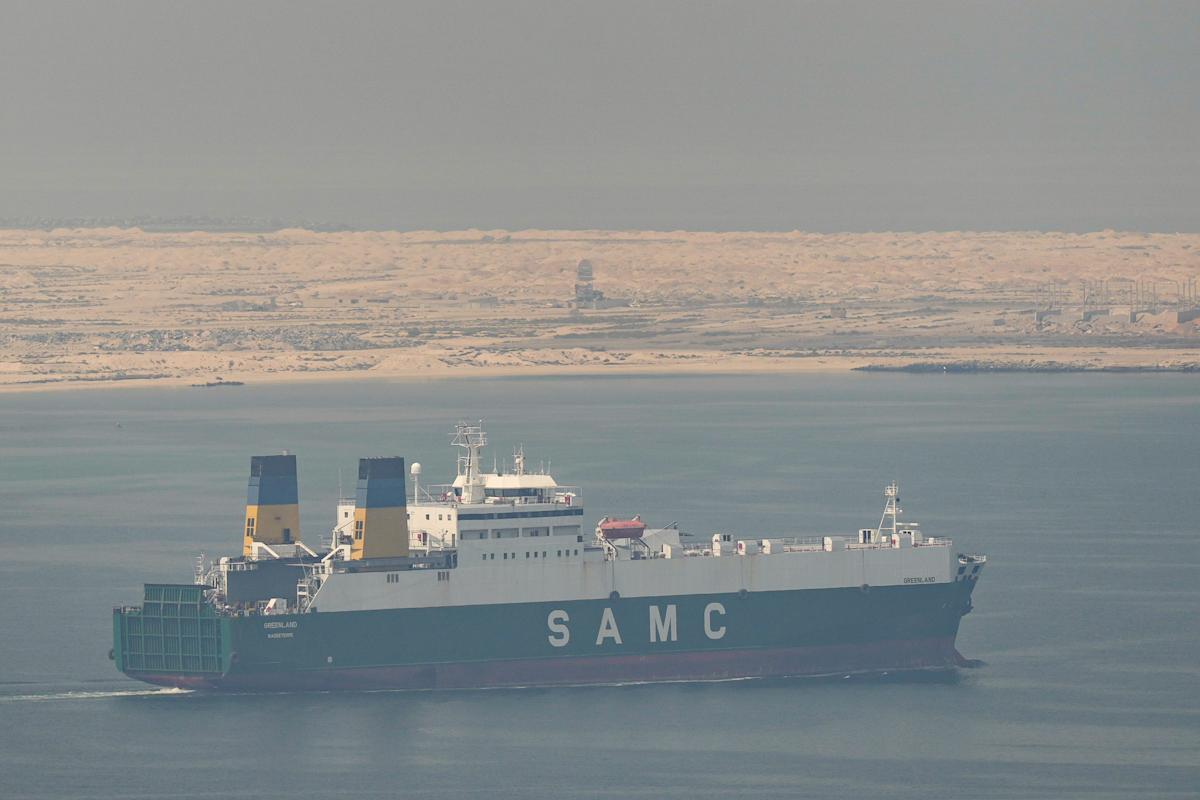
The ongoing Iran war and AI proliferation have created split fortunes for players in the freight and logistics sector.
The shutdown of Strait of Hormuz — forcing vessel to reroute around Africa’s Cape of Good Hope — has been a tailwind for maritime operators like Maersk (AMKBY) and Hapag-Lloyd (HLAG.DE). The longer journey allows the companies to collect higher surcharges for more days at sea.
However, global forwarders like DSV (DSV.CO) and Kuehne + Nagel (KHNGY) are navigating a “logistics nightmare” of vessel bunching and increased fuel consumption, pressuring shares for both firms over the last month. Unlike operators who own the ships and profit from longer voyages, forwarders must manage these logistical headaches while attempting to pass rising costs to cargo owners.
Read more: How oil price shocks ripple through your wallet, from gas to groceries
Against this backdrop of geopolitical chaos, Morgan Stanley argues that AI is moving from experimentation to a core operational necessity for the freight and logistics sector. But while the technology is becoming universal, the resulting profits likely won’t be.
Recent research from the bank, citing an AlphaWise survey, found that 96% of transportation companies reported productivity gains from AI over the last year.
The theoretical upside is massive. The firm’s scenario analysis suggests that a 10% reduction in staff costs via AI could lift EBIT margins by 180 basis points, while a 30% reduction could effectively double average margins for the industry’s top players.
Despite these projections, the Street remains skeptical because it has seen this pattern before. In the freight industry, when a company uses new technology to save money, it often uses those savings to lower prices and gain market share.
If AI tools become easily accessible to everyone, the resulting productivity improvements may simply reset the industry cost baseline rather than expand margins, Morgan Stanley’s Cedar Ekblom and Ravi Shanker wrote.
“There is a real risk that AI improves price delivery for customers, and in that way, weighs on pricing and compresses gross margins,” Bruce Chan, managing director of global transportation and logistics at Stifel, told Yahoo Finance.
To stay ahead, analysts say firms need historical pricing data. This allows a company’s AI to move from the realm of basic automation into one in which it makes highly accurate predictions.
“If the value of AI is in the data itself, the largest providers have a significant advantage,” Chan explained. “AI really does, I think, exacerbate that competitive differentiation.”
This explains the widening gap between industry winners and losers. Morgan Stanley and Chan highlight C.H. Robinson (CHRW) as the primary beneficiary of this shift. The firm’s generative AI agents process over 2,000 quotes in minutes and automate more than 10,000 emails per day across the shipment lifecycle.
While the company has been historically viewed as “headcount heavy,” Chan notes that under CEO Dave Bozeman, the firm is pairing its massive scale with disciplined cost management. It’s using AI to handle logistics and paperwork, allowing them to cut costs and protect margins. In February, Bozeman brushed off AI fears, declaring the firm was a “disruptor … not the disrupted” to Yahoo Finance.
Similarly, XPO Freight (XPO) has successfully deployed AI to optimize route density, a move that is already reflecting in its margin resilience, per Chan. In the parcel industry, UPS (UPS) and FedEx (FDX) are also cited as early adopters that have successfully deployed AI solutions.
While these firms are well regarded for their technology, he noted investors have yet to see the “real leverage” that AI can have on their business models.
Conversely, Landstar Systems (LSTR) faces a steeper climb because it operates through a dispersed network of independent agents. Chan pointed out that it is significantly harder to “enforce and incentivize” AI adoption across a decentralized workforce, potentially delaying the return on investment.
Meanwhile, Expeditors International (EXPD) is viewed as “at risk” because its main advantage — personalized customer service — is being replaced by automated tools and instant pricing. Without the massive amount of private data that its bigger rivals have, it’s becoming an uphill battle to keep profits high.
“We think the impact from AI depends on the business, rather than there being a ‘one size fits all impact,'” the Morgan Stanley analysts said.
 A man walks on rocks along the shore as oil tankers and cargo ships line up in the Strait of Hormuz, as seen from Khor Fakkan, United Arab Emirates, Wednesday, March 11, 2026. (AP Photo/Altaf Qadri) · ASSOCIATED PRESS
Francisco Velasquez is a Reporter at Yahoo Finance. Follow him on LinkedIn, X, and Instagram. Story tips? Email him at francisco.velasquez@yahooinc.com.
Click here for in-depth analysis of the latest stock market news and events moving stock prices
Read the latest financial and business news from Yahoo Finance