
When people hear “invasive species,” they often picture a dramatic ecological disaster: a sudden collapse, native species disappearing, everything falling apart.
But a new study on pollinators in Chile suggests invasions don’t always look like a catastrophe in the short term. Sometimes they look like normal functioning – just with the entire system slowly rewired underneath.

The researchers say invasive bees are reshaping Chile’s native plant-pollinator networks in what they call a “silent takeover.”
The networks are still operating. Flowers are still being visited. Pollination is still happening. But the relationships are becoming more generalized and homogenized, and that shift threatens the long-term stability of one of the world’s most distinctive biodiversity hotspots.
Why Chile is especially vulnerable
Chile isn’t just another country with interesting ecosystems. Ecologically, it functions like a “biogeographical island,” separated by huge natural barriers: the Andes to the east, the Atacama Desert to the north, and the Pacific Ocean to the west.
That isolation helped create a highly specialized set of plants and pollinators – the kind of tight partnerships that can take a long time to evolve.
The downside of that specialization is fragility. When new species arrive and start interacting broadly, they can disrupt those finely tuned relationships.
And Chile has a long history of introducing non-native bees for agriculture, often to improve crop pollination.
The new study set out to measure what those introductions have done to the wider pollination network over time.
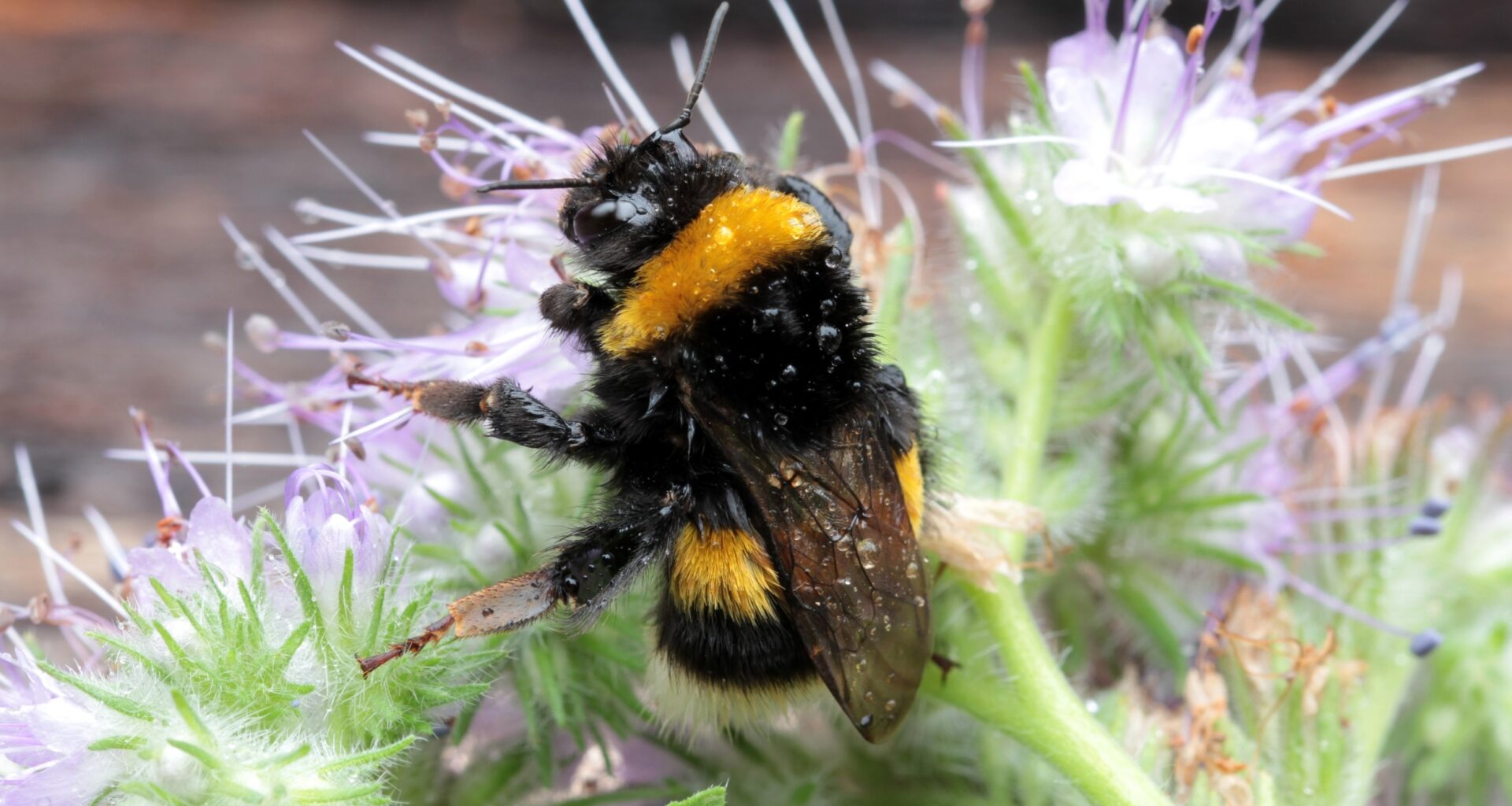
The researchers paid special attention to the invasive bumblebee Bombus terrestris (the buff-tailed bumblebee), a species that has expanded aggressively in parts of South America.
What the researchers did differently
Instead of focusing on one region or one crop, the team tried to reconstruct the national story by building a large dataset of pollinator interactions.
The researchers compiled more than 2,100 records, combining historical scientific observations with citizen science data.
They focused on three non-native bees that are now widespread: the western honeybee Apis mellifera, the buff-tailed bumblebee Bombus terrestris, and the large garden bumblebee Bombus ruderatus.
“The motivation was to understand whether these invasions were simply adding species to the system or quietly transforming it from within,” explained lead author Rafaela Cabral Marinho from the Universidade Federal de Uberlândia.
That framing matters because an ecosystem can “look fine” if you’re only counting species or measuring basic pollination rates.
The deeper question is whether the structure of interactions – who pollinates whom, and how specialized those relationships are – is being altered.
One invader dominates the conversation
The clearest result was how dominant Bombus terrestris has become. In the combined dataset, it accounted for more than 70% of all recorded interactions. That’s an astonishing level of integration for a relatively recent arrival.
“That level of integration into a national pollination network is remarkable for a relatively recent invader,” said study co-author Barbara Guimarães.
The study also found that invasive bees tended to interact heavily with non-native plants, and they behaved in a highly generalist way – visiting many different plant species rather than forming tighter relationships with a smaller set.
In the short run, that can keep pollination “working.” In the long run, it can reduce the uniqueness and stability of native mutualisms.
What changed after 2005
To see how the network shifted over time, the researchers compared data from before and after 2005 – the year B. terrestris began to be used extensively in open fields.
That comparison revealed a worrying trend: native species were being displaced over time, including Bombus dahlbomii, the iconic giant bumblebee native to southern South America.
“The networks did not collapse; instead, they became more generalized and homogenized. Native bees were not always disappearing completely,” the authors wrote.
“The system kept functioning, but in a different way. This quiet reorganization is what led us to describe the process as a ‘silent takeover.’”
That’s the uncomfortable part. If you only look for obvious die-offs, you may miss the transformation until it’s far along. The ecosystem may still be humming, but it’s becoming less distinctive and potentially less resilient.
The role of citizen science
A big chunk of the dataset came from people outside academia – everyday observers logging bees and flower visits.
“We were surprised by the volume and value of citizen science contributions, and how they can provide meaningful insights when combined with research data,” Fontúrbel said.
That’s a practical takeaway: citizen science isn’t just nice for outreach. For invasive species tracking, it can be one of the best early warning systems available, especially across large geographic areas.
Subtle changes with a big impact
The researchers argue that biological invasions don’t always arrive as sudden disasters. They can be slow shifts in relationships that change how ecosystems function and what kinds of interactions survive.
Invasive bees may boost pollination for some crops, and they may even keep overall flower visitation rates high.
But the cost is that native, specialized relationships can weaken. Over time, that can lead to biotic homogenization – ecosystems becoming more similar to one another and less unique.
And for a place like Chile, whose biodiversity has been shaped by isolation and specialization, that is a real threat.
“One key takeaway is that biological invasions are not always catastrophic overnight events. They can be gradual reorganizations of ecological relationships,” the researchers noted.
“While invasive bees may increase pollination for certain crops, they can simultaneously reduce the specialization and stability of native mutualisms.”
“Our research highlights that conservation is not only about protecting species, but it is also about protecting interactions.”
Future research directions
The study ends with a pretty clear call for more coordinated policy. The researchers advocate for stronger regulation and planning around species introductions, better early detection and monitoring, and continued public engagement.
This will be very helpful since once a generalist pollinator is embedded across a network, reversing the change becomes extremely difficult.
The bigger message is that conservation isn’t only about keeping species from going extinct. It’s also about preserving the web of relationships that makes an ecosystem what it is.
Chile’s pollination system may still be running – but the study suggests it’s being quietly rebuilt into something less Chilean, and that should worry anyone who cares about biodiversity that can’t be replaced.
The study is published in the journal NeoBiota
—–
Like what you read? Subscribe to our newsletter for engaging articles, exclusive content, and the latest updates.
Check us out on EarthSnap, a free app brought to you by Eric Ralls and Earth.com.
—–