
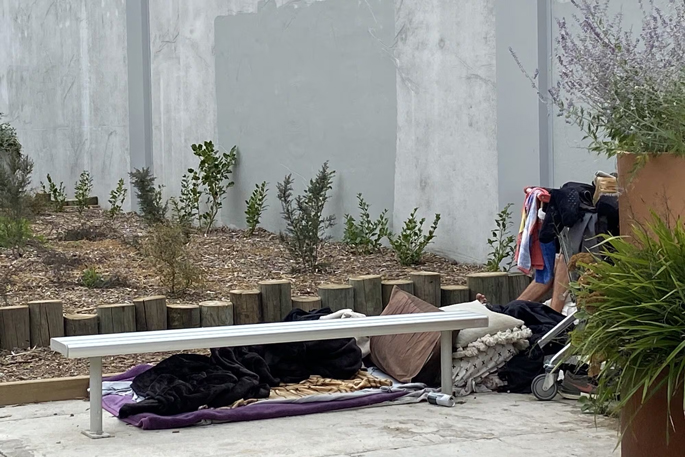
Homeless people and their advocates are joining a protest against proposed new police powers they say will “further victimise” vulnerable people.
The proposed changes to the Summary Offences Act would give police powers to order people causing disruptions, rough sleepers and beggars as young as 14 to leave public places for up to 24 hours.
Breaching an order could result in a fine of up to $2000 or three months in prison.
A family friendly protest will be held on the lawn of Holy Trinity Church, Devonport Rd on Sunday from 1pm to 3pm as part of the National Day of Action initiated by Auckland-based Kickback, an organisation supporting young people experiencing homelessness.
Local advocacy groups taking part in the protest say the legislation would further marginalise people already living with significant hardships, while doing little to address the underlying causes of homelessness.
Angela Wallace, board co-chair of Awhina House, which provides transitional housing and support services for homeless women in Tauranga, urged people to attend the “peaceful protest” action.
Wallace said she and other staff worked closely with people who had slept rough and understood the complex realities behind homelessness.
“We believe this legislation will not address the underlying issues of homelessness and will further victimise whānau who are already vulnerable and have no place to go.
“Moving rough sleepers from place to place does not help their situation. Vulnerable women who seek safety in well-lit public areas will be at risk if forced to move to less safe areas.”
She said it would also make it less likely they would get support.
“Police will become the enforcers of the move-on orders … while the needs of vulnerable whānau remain unmet and homelessness continues to rage on unchecked.”

Awhina House board co-chair Angela Wallace. Photo / NZME
Wallace said protest attendees would hear from speakers about alternative approaches to move-on orders and learn how to formally oppose the legislation.
Takitimu House operations manager Jessica Gamble said the proposed law did not address the housing shortage or the need for more resourcing of community organisations providing wraparound support.
Takitimu House provides transitional housing and other support for unhoused men.
Gamble said housing was not just a social issue – it was a “justice and economic” issue.
“Transitional housing works because it treats people with dignity and gives them a real chance to rebuild their lives. Instead of fines and prison cells, we should be investing in pathways that genuinely lead people out of homelessness.”

Takitimu House provides transitional housing and other support to homeless men. Photo / NZME
She said this required a stronger focus on increasing housing supply, particularly one- or two-bedroom homes, and better resourcing for community groups. .
“When people have stable housing and consistent support, outcomes improve for individuals, communities and the public purse.”
Gate Pā Community Centre Trust chairman Doug Barnes agreed.
Homelessness was rarely the result of a single factor, he said, and most homeless people had complex needs and a complicated backstory.
“We’ve seen a huge increase in homelessness, and at the same time we’ve seen a reduction in the availability of support services needed to address those needs.”
He said moving homeless people, particularly women vulnerable to exploitation, from one place to another created more problems and safety risks.
“As a community, we need to do more to address our homelessness problems and work together with local and central government to find real solutions.”
Holy Trinity Church vicar Nigel Dixon said he believed the legislation was “quite disingenuous” and an extreme response to homelessness and poverty.
He said police could already move on people who were “creating a real nuisance” and the legislation would be a “pretty blunt instrument”.
“You can’t legislate societal change from afar with punitive measures. What does work is empowering and resourcing local communities and local people to respond with compassion and practical solutions.”
During the protest, there will be a free sausage sizzle and bottles of water, music and performances, and sign-making. Good Neighbour Aotearoa Trust’s mobile shower and laundry unit will be on-site.
Attendees were encouraged to bring clean blankets to sit on or warm jackets and donate them for distribution to homeless people.

Justice Minister Paul Goldsmith.
Justice Minister Paul Goldsmith said the legislation was about “reclaiming our streets and city centres” for the enjoyment of everybody who visited, worked and lived there.
“We currently have many tools to help those who are in need, including access to one of the most generous welfare systems in the world, but we have limited tools to deal with disorderly behaviour.”
Goldsmith said New Zealanders were “fair-minded” people.
“Our culture is one where we seek to help those who are in need, but that doesn’t mean we should accept our city centres, particularly our showcase tourist spots, becoming places of intimidation and dysfunction.”
He said a move-on order was not a criminal charge.
“Only people who refuse to comply with a move-on order will face criminal proceedings. Police have the expertise to connect people with the help they may need.”
Sandra Conchie is a senior journalist at the Bay of Plenty Times and Rotorua Daily Post who has been a journalist for 25 years. She mainly covers police, court and other justice stories, as well as general news. She has been a Canon Media Awards regional/community reporter of the year.