

Article – RNZ
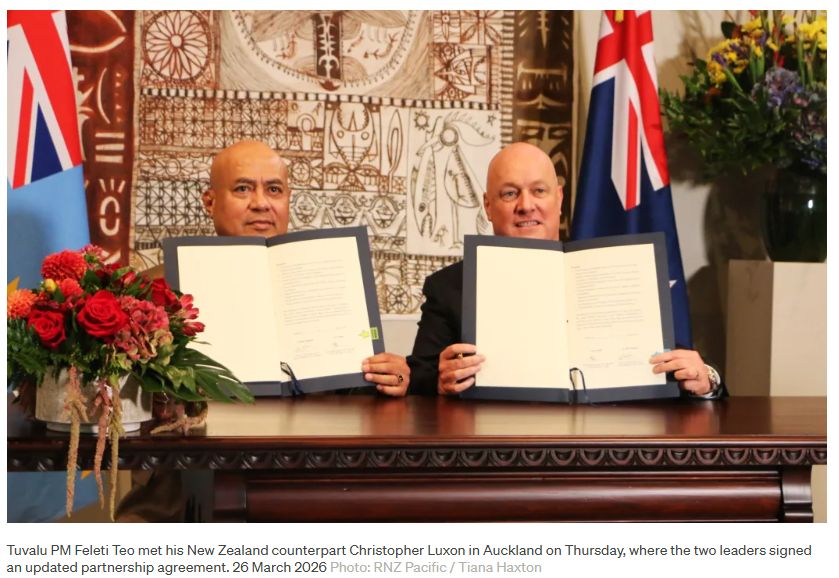
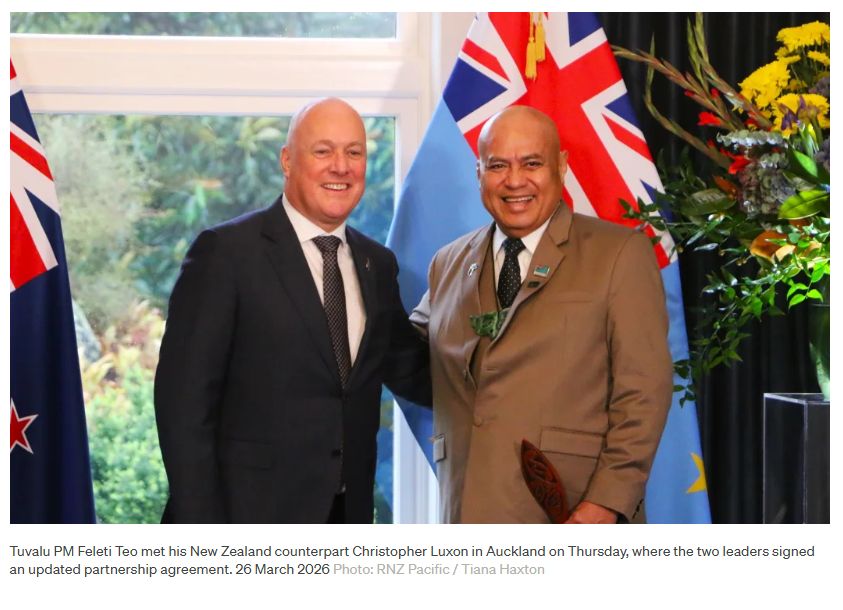
Feleti Teo met his New Zealand counterpart Christopher Luxon in Auckland on Thursday, where the two leaders signed an updated partnership agreement.Kaya Selby, RNZ Pacific journalist
Tiana Haxton, RNZ Pacific journalist
New Zealand will provide an additional $20 million to flood resilience work in Tuvalu.
Prime Minister Christopher Luxon met with his Tuvaluan counterpart Feleti Teo on Thursday morning in Auckland, where the two leaders signed an updated partnership agreement.
They also discussed how Kiwi support for Tuvalu may continue, including the prospect of a treaty by 2028, though details were vague.
The contribution to the Tuvalu Coastal Adaptation Project more than doubles Aotearoa’s aid to the island nation in the current financial year, according to Ministry of Foreign Affairs and Trade’s Devdata website.
Luxon said he has “huge admiration” for Tuvalu.
“It is leading the way globally in responding to sea-level rise, and we are incredibly proud to support Prime Minister Teo’s globally renowned land raising and coastal protection efforts,” he said.
“We know that the outcomes for our people and our region depend on that resilience … New Zealand stands ready to help provide practical support.”
Teo said any sea-level rise will have “a devastating impact” on his country, both real and theoretical.
“As you will know, Tuvalu is an atoll island nation, it is totally flat,” he said.
“I have spoken in many international arenas, advocating for countries to continue to recognise Tuvalu’s sovereignty and the permanency of its maritime boundaries despite the impact of sea-level rise.”
Luxon said he was proud of the 6500 Tuvaluans living in New Zealand, the largest Tuvaluan diaspora in the world.
Treaty could come in time for Tuvalu’s 50th Independence Anniversary
The threat that Tuvalu could lose it’s legal status as a nation, if too much of its land area becomes submerged, has become the subject of its diplomacy in the last few years.
A projection widely circulated by the United Nations estimates that 95 percent of Tuvalu’s land area, across all nine of its islands, could be underwater by the turn of the century.
Acting on this dilemma, Tuvalu has sought treaty agreements with several wealthy partners, including Australia and, more controversially, Taiwan.
As part of their Falepili Union treaty with Australia, Tuvalu secured “climate mobility” visas for up to 280 Tuvaluans, or roughly 2 percent of their population, each year. The first group arrived early this year.
Tuvalu also promised mutual agreement with Australia on any partnership or arrangements to do with defence and security.
Two years later, they struck the “Kaitasi Treaty” with Taiwan, guaranteeing their continual recognition of Taiwan at a time of significant Chinese influence in the region. China has refused to have diplomatic relations with any country simultaneously with Taiwan for years.
It makes Tuvalu one of only three Pacific nations to recognise Taiwan, alongside Palau and the Marshall Islands.
Luxon said any features of a treaty were premature at this stage.
“We have not defined what that looks like yet, that is the work that we will get through with our officials in the coming years,” he said.
But Teo canvassed a number of issues in their joint press conference, from security, to energy, to climate.
He said he was pleased Luxon was open to the idea of a treaty.
When asked whether it may resemble the Falepili Union with it’s special visas, Luxon said they were monitoring it’s progress.
“We are learning a lot from the Falepili treaty and how it is being implemented and what is working, and maybe, what can be improved on,” he said.
Teo added he hoped to have it in place by 2028, the 50th anniversary of their independence.
Content Sourced from scoop.co.nz
Original url