
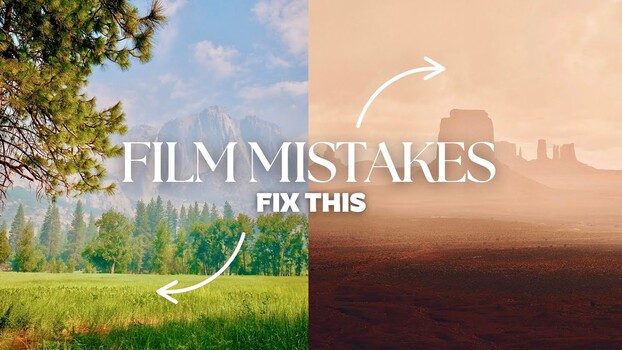
Shooting film for a decade gives you a clear view of what separates a polished image from one that looks like it came from a beginner. The culprit is almost never the camera or the film stock itself; it’s a handful of repeatable mistakes that are completely fixable once you know what to look for.
Coming to you from Jonathan Paragas of KingJvpes, this sharp and practical video has Paragas walking through the four biggest mistakes that make film images look amateur. The first two are straightforward. Exposure is the most obvious offender: underexpose, and you get muddy, grainy shadows with ugly color shifts; overexpose too aggressively, and you lose detail entirely. Paragas is clear that the “always overexpose film” advice you see online is situational, not a universal rule. Use your in-camera meter, grab a meter app, or learn the sunny 16 rule, and you’ll nail it far more consistently. The second mistake is not researching your film stock before you shoot. Something like Kodak T-Max P3200 is an extremely sensitive film: shooting it in daylight will push you to absurd settings like f/16 at 1/1000 sec, and it can still come out overexposed. Paragas recommends a simple principle: research the characteristics of your film stock and match it to the conditions you’re shooting in. Heading out to photograph warm, golden sunsets? Reach for Kodak Portra. Shooting contrasty street scenes? Kodak Tri-X is built for that.
The third mistake is something a lot of people overlook entirely: texture. Film already has grain working in its favor, and when you pair that grain with physical texture in the frame, you get depth and dimension that digital simply can’t replicate. Paragas breaks down how to think about contrasting textures and introduces the concept of foreground texture, where you photograph something close to the lens while your focus sits further out. It creates a sense of depth that makes the grain and light feel intentional rather than accidental.
The fourth mistake is where things get more nuanced. It has everything to do with how you position yourself relative to the light. Paragas gets specific about the difference between backlit and front-lit situations, and how certain film stocks like Kodak Gold 200 or Cinestill 800T respond very differently depending on where your light source sits in relation to your subject. He explains exactly how he thinks about light while composing a shot and what questions he asks himself before pressing the shutter. Check out the video above for the full breakdown from Paragas.