
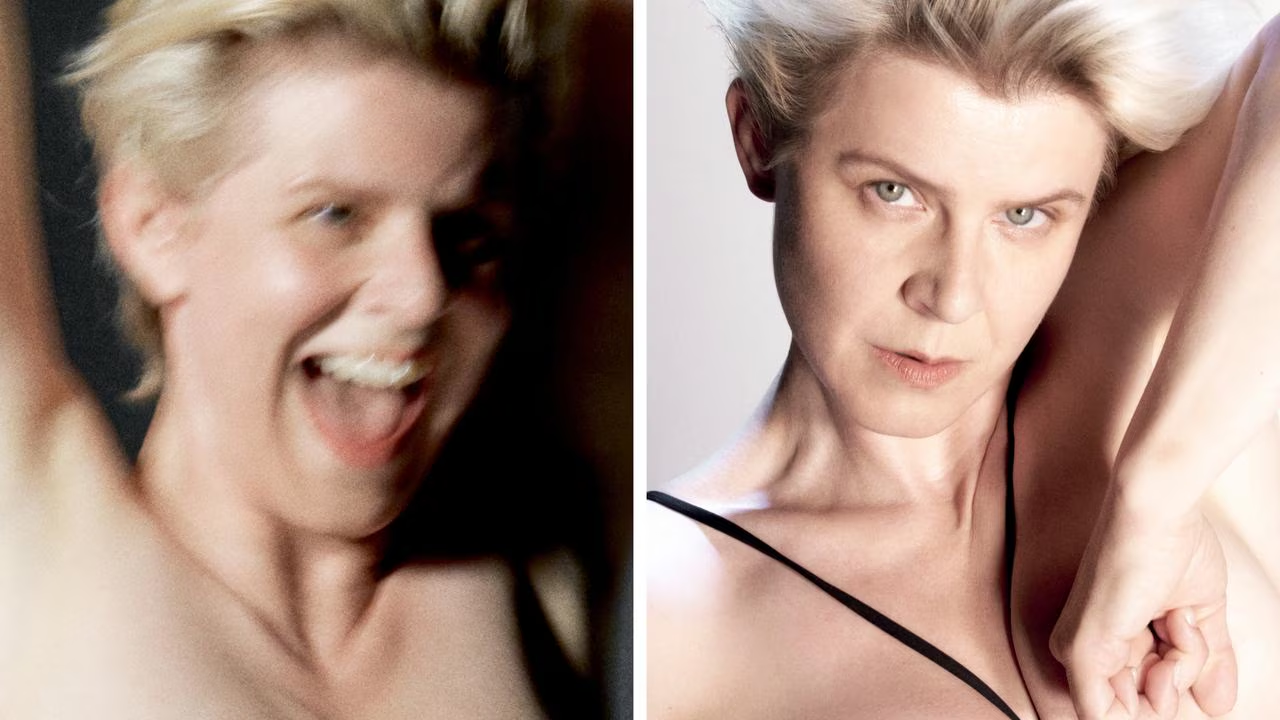
It seems an unbelievable stat – she’s still only 46 years old – but it’s now more than 30 years since Swedish pop star Robyn released her debut album.
At the time, she was a rare European entry into the US teen pop boom, earning a couple of American top 10 hits with the singles Show Me Love and (Do You Know) What It Takes before disappearing from international audiences’ view just as quickly as she emerged.
It was to be almost a decade until she really resurfaced on the world stage, remaking herself as an independent pop artist with a string of classics like Be Mine, With Every Heartbeat and Dancing On My Own.
The release of that last song in 2010 felt like a real breakthrough moment for Robyn – but since then, she’s marched to the beat of her own drum, releasing only one more studio album, 2018’s Honey, amid a slew of side projects.
Thankfully, the musical drought ends today, with the release of Robyn’s ninth studio album, Sexistential. It’s a sleek, concise record, packed with punchier pop hooks than her last effort, Honey.
As the title suggests, it’s also an album with a particular focus on one topic. Robyn recently spoke to news.com.au about channelling what’s been on her mind – sex, dating and first-time motherhood – into Sexistential.
You recently announced your first-ever Australian arena tour. Longtime fans will remember there was a time almost 20 years ago now when you returned to our shores three times in the space of about 18 months to play a string of tiny club gigs. Aussies got to seeing a lot of you … then you left us!
I had a great time in Australia, and I kept coming back because it was so fun. But then I was in a different time in my life where I wasn’t leaving Sweden that much, and the travelling… it’s a long way! Maybe I overdid it. And you’re right, it went from very small shows to then playing festivals, which was really fun. It was a good time.
Your audiences have grown a lot since then, but does part of you still like a little sweaty club gig like that?
Smaller shows are great, but I don’t get to do them as much as I used to. I remember when I started playing in London, it was to like 200 people. And I played so much between 2008 and 2012, just constant touring. It was my grinding years, but it was really instrumental for me in learning how to own a space.
Coming out of those ‘grinding years,’ you’ve had much bigger gaps between albums – eight years before Honey in 2018, then another eight before Sexistential. Is there a feeling of, ‘I need to go and live my life so I have something I can bring to a new album?’
I don’t think it’s been a conscious decision at all. After Body Talk [in 2010] I did quite a lot of music but it was just a different kind – collaborations and EPs. I kept busy, so the gap between Body Talk and Honey was really only three years. I’m not trying to make it sound like less!
But the big gap was between Honey and this album: It was the pandemic, I had a son, and I started working with new people. But somehow, [albums] just take time for me. I’m not a quick writer.
Honey really doesn’t feel like it was eight years ago, I think because it’s the definition of a ‘grower’ album. It takes some time to reveal itself.
I’m so happy to hear that. I think one of the intentions with that album was to make something that felt slow and had a longevity to it, or some kind of quality where you lose sense of time. I was interested in writing songs that were more informed by dance music than the kind of pop writing I usually do. I wasn’t so interested in choruses … I think that’s really what club music is; you don’t have this song-based structure, it is something that builds slower.
I’d been clubbing a lot before the pandemic, spending time on dance floors, and that was how I wanted the music to be. And now those songs are just amazing to play live. I can see the audience … when we play Honey, for example, I can tell it gives people the space to go inward, and that’s really what I tried to do.
You mentioned one very good reason for your gap between albums – you had your son Tyko in 2022. It strikes me that we don’t know a whole lot about your life outside of music: The first time some fans might realise you have a child is when they hear you mention it on this album.
I don’t think that I’ve been that open about my private life because my private life is mundane. I think what’s interesting is this duality that we all live in, having this very emotional inner world. The big existential questions that we all have about the meaning of life, and then how we put that together with our everyday, our relationships and our role in society.
That’s something I really wanted to describe on this album: the craziness of thinking about the fact that I might not ever become a parent, then talking about donors with my doctor, then counting the days and knowing exactly when I was ovulating, like I was a machine. It felt super emotional and existential, just having to manage these two worlds at the same time.
But this album is not really about becoming a parent. I was on dating apps at the same time as I was trying to get pregnant! The contrasts with that … it made me laugh a lot of time, it was just so crazy. So that contrast was what I was trying to describe, more than my exact private life.
So it’s about the contrast of me enjoying my sensuality and my sexual life at the same time as being very existential and dissecting how I was going to become a mother and a grown-up, in a way.
You’ve said that sex and desire are big themes on the album. That really comes across in the video for Talk To Me: You’re really revelling in the pleasure and physicality of dance.
I wanted that video to be playful, camp, and … generous, and it was so fun to make it. The song itself really is about pleasure and about submitting to it and it’s been so fun to see everybody’s reactions because I wanted to give love and feel playful. I feel like that’s what people are getting from it.
I mean, the album title was a joke at first. My sister and I were laughing about it, it felt like this ‘MILF’ sort of embarrassing title. Then after a while I thought, no, it’s actually a really good juxtaposition of the things I’m thinking about with this album: Sex, playfulness and dating.
You’ve included a new version of your 2002 song Blow My Mind on the album – that’s long been a favourite from your early years. It seems like with a slight tweak of the lyrics it’s now a tribute to your son?
Yeah, I was breastfeeding my son and realising there’s this total invasion of your body when you have a little kid. There’s these very contradicting feelings of being tired of them being on you all the time: The scratching, the forced closeness … but then also this total feeling of love. We opened Blow My Mind back up and it felt like the lyrics were a bit outdated, and we really enjoyed turning the song into this more specific experience.
That song comes from an interesting period of your career, between your debut album in 1995 and your second international breakthrough with your fourth album Robyn in 2005. Some fans might not realise there are two great Sweden-only albums sat there on streaming platforms waiting to be heard.
Yeah, that’s true. But you know, the first 10 years of my career, I was so young that I don’t think I really knew what I wanted to say. I was just exploring, enjoying making music with people that were much better at it than me. But over the years it’s becoming clearer and clearer to me and I’m actually really in love with songwriting: it’s still what I’m obsessed with and what I really just want to do all the time, it is my favourite thing.
Speaking of songwriting, I have to ask about Dancing on My Own. It was a hit when it was released, but it feels like its cultural impact and legacy grows each year. Did you know when you wrote it that this could perhaps end up as the song of your career?
When I wrote Dancing on My Own, it was a very intuitive process and something that happened quite quickly, I knew that I had written something good. And then you never know what other people would think, but I knew that I had hit something that felt true to me. I had a lot of belief in that song. I remember saying ‘That should be the single.’ So I had the feeling, but then it’s up to so many other things: it’s luck, it’s timing. It’s a very unpredictable, hard thing.
Robyn’s new album Sexistential is out now. Robyn plays Sydney’s Qudos Bank Arena on November 21 and Melbourne’s Rod Laver Arena on November 24, tickets through Live Nation.