
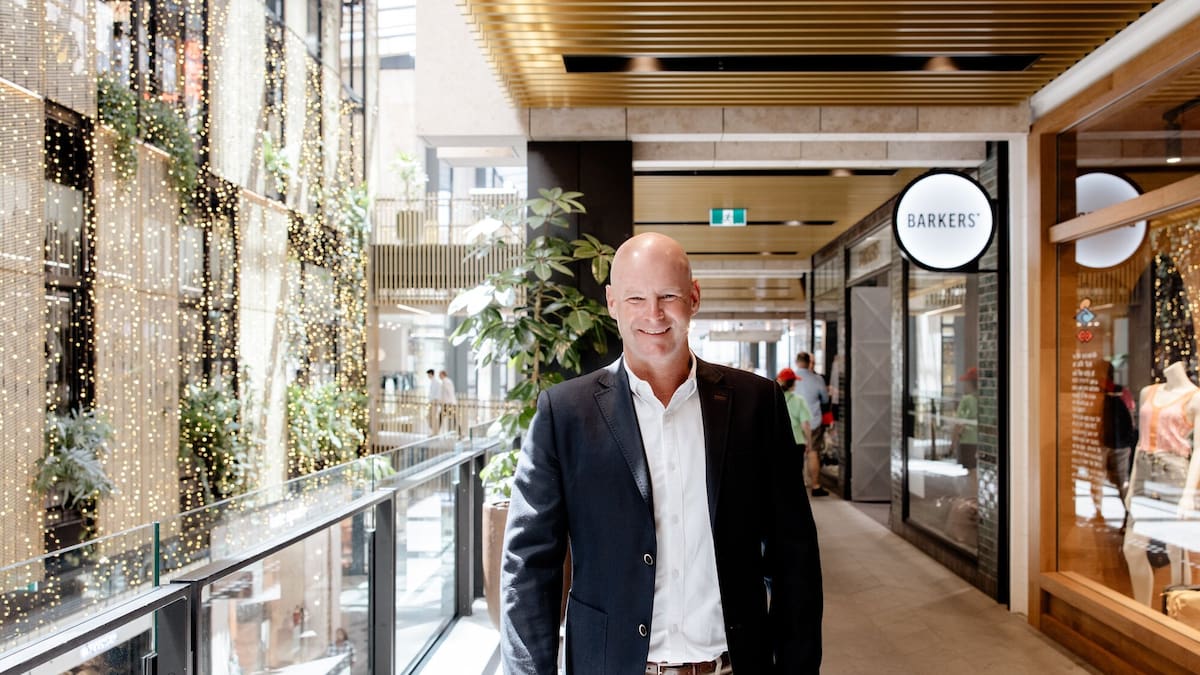
“I think we’ve got to convince people that our city is outstanding – and our city is outstanding,” Pritchard says.
“Our city’s got to feel like a community. You’ve got to feel safe in the city centre and for it to be a place where you can enjoy the city, whether you’re working there, living there or socialising there.
“There are some terrific examples of other cities around the world that have done it very well. And I think the potential for that in Auckland is immense.
“The Auckland isthmus is very narrow. I don’t think urban sprawl is the answer for housing. Greater density is most certainly the answer and, I think if we do that in a really well-planned way, the Auckland city centre could look really different in another 10 to 20 years.”
NZX-listed Precinct Properties is walking its talk.
To date, it has delivered $2.3 billion of mixed-use developments that have redefined city centres, such as the Commercial Bay and Wynyard Quarter precincts in Auckland city and the Bowen Campus in Wellington.
Well-known as a commercial office owner and developer, the publicly traded company’s strategy has evolved to include residential and purpose-built student accommodation while scaling its capital partnering model. Precinct defines itself as a long-term owner, developer and manager of city centre real estate, specialising in city spaces.
Beca House, the final stage of the Wynyard Quarter Innovation Precinct.
Its next major project is the transformation of Auckland’s Downtown carpark site into a mixed-use commercial, residential, hospitality and hotel community with high-quality public space, which will integrate with the Commercial Bay precinct.
The company says the development, which it expects to begin this year, subject to consenting and procurement steps, will enhance east-west connectivity across the city and strengthen the link between the city centre and waterfront.
Once completed, the Downtown Project is expected to lift the Commercial Bay workforce by 70%, from 10,000 to 17,000 people, while the hotel will attract thousands of visitors a year.
Precinct says the recently acquired Downtown site is one of the last major opportunities to reconnect Auckland’s commercial heart directly with its harbour.
The company is now seeking resource consent for the project with the Environmental Protection Authority under the fast-track consenting pathway.
Precinct’s next project will be the Downtown carpark building. Photo / File
“We’re really excited about the prospects of that project,” Pritchard says.
“It is large-scale, so the intent for that is to really leverage on the work that’s been done with Commercial Bay and to concentrate a lot of our activities for Auckland in these few waterfront blocks, right on the water’s edge.”
As an “active champion for Auckland as a globally ambitious city”, the company is a cheerleader for investment in the city centre for a simple reason, Pritchard says.
“I think Auckland could, without any doubt, be the best waterfront city in the world. It’s very much about connecting the Hauraki Gulf and the city centre and, as well as that, creating a community within a city.
“In doing that, I think we’ll start to see the range of uses start to really operate in harmony.
“At this stage, I think the city is making great progress towards that, but there’s still a huge amount of opportunity to really get all of those uses working in harmony.”
Precinct says as Auckland competes globally for talent, investment and students, the shape and quality of its city centre matter more than ever.
So what are the challenges ahead to realising the vision of a thriving, vibrant city centre community?
Commercial Bay, developed by Precinct, is a mixed-use development of office use, retail use, hospitality use and a hotel.
“I think at the moment there’s a bit of a perception issue around the city that I think is unfounded. It’s had some challenges in the last four or five years around those perceptions and they principally relate to safety and crime and so on,” Pritchard says.
“I think the reality is that in the last couple of years, central government agencies, local government agencies and a whole bunch of other participants in the market have done a huge amount of really good work to create a city that’s really vibrant, safe and fantastic.
“So one of the biggest challenges is overcoming that perception. The second is really trying to knit the city together so that it can leverage all its great attributes.”
Pritchard thinks Precinct’s role in trying to shape the city is best evidenced by what it has achieved already.
“Commercial Bay is a mixed-use development of office use, retail use, hospitality use and a hotel. In one city block there’s probably 7000 or 8000 office workers and, at any given time, a few hundred people staying at the hotel. There are 120 shops and all those uses are working in harmony.
“When I think about the city and role that Precinct has to play, I think we can do that on a bigger scale – that’s where the secret sauce exists.”
Precinct has around $5 billion of assets. It owns around $4b of this portfolio, Pritchard says, the remainder being managed. While the company has capital project partners from offshore, as a publicly listed entity, its makeup and ownership is largely held by KiwiSaver mum and dad investors, he says.
This year Precinct has reason for confidence in its mixed-use project strategy.
It reports strong momentum in office leasing, with first-half leasing significantly higher than in recent years and occupiers having a strong preference to be in core Precinct locations.
It notes strong occupier demand for premium Auckland CBD offices, outperforming other New Zealand markets, and 13 million-plus visitors to Commercial Bay annually.
Pritchard says the notably higher office leasing demand in the first half of the year is due to a reversal of work-from-home practices post-pandemic.
“A lot of businesses over the last five or six years have shrunk their office footprint, while a number of their staff were working from home.
“I think they’ve realised productivity takes a big hit … and so almost all of our occupiers within the precinct portfolio are trying to encourage their staff back to the office more often That’s putting quite a lot of upward pressure on office space at the moment.”
The company notes strong in-office attendance by occupier staff – 4.1 days a week against the national average of 3.3 days.
“The second thing is that to get their staff back in the office, they’re having to rent really high-quality offices. That’s something the precinct is most certainly benefiting from,” Pritchard says.
Precinct’s part in overcoming perceptions is “to design spaces people want to be in”, he says.
“They’re well lit, they’re spacious, they’re safe. There are a lot of people around and because the urban environment is so good, people are attracted to it.
“The more people that are in the urban spaces, the safer it is.”
Precinct also has an active residential pipeline of development with $375m of build-to-sell projects – most recent being Dova in Mt Eden and Pillars in St Mary’s Bay/Ponsonby.
Pillars, College Hill
The company says its purpose-built student accommodation strategy supports Auckland’s education economy, vibrancy and long-term CBD resilience.
The most recent projects in this class include a 964-bed construction at 22 Stanley St, due to open in 2029 and a 638-bed build at 256 Queen St, also opening in 2029.
Bringing the vision of a powerhouse global city centre together will take more than Precinct’s efforts, however.
The Stanley St project.
“The city needs to have a sense of community and an absolute commitment for people to be safe here,” Pritchard says.
“We need contributions to things like schools, so that families can live here.
“We need to leverage the infrastructure that’s been invested in – the likes of the City Rail Link finishing later this year and the International Convention Centre.
“I think it’s about prioritising that this is the most productive 4.5km in our country. Now we want to layer it up with other uses.
“At the moment our city centre is set up to be a workplace. We need to set it up to be thriving, 24-7.”
Precinct Properties is a sponsor of the Herald’s Project Auckland report.