
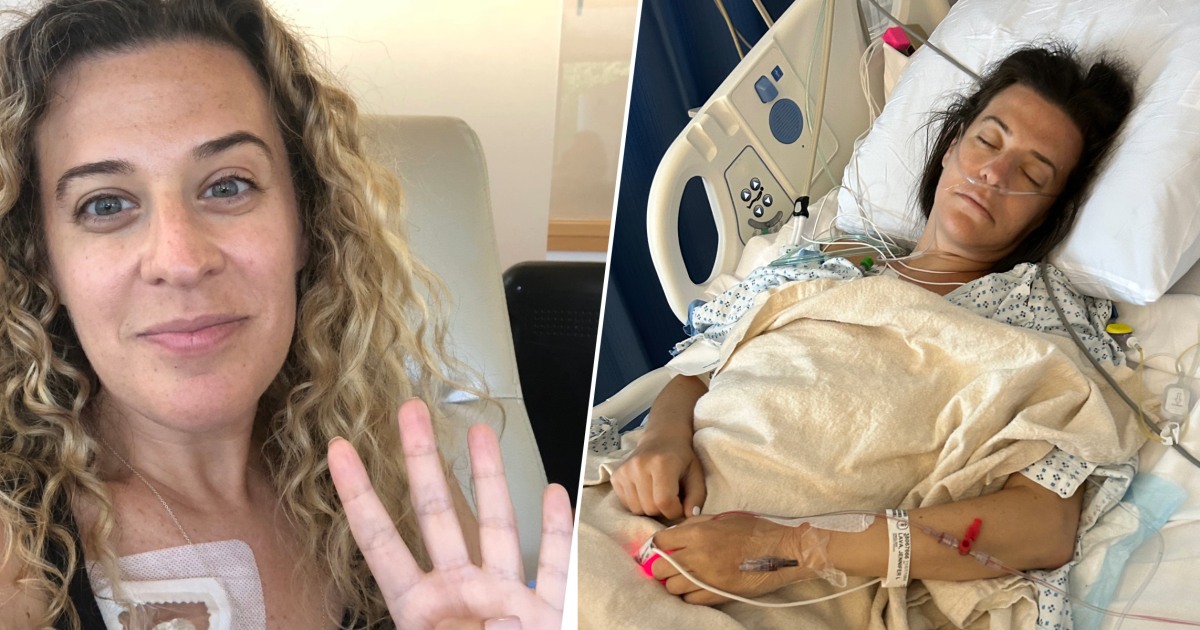
In 2019, Jennifer Lava had just moved to Washington, D.C., to start a new job and chapter.
The New Jersey native, then 34, had a remarkably normal life and an unremarkable medical history.
“I had been doing spin three or four times a week. I was eating healthy, I’m not a huge drinker and not a smoker,” Lava tells TODAY.com.
Like many other people diagnosed with colorectal cancer, Lava didn’t have any obvious risk factors.
So she never suspected that the vague gastrointestinal symptoms she experienced after moving to a new city were something serious — let alone, tumors growing in her abdomen.
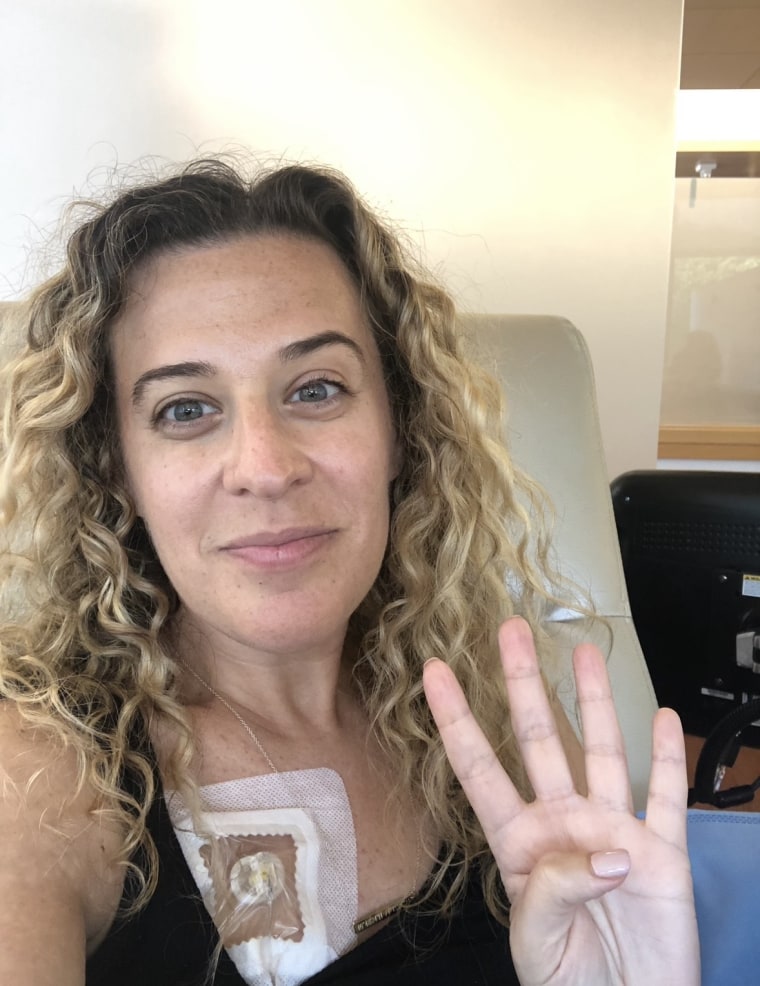 Jen Lava has beaten colon cancer four times since turning 34.Courtesy Jen LavaFrom Occasional Nausea to Sharp Pain
In April of 2019, Lava started experiencing occasional stomach aches. “It would always be so excusable, like, I just had coffee on an empty stomach or I ate a lot of dairy,” she recalls.
The aches were never consistent or too worrying. She even stopped drinking coffee, which seemed to help at first.
A few months later, in June, Lava got home after a birthday party feeling nauseous and tired. The next morning, she threw up. “I thought maybe there was a stomach bug going around,” Lava says.
Over the next few days, Lava experienced what she says were textbook early pregnancy symptoms: nausea, vomiting in the morning, food aversions and fatigue.
The catch? “I was definitely not pregnant,” says Lava, who had normal periods every month.
Then, one day soon after, she woke up and doubled over in sharp pain. “I was unbelievably nauseous. My stomach was distended,” she recalls. Lava already had her appendix removed, so she knew it was something else.
Her best friend took her to urgent care, then the emergency room. “They did an ultrasound instead of a colonoscopy. I think if I were a man, that’s what they’ve would’ve done first,” says Lava.
The scan revealed an 8-inch, 4.5-pound tumor on her right ovary. “It was pushing against all my other organs, causing the pain,” Lava explains.
Due to the location of the tumor, the working diagnosis was ovarian cancer.
Lava recalls having an “out of body” experience hearing that she had cancer. “I could feel my best friend grab my hand and hear talking, but I was just above myself. … It didn’t feel like real life.”
She sent the text to her family no one wants to send, and packed up to travel back to New Jersey for treatment.
Stage 4 Colorectal Cancer Diagnosis
Next, Lava saw a gynecological surgeon, who did more extensive tests and scans, which revealed a spot on her colon.
When her surgeon asked about her bowel movements, Lava says she couldn’t recall anything abnormal. “I was very consistent, I would go every day at the same time,” says Lava.
Hours after her colonoscopy, on the car ride home, she got a call.
On June 19, 2019, she was told it was colon cancer, not ovarian. “I laughed. That was my honest reaction because I could not comprehend how a healthy woman in her 30s would have colon cancer,” she says.
Lava met with a team of oncologists at Memorial Sloan Kettering Cancer Center, who delivered the hardest news so far: It was Stage 4 metastatic colorectal cancer.
 Jen Lava recovering from her third colon cancer-related surgery.Courtesy Jen Lava
This means the cancer has spread beyond the colon to distant organs such as the liver, lungs or ovaries, per the National Cancer Institute.
“I always thought Stage 4 was a death sentence. And at no point did my doctors (make me) feel that way … but it was a whole new world,” says Lava.
In the summer of 2019, she underwent surgery to remove both of her ovaries and fallopian tubes, 21 lymph nodes and part of her sigmoid colon. Afterward, she did eight rounds of chemotherapy.
It wasn’t until later that Lava learned one of her ovaries didn’t test positive for cancer. She had initially hoped to save it and freeze her eggs after chemotherapy because she didn’t have time to do the retrieval before her surgery.
“I wanted to have kids. So it was really hard,” says Lava.
Colon Cancer Recurrence
After treatment, Lava tried to move on with her life. She started hormone replacement therapy because the removal of her ovaries sent her into early menopause.
“I would go every six months for colonoscopies, and scans were every three months. They were all clear,” until April 2021, when Lava went for a routine check. She was just a few months shy of the two-year mark, when you can be called “cancer-free.”
Doctors found a new spot of cancer in her abdominal cavity. “I did seven rounds of a stronger chemo, then they went in to remove it and previous scar tissue and endometriosis they found,” says Lava.
She was told she had a 50-50% chance of cancer recurrence. A little over years later, it did.
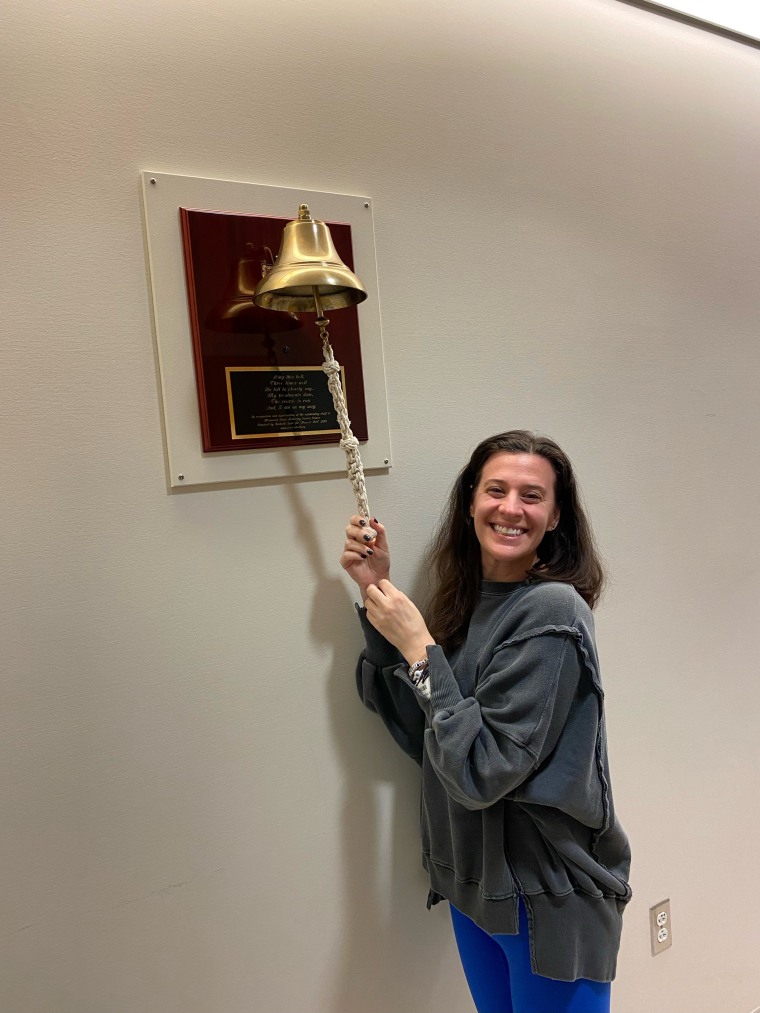 Lava ringing the bell after finishing chemo.Courtesy Jen Lava
“In October 2023, the stomach aches came back, and I knew. My best friend came to the hospital with me (to get) scans,” Lava recalls.
The cancer had returned, but this time it had invaded her uterine wall. “It was a whole new ball game,” she says.
Lava had 26 rounds of radiation and another surgery. Doctors performed a partial bowel resection, removing the affected parts of her colon and rejoining the healthy ends, and a hysterectomy.
“The part that I was most scared about was the ileostomy,” says Lava. This involves connecting the small intestine to an opening in the abdomen, so that waste can divert into a bag while the newly connected colon heals, per the Cleveland Clinic.
The ileostomy was temporary, and after three months, she had a reversal in 2024.
Lava was in the clear until 2025, when doctors found a spot on her right lung. She had an ablation to remove it earlier this year.
“I’ll never be cancer free. The best I can be is ‘NED,’ or no evidence of disease,” says Lava.
“It’s basically the same as remission,” Dr. Andrea Cercek, a gastrointestinal medical oncologist and Lava’s doctor, tells TODAY.com.
“The five-year survival rates (for Stage 4 colon cancer) are low, probably around 20%, and we’re making some progress, but it depends very much on the individual and their tumor,” says Cercek.
Lava says she hopes to reach NED status in April 2026, almost at the seven-year mark from her diagnosis.
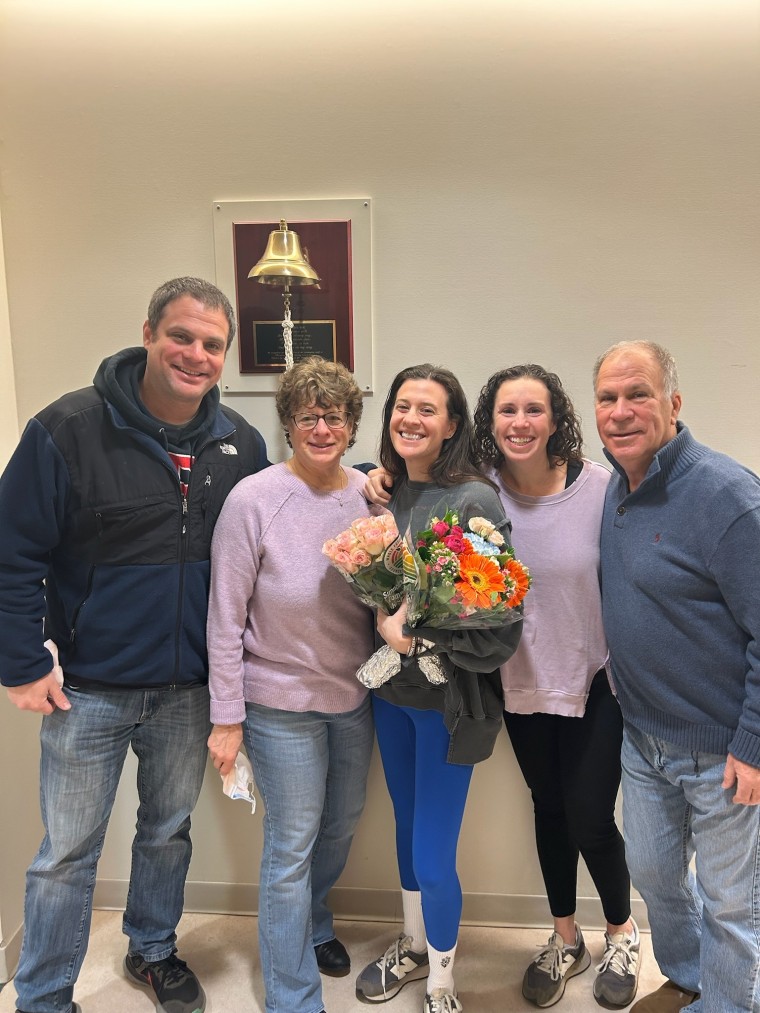 Lava celebrates finishing chemo with her family.Courtesy Jen Lava
“I am truly fortunate. (My care team) has made me feel so much better in a situation that is so scary,” says Lava.
Colorectal Cancer on Rise in Young People
Lava is part of a growing number of early onset colorectal cancer patients in the United States.
The incidence of colorectal cancer is rising 3% every year among adults ages 20–49, according to a new report from the American Cancer Society. It’s also the leading cause of cancer-related death among people under the age of 50 in the U.S., per the ACS.
The vast majority of these early onset colorectal cancers are diagnosed at an advanced stage, like Lava’s.
Many of these patients have no lifestyle or genetic risk factors to prompt screening before the age of 45, at which routine colonoscopies are recommended.
“Minus the cancer, I was very healthy, and I had no family history. They also did a full genetic panel, and I tested negative,” says Lava.
“She was very young, even on the young end of the spectrum for early onset cancers,” says Cercek.
The reasons for the rise in early onset colorectal cancers aren’t exactly known.
“The first thing my oncologist said to me was, ‘You didn’t do anything wrong because we don’t know what is causing this,’” says Lava.
Early Symptoms Can Be Missed
In the early stages, colorectal cancer often causes no symptoms — and when it does, these can be subtle. As the cancer progresses, it may cause changes in bowel habits, abdominal pain, bloody stools, cramps or unexplained weight loss.
However, these symptoms can also be misdiagnosed as other health issues, such as IBS or hemorrhoids.
“It’s very common, unfortunately, to present with pelvic pain and think it’s gynecological symptoms, like a heavy period or endometriosis,” says Cercek.
Even when there are symptoms the road to diagnosis can be long. “There’s some data that most young adults under screening age take a long time to get diagnosed, usually many months,” says Cercek.
This is often due to a combination of patients dismissing their own symptoms and providers not screening. “Patients get passed around from from physician to physician and get various workups, until finally they land in the ER,” says Cercek.
Cercek says these delays may explain why so many young adults are diagnosed with more advanced cancer, but more research is needed.
As for Lava, she didn’t have obvious early signs as the cancer was slowly growing in her body. But she encourages anyone who does to get checked out.
“It’s not always going to be cancer, but you don’t know, so advocate for yourself. Ask questions. Keep going,” says Lava.
 It was important to Lava to laugh and stay positive through her cancer treatment.Courtesy Jen Lava”You didn’t give me cancer.”
Lava credits the support of her family and friends, along with her “all star care team,” for getting her through. But having a sense of humor has also helped tremendously.
When she first discovered her melon-sized tumor, she gave it a name: Carl. She cursed at Carl often. She makes a lot of poop jokes and laughs at herself often. Lava documents her journey in a blog, called, “That’s OK, you didn’t give me cancer.”
The name is inspired by her favorite response to people who apologize when she tells them about her diagnosis.
“It kind of breaks the tension and let’s them know that it’s OK to make jokes. Some of the times I’ve laughed the hardest in my life were when I was in the hospital,” says Lava.
“Before I got sick, I heard someone talking about having a negative attitude in a bad situation, how you’re suffering twice, and it always stuck with me,” she adds.
While Stage 4 colorectal diagnosis is no longer a “death sentence,” it can still be devastating, especially at 34, Cercek points out.
But “you’re allowed to be happy,” Lava says. “We’re allowed to laugh. You can’t control cancer, but you can control your attitude.”