
“In many ways, it looks like New Zealand is starting to behave like an acolyte. We’re being inconsistent.
“And I actually think that puts us at risk. It means that we’re squeezable.
“I mean that if we are not being clear that we stand up for the rule of law and stand up against human rights violations regardless of who’s committing them, then we’re potentially under more pressure to turn our position.”
Foreign affairs is a role that usually goes to a well-established senior MP, but Walters is a relative newcomer.
She did a term as MP for Upper Harbour in northwest Auckland when Labour’s handling of Covid-19 swept it to a majority Government in 2020.
She was voted out of Parliament in 2023 and was ranked fractionally too low for the list to save her, until former Attorney-General David Parker retired from politics in May last year.
She is also shadow Attorney-General and has responsibility in Labour for the spy agencies, the GCSB and the SIS.
So, who does she rely on as her sounding board in foreign policy?
She speaks a lot to former Prime Minister Helen Clark, she said.
“I’ve known Helen for some time now. We don’t always agree on every position, but she’s a wealth of knowledge, and certainly in my view has her finger on the pulse of many conversations that are happening internationally.”
She has also spoken with former Labour leader and former Foreign Minister Phil Goff since the termination of his job as High Commissioner to London for publicly criticising Trump.
She also speaks frequently to Colin Keating, who was the New Zealand representative at the United Nations in 1994 and chaired the Security Council that dealt with the Rwandan genocide.
“I always admire him because he did so much to try to drive UN action with regards to Rwanda, and he’s been a wonderful source of information for me too.”
Walters has already made her debut in Parliament in the new role, speaking in the debate on March 3 about conflict in the Middle East, three days after the United States and Israel attacked Iran, and leading a snap debate this week on how New Zealand would support opening the Strait of Hormuz.
She was concerned the wording of a statement issued last weekend by 29 countries, including New Zealand, suggested they were preparing to join a US-led coalition to clear the strait, which could lead to complicity in breaches of international law.
“The Government’s actions have been irresponsible, unprincipled, and do a disservice to New Zealand’s independent approach to foreign affairs,” she said.
Foreign Minister Winston Peters savaged her, calling her appointment “disastrous” and her arguments “puerile”.
“What absolute crap,” he said. “What absolute nonsense. New Zealand is not a party to this conflict, and we have absolutely no intention of joining it.”
Walters said later her approach was and always would be to play the ball, not the person.
“Given the seriousness of the issues in the foreign affairs space, I look forward to developing a mutually respectful cross-party relationship with the minister.”
Walters, 44, was born in Sri Lanka. She arrived in New Zealand in 1987 when she was 5. Her father was an accountant and her mother an economist.
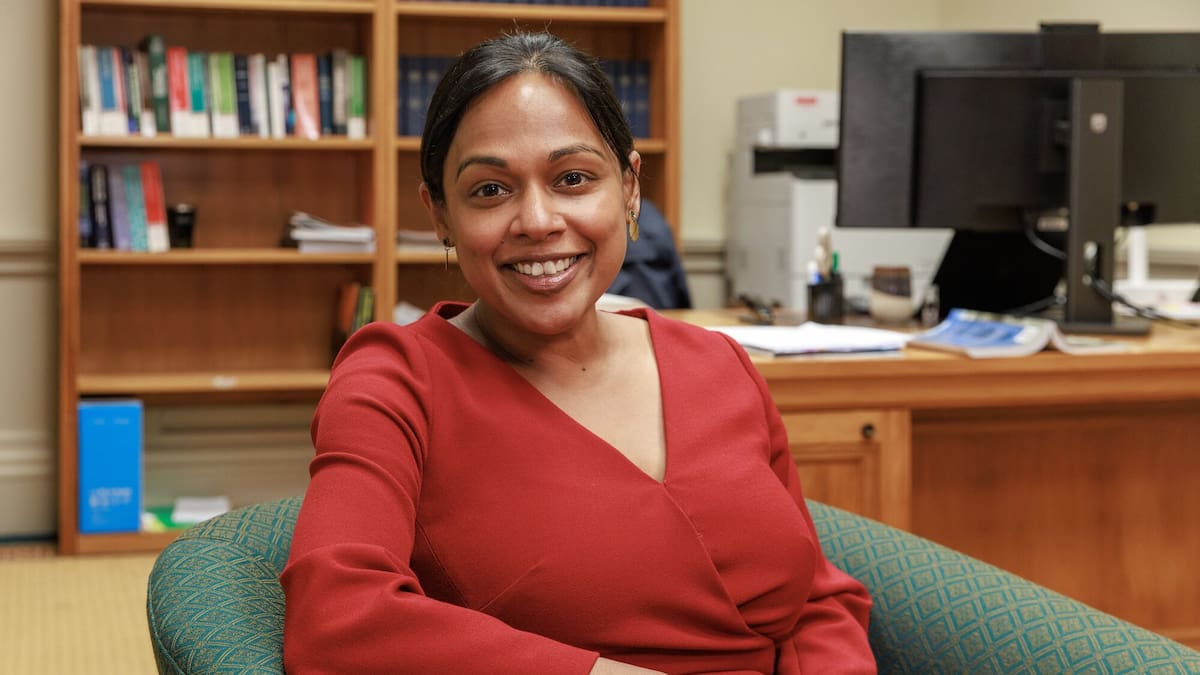
Vanushi Walters, in her office at Parliament, is concerned that New Zealand is becoming more “squeezable”. Photo / Mark Mitchell
They had spent the previous few years in Zambia, but her parents wanted to expand their careers and keep their three girls together rather than sending them to boarding school. Her mother’s sister also lived in New Zealand.
“So my first memories are of elephants and giraffes and Victoria Falls and crossing the border into Zimbabwe,” she said.
“Zimbabwe at that stage was kind of the breadbasket of Africa. And so we’d do our shopping at the weekends over there and head back.”
She started school in Zambia before moving to New Zealand with her parents and older sisters.
She did most of her schooling in Wellington but finished in Auckland when her father got a job at the North Shore City Council.
When Walters came to Parliament, she had served on Labour’s policy council and had well-established credentials in international law and the protection of human rights.
She has a law degree from the University of Auckland and a master’s degree from Oxford in international human rights law.
Vanushi Walters at her graduation from the University of Oxford in 2010. Photo / Supplied
The move into human rights was strongly connected to Sri Lanka.
She was about 12 or 13 and living in New Zealand when her mother told her about journalist Richard de Zoysa, who was her father’s second cousin and was vocal about human rights issues.
He knew he was being targeted by the secret police and, because of that, got a job with Reuters overseas.
“The day before he was due to leave, he was picked up and his body was found the next day on a beach just outside of Colombo. It made an extremely strong impression on me.”
As a schoolgirl, she got involved with Amnesty International. She got on to the New Zealand board and then the international board.
When she came off the international board, she did some consulting work for the international secretariat and went to Mongolia, the Philippines and Nepal “training the board and the senior executive directors on governance and management, issues, planning, separation of roles and functions, and then also mediating issues”.
Her first job after leaving university was to work at Chen Palmer law firm in Wellington, founded by Mai Chen and former Prime Minister Sir Geoffrey Palmer.
“I was there when Geoffrey was there, and for a glorious few months had the office right across from his, which was actually quite difficult to work from because he’s quite loud on the phone but in a very engaging, entertaining way.”
He was New Zealand’s representative on the International Whaling Commission at the time.
“And so just hearing some of his powerful advocacy in that space was rather extraordinary.”
She has worked at the Office of Ethnic Communities in Auckland, been a climate campaigner with Greenpeace in Britain, worked in community law, volunteered for Youth Law Aotearoa and worked for a year in insurance litigation.
She also worked with her husband, Rhys Walters, in his firm, Cogent Law.
Labour MP Vanushi Walters speaking in Parliament this week. Photo / Mark Mitchell
She recalls vividly the day she decided to leave private practice. At lunchtime on March 15, 2019, she was in Auckland watching a climate march by school students up Queen St, the same day as the mosque massacre in Christchurch.
“I always remember going from this incredible high, kind of feeling like this is a generation who will stand up for the environment… to being on the train in the afternoon and starting to hear the news, what was happening in Christchurch.”
She decided then she needed to get out of private practice and go into race relations and back squarely into the protection of human rights.
A few months later, she took a job as adviser to Race Relations Commissioner Meng Foon.
She said visiting Christchurch with Foon after the killings was an extraordinary experience.
“The thing that I take the most out of it was the grace of the people who were there for everyone who was coming to visit… when they were still deep in grief.
“But what struck me apart from the mosques was visiting one of the childcare centres that had to, overnight, just massively increase the security for the kids, and who had lost members of their family as well.”
She became manager of the advisory and research teams at the Human Rights Commission, which suggested to her it would be appropriate for her to step down from Labour’s policy council.
She did, but said she instantly felt the separation from policy development.
And at the end of 2019 and into 2020, the party started having conversations with her about standing for Parliament in 2020.
“At that stage, I must admit I was still unsure. I always knew the work that I wanted to do, which really has been about protecting the rule of law, developing human rights architecture internationally and in New Zealand.”
She and her husband had three boys, the youngest of whom was 3 at the time – they are now aged 9, 12 and 14 – but with encouragement from the party president at the time, Clare Szabo, she decided to stand.
In the 2020 electoral swing to Labour, she won the Upper Harbour seat vacated by former Deputy Prime Minister Paula Bennett, but was beaten in 2023 by National’s Cameron Brewer, a former Auckland councillor.
In November this year, she will be Labour’s candidate for Waitākere, where she lives.
Between now and then, she will be meeting diplomats and foreign policy experts and developing new policy.
She believes the current Government, with Peters as Foreign Minister, has moved New Zealand closer to the United States.
“And I don’t think that it’s subtle in terms of the last four months.
“I think that we need to be concerned that New Zealand’s foreign policy is becoming less independent.”