
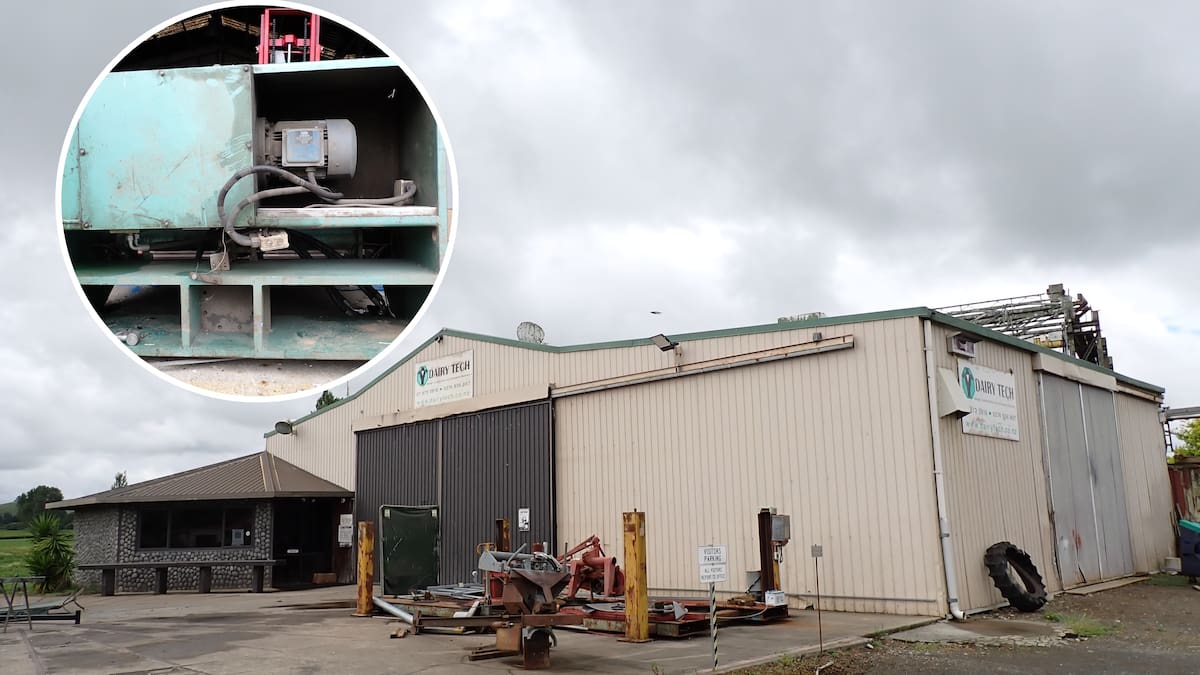
According to the court document, the victim’s family was at the hearing and gave victim impact statements, which were suppressed.
Peter Douglas Gray, the principal of Peter Gray Engineering, was also there. NZME understands he has since sold the business, which was operating as Dairy Tech Limited at the time of the incident.
Judge Matenga thanked those affected by the workplace incident for attending.
“It is not an easy thing to do and I hope that they will be able to move forward after this,” he said.
The court heard that on the day of victim’s death, he and other workers tried to move a 1.84-tonne press brake into the workshop.
The machine had been unloaded from a delivery truck using a forklift that morning, but the forklift could not fit through the workshop entrance while also lifting the press brake.
Employees instead tried to move it using two skates, a stacker and later a farm jack.
Workers lowered the press brake onto the stacker and skates and tried to pull it into the workshop.
The press brake that fatally crushed a young worker at Peter Gray Engineering. Photo / Supplied
But as the press brake was being moved, the right-hand skate became displaced after the stacker’s wheel passed over a crack in the workshop floor.
The victim got a farm jack and tried to lift the press brake to reposition the dislodged skate.
While using the jack, his efforts caused the machine to rock and shift the skate.
When he tried another full stroke of the jack’s ratchet mechanism, the press brake rocked backwards and then forwards.
This movement pushed the right skate out from beneath the machine, and the press brake slid off the stackers’ forks, fell towards the victim and trapped his torso and legs beneath it.
He died at the scene due to crush injuries to his chest and abdomen.
‘A lack of appreciation of the risk’
WorkSafe’s investigation found that the company had not undertaken an effective risk assessment for transporting the press brake, had not ascertained its actual weight and had not identified safe alternative means of moving it.
Judge Matenga’s notes stated that the stacker used was rated to one tonne, well below the weight of the press brake, and the skates were unstable and unsecured.
“The methodology used exposed workers to a readily foreseeable risk of death or serious injury,” he said.
“WorkSafe’s expert concluded that safer methods of moving the press brake were available, including using the forklift inside the workshop once the area was cleared.”
The expert further noted that the skates were poorly positioned, the farm jack was not used properly and the workers placed themselves in dangerous positions throughout the operation, the judge said.
In sentencing the company, Judge Matenga said it previously had a good record and an established safety framework.
The workshop, where the press brake was being moved into. Photo / Supplied
“The real problem here was that proper and careful thought was not given by the defendant to the task at hand,” he said.
“There was no real appreciation at all of the weight of the press brake or the challenges and risk moving it into position into the workshop would present.”
The judge said that was evidenced by some of the workshop area being cleared, but not enough to use the forklift inside, and the use of workaround tools, such as the stacker, was under-rated for the weight of the press brake.
“Then the decision to use the jack when the skate’s progress was halted by the crack in the floor again shows a lack of preplanning and consideration of that whole move of what is a very heavy piece of machinery into place within the workshop area.
“It all gave me the impression that it was all very ad hoc and there was a lack of appreciation of the risk.”
However, the judge accepted it was not a “wholesale departure”.
“It was a foreseeable risk, but I do not accept the WorkSafe submission that it was obvious in the sense that WorkSafe are suggesting but clearly a foreseeable risk and should have been planned for.”
The judge’s sentencing decision took into consideration the company’s previous good behaviour, cooperation, the reparation to be paid, and its guilty plea.
He said the relevant parties had agreed that emotional harm reparation of $140,000.04 should be paid to the victim’s family.
An order was made for the company to pay his paternal side $77,777.80, and four payments of $15,555.56 to his maternal side.
Peter Gray Engineering was also ordered to pay a $9000 fine and $7092.68 in costs.
Nigel Formosa, WorkSafe’s central regional manager, said the tragedy highlighted a risk seen too often in small workplaces – jobs that fall outside day‑to‑day routines are tackled without enough planning, the right equipment, or clear safety controls.
“Small businesses often rely on experience and problem‑solving on the job. But when heavy machinery is involved, improvising can have fatal consequences,” he told NZME.
“Experience does not replace planning. Even skilled workers can be put at serious risk if the job hasn’t been properly thought through.”
Formosa said the case offered clear, practical lessons for small businesses across all sectors.
“This case shows why small businesses need to treat non‑routine work as high risk. Know the load, use equipment that’s fit for purpose, set the job up so safer methods can be used, stop and reassess when things change, and keep people well clear of crush zones.”
Tara Shaskey is an assistant editor and reporter for the Open Justice team. She joined NZME in 2022 and has worked as a journalist since 2014.