
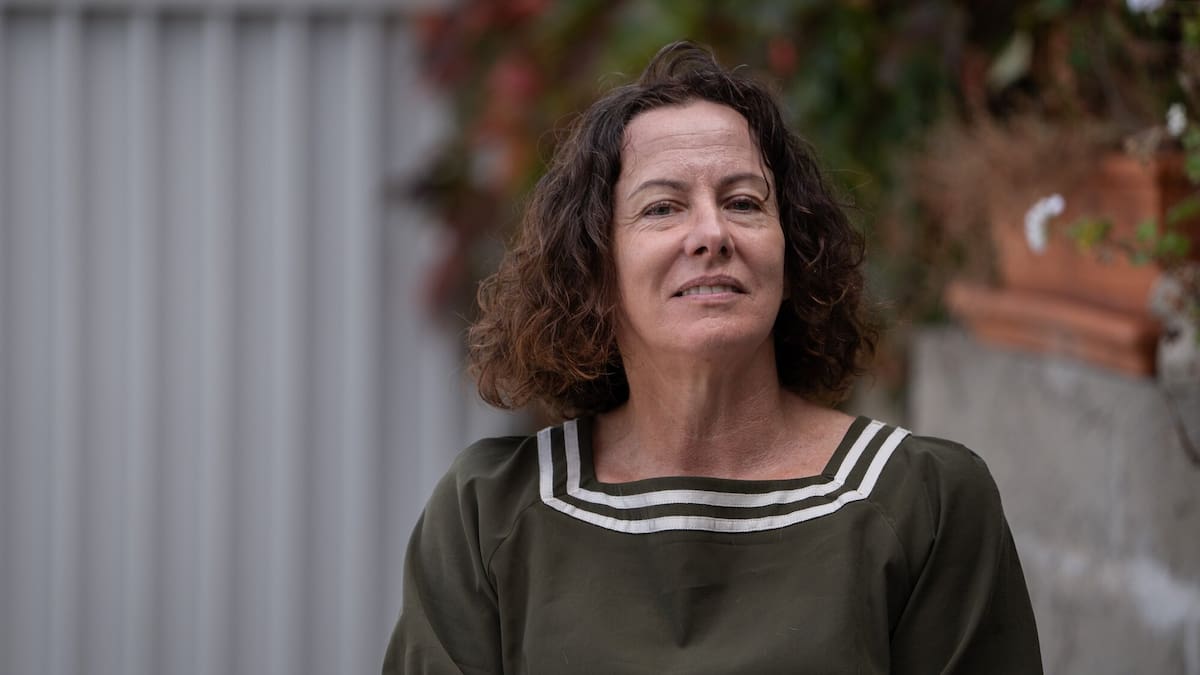
Twenty-two girls were rushed to Hastings Hospital, where a handful were admitted to intensive care. The most badly hurt, with serious head injuries and a severed spine, was Wenley. She’d just turned 16.
A boarder at Woodford House, a small private girls’ school in Havelock North, the sports-mad teenager had already run her first marathon and was captain of the cricket and hockey teams.
Now in her mid-50s and the mother of her own teenage girl, she has no memory of the crash that left her a paraplegic.
“I’d driven up to where the bus went over and it was just such a blank,” she says. “When I found the news story and played the tape, it still didn’t seem real.”
The bus rolled 20m down a steep bank, killing five people. Photo / NZME
Wenley’s new memoir, The Crash, is a personal reckoning with the accident, almost 40 years on, and the unresolved trauma others swept up in its aftermath still live with today.
The school itself closed ranks, believing the best way to deal with the tragedy was by maintaining a normal routine. Parents were not allowed to visit for two weeks, and boarders weren’t allowed to go home.
The day after the crash, a front-page story in the local newspaper reported classes had been held with pupils and staff “shell-shocked but putting on a brave face”.
One of Wenley’s close friends, who wasn’t on the bus, was sent to look after girls in the same boarding house as 11-year-old Belinda Pittar, one of two pupils killed. No counselling was offered in the weeks that followed, and she later suffered from panic attacks.
“We prefects had to get on with it,” she tells Wenley, who interviewed her for the book. “There was no time to grieve.
“We didn’t have assemblies or anything to talk about it. There were no chapel services to acknowledge the crash. There was this trauma that we never discussed, but it would never leave us – ever.”
When Wenley returned to the school in a wheelchair six months later, it was as if the accident hadn’t happened. A good friend had lost her younger sister, Kate Hutchinson, and been injured herself. They have never discussed it to this day.
Sally Wenley in her days as an RNZ reporter, interviewing lawyers Paul Gruar and Marie Dyhrberg outside the High Court at Auckland during a murder trial in 2002.
Wenley, an award-winning journalist, hopes her memoir will help crack open that cone of silence. Several old girls have already been in contact, wanting to share their own memories and ongoing distress after hearing about the book.
Guy Beamish, a local shepherd who was one of the first rescuers to arrive at the crash site, also gives a harrowing account of tending to the dead and injured. He, too, struggled mentally for many years afterwards and had flashbacks when he drove past the site.
“I’m not angry at the school,” says Wenley. “It was all ‘stiff upper lip’ back then, and dealing with emotions wasn’t a big thing. But I’m shocked by how much that horrific day still impacts so many people’s lives.”
Today, the Ministry of Education has traumatic incident teams based in all its regional offices. Schools are required to have an emergency response plan in place, including access to support, guidance and counselling.
Wenley, a keen boat skipper and fisher, with a snapper caught at Coromandel’s Waitete Bay in 2022.
Wenley, who lives in Auckland with her 17-year-old daughter, Georgia, and partner, Bruce, is travelling back to Havelock North next month for the launch of her memoir there and has been invited to address an assembly at Woodford House.
In 2022, a commemorative plaque dedicated to the five people who died was installed in the school chapel. The Kate Hutchinson Memorial Trust Award, established by her family, is presented annually to a Year 13 student, and planning is underway to mark the 40th anniversary of the crash next year.
Principal Julie Peterson acknowledges the “unbelievable trauma” suffered by Wenley, who was sports prefect at the time. She says the way schools respond to traumatic events has changed dramatically, with an emphasis on open communication and wraparound support.
At the time of the crash, Woodford had only one phone, and many students heard about the accident through news reports on the radio.
Woodford House principal Julie Peterson.
“The world was different, and I think people genuinely did what they believed was the best under the circumstances, which was to not talk about it – to internalise rather than externalise,” Peterson says.
“It really was a profound and very sad event for her to have suffered as a young person and for everyone else impacted, which was literally the whole school.”
In her memoir, Wenley gives a colourful and often brutally honest account of her life, navigating university and journalism school, travelling through Europe and the United States, and picking up multiple awards for her journalism.
A wild spirit before the accident, she struggled for many years with binge drinking and erratic, self-destructive behaviour.
It was only when she began researching the book that she discovered her neuropsychiatric symptoms – including addictions, extreme mood swings, depression, isolation and lack of empathy – were likely the result of brain trauma.
Wenley with daughter Georgia on the Hauraki Gulf in 2018.
“I think of Mum and Dad and how hard it must have been for them,” says Wenley, who lives with constant nerve pain from her spinal injuries. “I spent so many years being angry.
“It’s not an excuse for my behaviour, but I think it would have helped if I’d understood it more and so had the people around me.”
Some may be shocked by the more graphic elements of Wenley’s memoir, which reflects her direct journalistic approach and a wicked sense of humour.
The importance of telling her story honestly, even when it doesn’t reflect particularly well on her, is something she never questioned.
“I thought there’s no point sashaying around your bloody handbag, so I just started typing,” she says. “There’s nothing pretty about it, but I’m alive, and I’m doing pretty well. This is my life. This is me.”
Read an extract of The Crash in Canvas Magazine here.
The Crash by Sally Wenley (Massey University Press) is out on April 9.
Joanna Wane is a senior lifestyle writer with an interest in social issues and the arts.