
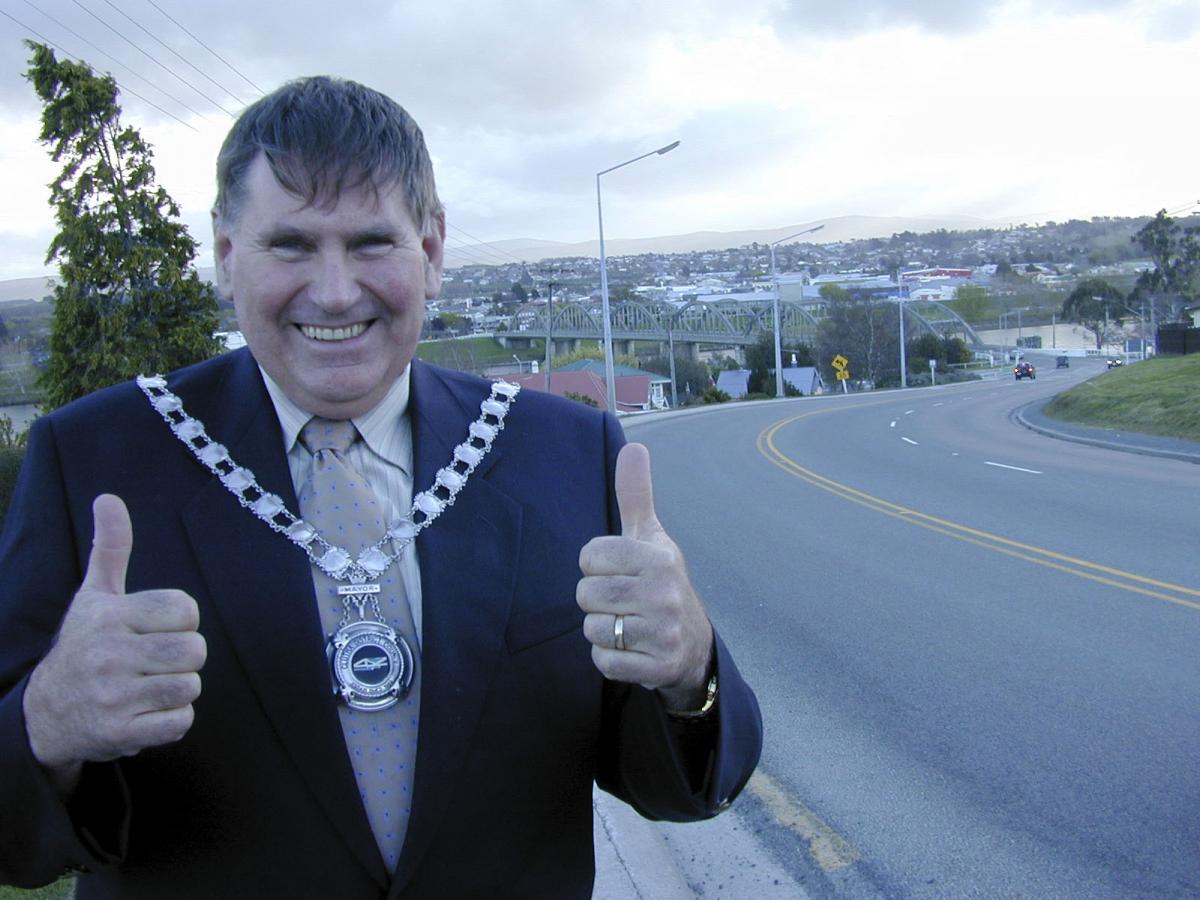
Juno Hayes was a builder.
As a sawmill owner, building and lumber was his business, but beyond that, in more than three decades in local government and a lifetime of volunteering, he was dedicated to building the Clutha community.
Most importantly, he built a large and loving family of eight children, 15 grandchildren and a great-grandchild.
The future mayor of Bruce District and then Clutha District was born Cyril Edwin Hayes on December 1943, the son of Cyril and Jessie Hayes.
He was the second of six children and the nickname by which he became universally known — ‘‘Juno’’ — came courtesy of his youngest brother, Mark. Cyril senior called the son named after him Junior, but the infant Mark Hayes could not pronounce that word, saying Juno instead. It stuck, and many people likely never knew it was not Mr Hayes’ actual name.
Although bright, the classrooms of Tokomairiro District High School were not for Juno Hayes. He left school the day before his 15th birthday and began working as a logging truck driver for a local sawmill.
A hard worker and a man who knew how to set himself goals, Mr Hayes dedicated himself to saving enough money to buy himself his first car. Two years later he was about to make that much-thought-about purchase, but Cyril senior intervened and asked his son to join him in setting up what would become the Hayes and Son sawmill.
The car savings became business capital, and Mr Hayes ploughed every hour he had into making the business a success. He worked all day, then much of the night by floodlight, going unpaid for two years to get the company established.
Mr Hayes focused on sawmilling and his father on logging. It was hard physical work but Mr Hayes never complained as he believed in what they were doing. He also took over part of his father’s forestry block, which Mr Hayes spent many hours carefully tending, and which he took real pride in.
Life was not all hard work, though. Mr Hayes loved sport and was a keen waterskier and a skilled axeman, excelling at the underhand cut.
Most of all, he was a true outdoorsman, never happier than when out deep in the bush or far out on the ocean waves. Throughout his life, Mr Hayes was an enthusiastic hunter, fisherman, climber, tramper, camper and skier, and took part in many an expedition with his brothers, sons and friends. He also had his pilot’s licence, enjoyed flying, and was an avid traveller.
Fiordland was a part of the world he loved, and in later years his brother bought the Uni, a 36m boat moored in Breaksea Sound, which became an annual holiday destination. Mr Hayes, a talented handyman, organised and did much of the renovation work on the vessel.
With the business on a stable footing, Mr Hayes decided to become a family man. He and his first wife had six children — Stephen, Christopher, Janelle, Glenn, Olivia and Matthew. The marriage ended in 1983.
With family responsibilities came a greater involvement in the local community, and in 1977 Mr Hayes was elected to the Milton Borough Council for the first of four terms. He eventually became deputy mayor.
In 1986, when council amalgamation led to the creation of the Bruce District Council, Mr Hayes successfully ran for the mayoralty.
Chairing the council came naturally to Mr Hayes: he knew how to address a crowd and had an empathy for what an audience was thinking and what they expected.
He aimed for what would now be called a collegial approach to local government, and in various interviews with the Otago Daily Times during his time in local government Mr Hayes stressed that what he wanted was a unified council.
Three years later the Bruce District Council fell victim to another round of amalgamation and Mr Hayes ran for mayor of the newly-formed Clutha District Council.
He was narrowly beaten by Keith Fyall, the Balclutha mayor. Of his 212-vote winning margin Mr Fyall said: ‘‘I said it would be close but I also knew if it was close I would win by a nose because I have the biggest one.’’
Mr Hayes had to be content with a place on the council, and served in that capacity until 1998, when Mr Fyall stepped down as mayor and Mr Hayes won the subsequent election.
In the meantime, in the mid 1990s he had conducted a shy courtship of local school principal Diane Findlay — so shy that a nervous Mr Hayes could not summon the courage to speak the first few times he called her, making his intended think that she had fallen victim to a prank caller.
Once Mr Hayes finally made his intentions known his kindness, loyalty and sense of humour meant that they fast became a couple.
They married on January 20, 1996, and it was a true partnership. Mr Hayes was dedicated and caring of Diane’s children, Jeremy and Rebecca, and of his new wife.
He called her ‘‘Sweet One’’ — a name he also later gave his boat — and if ever he was away from her Mr Hayes went to great lengths to call home and check in.
Settling into his new role as district mayor, Mr Hayes was guided by a deep sense of fairness and a desire to make things right.
That wasn’t always possible in the sometimes rancorous world of local politics and some divisive regional issues were talking points during the Hayes mayoralty — perhaps most notably the debate over a proposed regional stadium to replace Carisbrook.
With characteristic humour, Mayor Hayes launched a tongue-in-cheek campaign to relocate Otago rugby to Milton and build the ‘‘Tokobrook’’ stadium. It was never going to happen, but it gave the Clutha some positive publicity,
Another Hayes headline came when he challenged Dargaville, in the far north, over its attempt to adopt ‘‘Big River Town’’ — the slogan of Balclutha — as its own.
However, the biggest issue of his mayoralty was the proposal to build a new prison near Milton. The Corrections department’s plans were not universally popular, and Mayor Hayes had to balance the concerns of fearful opponents with the enthusiasm of proponents who expected an employment boost for the town.
Mr Hayes played a central role in negotiations during 2004 and 2005 between locals and the government on a set of safeguards and conditions before the project went ahead.
Local government was not Mr Hayes only community service.
He was a proud Rotarian (having joined in 1969) and received two Paul Harris Fellow awards — one the sapphire award for outstanding commitment and service to others.
He was also a St John ambulance driver for more than 25 year and served on the organisation’s executive, helped establish the Milton Medical Centre and chaired a fundraising committee which raised $130,000 for a new Milton pool.
Mr Hayes was also a Justice of the Peace and marriage celebrant.
Mr Hayes had easily won re-election in 2001, beating Vanessa Robertson-Briggs by a comfortable margin, but he faced a sterner challenge in 2004. It had been widely expected that Mr Hayes would be returned unchallenged but at the last minute Balclutha councillor Bryan Cadogan threw his hat in the ring.
Mr Hayes prevailed, by 3857 to 2899, and told the Otago Daily Times he was “relieved but absolutely elated” to have retained the mayoral chains,
‘‘We’ve got heaps to do, but we’ve got an excellent council and I’m privileged to be able to lead it.”
In 2007, Mr Hayes was returned unopposed as mayor, making special mention of how lucky he felt he was to lead a district council that was at the top of its game.
‘‘The council is a great organisation and a wonderful team which I think is a hallmark of what makes the Clutha district a great place to live.’’
It had been widely anticipated Mr Hayes, by then in his mid 60s, would retire in 2010. He had told the ODT it would ‘‘almost virtually’’ be his last term in the office and that his deputy, Hamish Anderson, would make a fine mayor.
Mr Hayes did indeed announce, on August 6, 2010, that he was stepping down saying ‘‘I will miss it like hell’’.
In fact, he decided he would miss it too much and a fortnight later — encouraged by strong community support — Mr Hayes decided to run after all.
‘‘‘The amount of contact the public has had with me … It’s been quite humbling the number of people who have contacted me,’’ he said.
However, that did not add up to enough people for him to win again: his old rival, Mr Cadogan, turned the table on Mr Hayes, winning by 354 votes.
Mr Hayes was philosophical in defeat, saying ‘‘That’s the way voting goes sometimes … I know I didn’t do myself a lot of good by announcing I was standing down, but then all those people said I should stand.’’
In 2011, the Hayes sawmilling business, by now renamed Bruce Sawmilling, was sold, Mr Hayes telling the ODT he now had ‘‘a bit more time for fishing and hunting’’.
In the 2014 Queen’s Birthday Honours, Mr Hayes was made an Officer of the New Zealand Order of Merit for services to local government and the community.
Mr Hayes was particularly proud of the fact that in the same honours list his brother, helicopter pilot and businessman Richard ‘‘Hannibal’’ Hayes, had become Sir Richard.
Diane was still working, but Mr Hayes’ retirement meant the couple had time for regular trips to Hawea and Nelson, an annual holiday to Australia, and a once-in-a-lifetime trip to Europe.
For the final eight years of his life, Mr Hayes was afflicted by Alzheimer’s. He remained at home, looked after by his wife and a team of family, friends and carers.
He died on January 12, aged 82.
— Mike Houlahan