
Researchers at Leiden University have developed microrobots that can move, navigate, and adapt without a brain, sensors, or software. Their behavior is driven entirely by their physical structure and interaction with the environment.
The robots are only a few tens of micrometres long, much smaller than the width of a human hair. Despite their size, they can swim and respond to obstacles in ways that appear life-like.
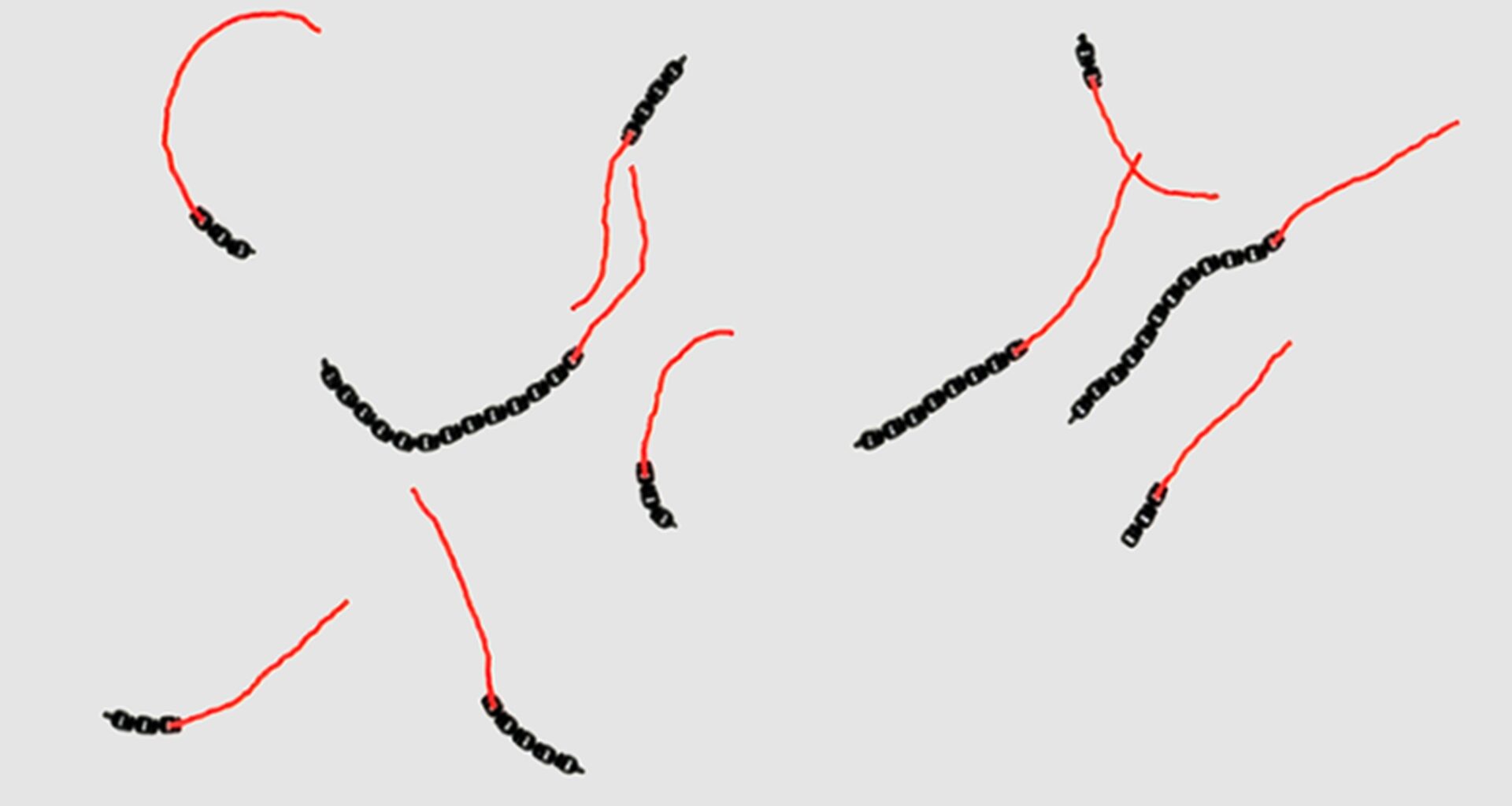
The team led by Professor Daniela Kraft and researcher Mengshi Wei built the robots as flexible chains of connected segments. When exposed to an electric field, the structures begin moving on their own.
Instead of relying on electronics, the robots use their shape and flexibility to generate motion and adjust to their surroundings in real time.
Nature inspires flexible motion
The concept is based on how animals move. Worms and snakes change their body shape continuously to move through tight and complex spaces.
“Animals like worms and snakes constantly adapt their shape as they move, which helps them to navigate their environments. Macroscopic robots similarly use flexibility for their function. However, until now, microrobots were either small and rigid, or large and flexible. We wondered if we could realize small and flexible microrobots in our lab,” Kraft said.
To create the robots, the team used a high-precision 3D microprinter. Each element is about 5 micrometres in size, connected by joints as small as 0.5 micrometres.
The structures are built as chains of self-propelling elements that collectively generate motion. Once activated, the robots move at speeds of around 7 micrometres per second.
The fabrication process uses advanced microprinting systems capable of operating at the limits of current manufacturing, enabling both flexibility and structural precision at extremely small scales.
When activated, the robots move with a wave-like motion. Their flexible design allows them to bend and propel forward without programmed instructions.
Shape drives smart behavior
The researchers found that the robots’ movement and shape constantly influence each other. This feedback allows them to adjust automatically when conditions change.
“But that was not all,” adds Kraft.
“We discovered there’s continuous feedback between the shape and motion of the robot: the shape influences how it moves, and its movements in turn alters its shape. This microrobot therefore senses how the environment changes its body and reacts to it, making it appear life-like. This means that we don’t need microscopic electronics for integrating smart abilities,” Kraft said.
The robots can avoid obstacles and change direction without any control system. They can also move through crowded environments and push objects out of their path.
“When the robot is slowed down or even stopped, it starts to wave its tail as if it wants to break free,” Wei says.
Researchers say the technology could support applications such as targeted drug delivery and minimally invasive procedures. The next step is to better understand how such behavior emerges from simple physical interactions.
The study was published in the journal PNAS.