
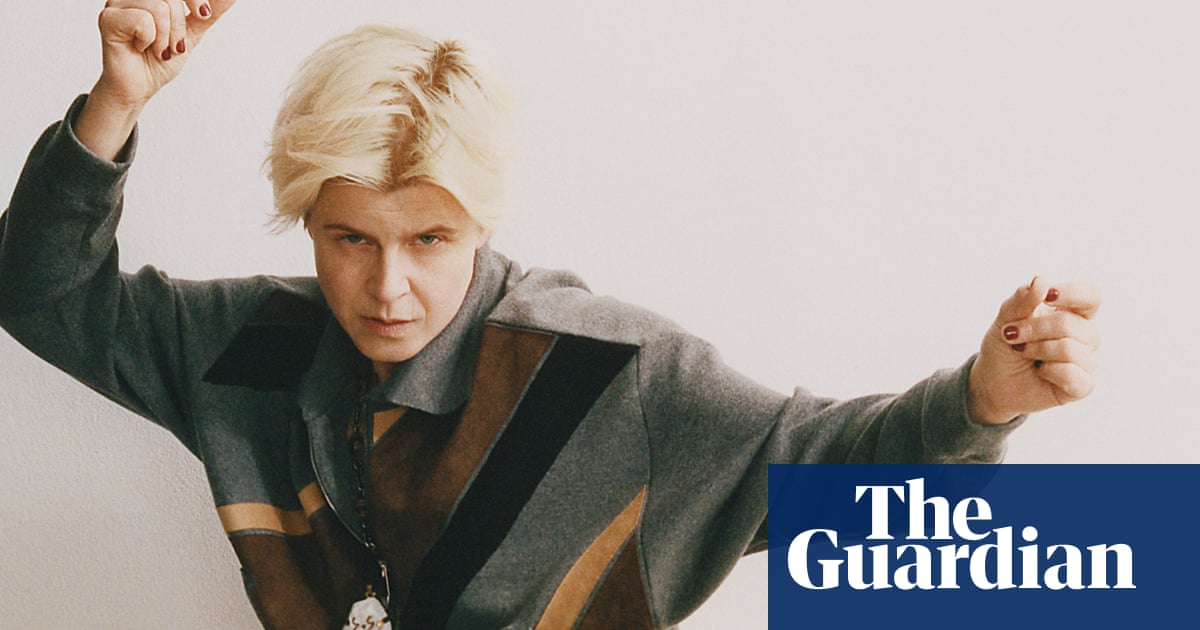
Robyn sits silently, eyes closed, for what feels like a full minute. “Wow,” she says. “This is really deep” It has been eight years since this elder stateswoman of alt-pop released music. She is talking about how, since then, her life has fractured and reassembled. The 46-year-old Swede’s previous album, Honey, was finished in the afterglow of repairing her engagement to director Max Vitali. Now, she’s no longer in that relationship, she’s raising a three-year-old son, Tyko, whom she had by IVF, on her own, and she has also reckoned with the scars of her own childhood, growing up in an exploitative music industry.
We meet in a breezy attic above a recording studio in London to talk about her new album, Sexistential – an ode to letting your guard down and feeling things deeply. “Defending my right to be myself and be vulnerable,” she says. She’s wearing biker boots and a mesh hoodie, and has tucked a bomber jacket, two overflowing handbags and a black leather sailor hat into the nooks and crannies of the sofa as if constructing a nest around herself. She’s thrilled to be back. “I’ve never released an album as a parent, so it’s really exciting to work.” She laughs, flashing a chipped tooth. “When I do get time for myself, it’s liberating and fun.”
It’s hard to imagine modern pop without Robyn. Born Robin Carlsson, she was signed at just 14, and groomed to be a teenybopper R&B star, the prototype for artists such as Britney Spears and Christina Aguilera. Then she walked away from the manufactured machine, set up her own independent label, and proved there was a way to make pop autonomously. A whole generation of artists – from Gracie Abrams and Lorde to Charli xcx, Carly Rae Jepsen and Harry Styles – are evangelical about her influence, both as an industry reimaginer and maker of very good songs. “I would never want to take credit for any of that,” she says when I mention this. She sits with her chin in her hands, elbows on her knees, furrowing her brow to emphasise her points.
Still, her back catalogue of synth-injected sad bangers – heartbreak anthems sung over ricocheting club beats, including Hang With Me (about a situationship), Call Your Girlfriend (being the other woman) and Dancing on My Own (seeing an ex‑partner), are so intrinsic to the millennial experience that Lena Dunham bookended her seminal TV show Girls with her music. “I’m in the corner / watching you kiss her” played as Dunham’s character Hannah Horvath danced around her bedroom with housemate Marnie Michaels in episode three, and cult TV history was made.
“Some people said that Girls popularised that Robyn song, but I’d actually say that Robyn popularised Girls,” Dunham tells me. “They will probably play it at my funeral and I’m really, really OK with that.” She thinks Robyn belongs in the same canon as Björk, PJ Harvey, Bette Davis, Kate Bush and FKA twigs, “as women who have not found a niche but created an entire universe”.
And it’s not just millennials who love Robyn. When Charli xcx brought Robyn on stage to sing Dancing on My Own at London’s O2 Arena during her Brat tour in 2024, it caused a frenzy among the largely gen Z crowd. “The moment I stepped out, I just had this wall of screaming,” Robyn says, her eyes widening. “I couldn’t believe it.”
Robyn in 1997 (top) and with Rahim Redcar, formerly known as Christine and the Queens, and Charli xcx in 2020 (above). Photographs: Ron Galella Collection; Dave Benett, both Getty Images
Robyn hadn’t intended to take so much time away from work, she tells me. In 2020, she was desperate to throw herself into making new music. The Honey tour had been punishing. “I had just mended my relationship, and then it fell apart.” Performing the record while heartbroken was challenging. “I just wanted to work, but the pandemic hit and, like everyone else, I had to quarantine – although, in Sweden, it was very different.” (Less a stay-at-home order and more a ban on large gatherings and travel.)
She was offered a studio room at Max Martin’s Stockholm recording space. She had worked with the super producer and Taylor Swift collaborator as a teenager and in her late 20s. (He was “graceful” to work with even back then, she says, but he’s more relaxed these days.) She loved being at the studio, “because there was this sense of community and I could start working again, which was really exciting. At the same time, I was dating, which was difficult in the pandemic, and I was doing IVF as well.”
Robyn had always known she’d wanted to be a parent. “I thought it would happen much sooner,” she says. “But then I think motherhood in a conventional heterosexual relationship, in my life at least, has been really hard to reconcile with what I think I would have to do to make that work.” What was that? The unequal split of labour? “Definitely the split of labour, but also …” She pauses. “I would have been able to accept things that weren’t great in a relationship without children. But, when kids exist, every single thing that the other person does is so important.”
double quotation markThe idea of having children in the relationships I was in felt like a very risky thing to doPortrait: Daniella Maiorano/The Guardian. Minidress: Dsquared2. Bikini: Rabanne. Shoes: Acne Studios
She adds: “The idea of having children in the relationships I was in felt like a very risky thing to do. I just felt [like] that was more scary than waiting.”
She had frozen her eggs at 34 – “because I wasn’t certain that I was in a relationship that would support my wish to become a mother” – but she’d done it in America. She couldn’t access them during the pandemic, so had to begin the harvesting process again. “And I was older. I didn’t know if it was going to work. I did a few rounds. It was a fucking rollercoaster, but also it makes you think about things that you otherwise wouldn’t. What is my identity as someone with children, and what is it without? It’s extremely existential.”
Doing it alone complicated things further. “I had seen myself having a kid in a stable relationship. I was sad to let go of that. It felt like a failure.” While pregnant with Tyko she tied herself in knots. When he needed a male role model, what would that look like? Would she be able to defend her decision to have him on her own?
double quotation markIt’s very, very taxing to be a single mum or dad. I grew up that way
“I don’t think any human being can say, ‘I have a right to have a child.’ But if you want it, you can’t really question your desire to be a parent. You can question how you do it and who you do it with, but you can’t question the actual need.”
She reaches into a handbag for a nicotine pouch and pops it into her mouth.
“It’s like saying, ‘Why are we here?’”
I say I read somewhere that one of her biggest fears was ending up a single mother. Why does she think that is? “It’s very, very taxing to be a single mum or dad. I grew up that way.” Her parents broke up before she was 11, and she and her younger brother and sister split their teen years between their homes in Stockholm, where Robyn still lives. “My mother was tired and she was struggling, and I just didn’t want to repeat things that I’d been through as a kid.” What kind of things? “I don’t want to expose my mum. She’s a great mum, but, you know, just the lack of time, the lack of energy to be present, to not feel happy with your situation.”
How was IVF for her? “It is pretty hardcore. It’s definitely a challenge, physically and psychologically.” She puts on a comedy sad voice as she adds, “But ‘boohoo, I had to do IVF’, it’s also a privilege. The fact that it’s even possible! It’s something that costs money, and a lot of people don’t even have the option.”
On Sexistential, she raps about being on the dating app Raya while having the injections and tests needed for IVF. (The record title – a hybrid of sex and existential – nods to this juxtaposition.) Did deciding to have a baby alone change how she approached dating?
“I think maybe having children and having a relationship are two very different projects. They’re not the same thing at all. Flirting, hooking up while I was pregnant, and not even telling people I was pregnant felt great, because I didn’t need to share that.” It was a sexual awakening of sorts. “When there isn’t as much at stake, sex becomes more fun.”
Was it ever difficult to juggle hook-ups with the side effects of IVF? “Well, sometimes you can’t have sex because you’re super fertile, you have 20 eggs growing in your tubes.” Her body started to feel like a machine. “That was one of the weirdest and most absurd experiences with the IVF.”
She poured all of this into the album. It is longing and urgent with bright synths, beats pulled from sweaty dancefloors and lyrics exploring loneliness, heartbreak, sensuality and abandon: “My body’s a spaceship with the ovaries on hyperdrive / Got a whole universe inside that exists in between my thighs / Do I have the consistency to persist and finish this ride?” She remembers listening to a lot of Prince and the US band Suicide as she was writing, getting excited by guitars and riffs. She’d been stockpiling songs that sounded like that for years – including Dopamine, Sexistential’s sad-happy first single – but they hadn’t been right for Honey. That album’s dreamy club hits had been a rejection of her public image. “I was tired of this broken-hearted character that I was portraying all the time, and I tried to really move away from that,” she says. This time, something changed. “I saw this heartbroken archetype, on Dancing on My Own, as an asset. The thing that I had been maybe embarrassed about, you know – always being so sad.”
Robyn spent her earliest years touring Sweden in a VW minibus with her parents, Wilhelm, a director, and Maria, an actor and director, in the experimental theatre group Teater Scheherazade. “It was a very cool environment to grow up in,” she says. “I remember not being bored, but just having this sense of endless time. My parents believed in creative freedom. They were very ideological in that sense: defending expression, not making theatre with a commercial purpose. I think that environment made me used to certain things that were very hard to find when I started working in music.”
She was singing a song she’d written about her parents’ divorce in a school assembly when she was discovered by Swedish pop star Meja Kullersten and signed a deal, ending up at Jive Records, which later became a subsidiary of BMG. She had a platinum album in her homeland before she turned 18. She opened for Tina Turner aged just 16. (“I had this feeling of, ‘I’m just a little shit, like, I’m just a little fart in the universe, next to this woman.’”) She went on roadshows in the UK – playing coastal towns with the Spice Girls – and in the US with Destiny’s Child and ‘NSync.
Watching clips of her from around this time, she’s every bit the squeaky-voiced teen idol – bopping to You’ve Got That Somethin’, in a matching tan suede coat and bootcut trousers. She’d often end up in different time zones from anyone she knew back home, and international calls were expensive and difficult to organise. She remembers sound checking at an arena with Destiny’s Child thinking about how focused they were, how “American” compared with her. “I just felt like a UFO. And I was there by myself, without my parents. It was scary and confusing.”
Even when she was able to reach her family, “I was having a lot of very formative and big experiences, like learning how to decipher this whole new culture, and just never really having – which I don’t think you have at that age – the language to translate that to anyone at home, either.” It sounds really isolating, I say. “Very isolating. That’s why I checked out. I just couldn’t do it. I wasn’t built for that.”
I’ve heard talk about how she started out in the industry before the #MeToo movement. What were the men she was working with like during this time? “Fortunately, I never had any experiences that could be labelled as abuse. But there was an environment and a culture that was disgusting, and the language around my body, or how grown-up men would talk about pictures and images, about styling, about sexuality …” she grimaces. “It was extremely brutal and intimidating, and my way of dealing with it was just putting on armour. I didn’t want to show my body, I didn’t want to even experiment, which I think is sad.”
double quotation markI don’t want to sound like a snob, but I’m not interested in commercial pop culturePortrait: Daniella Maiorano/The Guardian. Sweater: Bless
When Robyn talks about motherhood, it feels as if she’s carefully placing every word in each sentence, often pausing to recalibrate. Now, she’s letting rip.
“Of course, I look at it as, like, ‘Oh, that was great that I had the strength to do that.’ And Billie Eilish is a great example of how it’s still possible and needed to shut that down when you’re a young artist, if you want to keep your integrity. But it’s sad because you do have a sexuality when you’re 16. You do have a playful, sensual side as a young woman that can still be interesting and beautiful, but it wasn’t at all possible for me to explore that.”
She remembers one particular time, being in a room full of men in their 30s and 40s, with no other women present. “They were talking about how they wanted me to show my ‘youthfulness’, which meant more skin.” She was aware of how grotesque that was; she even joked about it with her friends at the time. “But in those meetings, they weren’t even thinking about it as being embarrassing. There was no one on the other side that would defend my perspective, so my strategy was just keeping them at arm’s length.”
An article from 2003 described one of her record labels as “Sweden’s Lolita-pop doll house”; language like that was used all the time back then, she tells me. “You were interviewed about your body and the way you look; Howard Stern talking to women about their weight. Just this culture in the 1990s that was disgusting.”
It took years of psychotherapy to fully process the effect that decade in the machine had on her. The relationship between her and label bosses deteriorated rapidly. Her second album, My Truth, in 1999, included Giving You Back, a song she wrote about having an abortion. It was never released in America.
“You would have to ask them if it was specifically because of that song,” she says. “I think I also made an album that just wasn’t as commercial as my first. They realised I was going to be a tricky artist to work with. I know for a fact that they had a big problem with the subject matter, and there were discussions about, ‘If we release it, we’re going to have to take it off the album.’”
Robyn in concert in 2019. Photograph: Gary Miller/Getty Images
It took a long period of negotiation in order to get her out of her final contract. She managed to quit in 2005, giving up the right to royalties. She is very grateful to have got out. Max Martin would go on to write for another teenage pop wunderkind, Britney Spears. Robyn recorded the demo and backing vocals for Piece of Me, the single Spears wrote about her fame-induced breakdown. Did she ever compare their diverging trajectories?
“It wasn’t even something I had to process later. I was aware of it when it was happening. And I was just lucky that I was brought up in a very different context. There was no interest from my family for me to have a career. [My parents] were like, ‘We just think you’re crazy – why do you want to do this?’ That protected me.”
She tells me she was recently looking at an old record contract with her lawyer and discovered that her artist deal had just a 6% royalty. “It’s insanely little. It’s unheard of nowadays,” she says. The average is up to 25% for sales. “These insane inequalities between artists and the industry have got better. Although the whole streaming thing is another problem.”
The sense of relief she felt when she left was massive. She remembers watching MTV during that time and seeing videos from Spears and Aguilera. “It was basically Instagram before Instagram for me, comparing our lives. But I just knew that I was never going to do this. I knew I wasn’t going to be able to go back to that kind of environment.”
Robyn with songwriter and producer Klas Åhlund, 2011. Photograph: Campbell Black/ WireImage
The world Robyn has built for herself is totally different. She still runs her own label, Konichiwa Records. She has writing credits on every song on Sexistential, and production credits on most, alongside Swedish hardcore rocker Klas Åhlund, “the second member of the band Robyn”. Her performances are often playful – she might salsa, tumble across a floor or pretend to be a bull. Her first TV performance of Sexistential, on The Late Show with Stephen Colbert in January, saw her grind the stage in a studded leather vest.
How does she think the current pop landscape for women compares with when she started out? From the outside, it seems as if artists such as Rosalía are able to be more individual?
“Just the fact that people are not expecting female artists to be a certain thing is cool. You expect diversity and you expect expression.” She takes a long breath. “I love it, but I don’t relate to this very commercial layer of pop. I don’t want to sound like a snob. I’m not talking about Rosalía specifically, because I think she’s amazing, but I don’t see all us girls as the same thing. I’m not interested in commercial pop culture.”
She doesn’t see big female artists as her peers. There’s a group of musicians in Sweden she leans on as a support network, including singer-songwriters Frida Hyvönen and Jenny Wilson. The rapper Yung Lean is a neighbour. Charli xcx is a close friend, too, despite their 13-year age gap. “Whenever we meet, it’s not, like, ‘Oh, I got you, because you’re a girl and we have the same experiences.’ It’s never been that – it’s been a real personal connection,” she says of the British star.
Robyn is considered but firm. She ruffles her white-blond bowl cut whenever she thinks deeply. Over the course of our conversation it has gone from lightly tousled to the unruly mane of a pop-punk band member.
I wonder how she feels about ageing. Music is not an industry known for welcoming women in midlife who want to explore their sexuality on their own terms. “I don’t have this feeling at all that my age is defining me. It’s more the other way around. I think that it’s starting to define me less and less.”
Still, it’s not as if we’re living in an era of age positivity. It feels as if the pressure to be smooth of face at every stage of life is only increasing. Sitting opposite Robyn now, it’s striking to see a pop star with smile lines and soft creases in her forehead as she talks.
double quotation markSometimes you can feel, as an older woman, that there’s this desert, there’s this man desertPortrait: Daniella Maiorano/The Guardian. Jacket: Robyn’s own. Jeans: Helmut Lang, courtesy of Dossier LDN. Shoes: Maison Margiela, courtesy of Jessica Temple at For The Soup
“I have no problem with Botox,” she says. “Do whatever you want, seriously. The sad part is that sometimes you can feel, as an older woman, that there’s this desert, there’s this man desert. Are there any men out there who understand and appreciate and feel curious about what it’s like to be a woman over 40? I think there are.” She’s not a person who likes to generalise about men, she tells me. She’s been doing a lot thinking about what wasn’t working in her previous relationships. “A lot of it is about who I was in those relationships. I’m a different kind of person than I used to be. I’m older and I’m a mother. I want stability and if there’s not that I don’t need to commit.”
She describes becoming a mother as a series of “extremely small things that profoundly alter your way of existing”. Like Bluey beating out your actual favourite artists in your Spotify Wrapped? “For sure.”
It feels punky to raise a child on her own, she says. “I’m not saying women should ditch fathers at all. I don’t think that’s smart, but I think that, for me, it was kind of nice to not have to deal with another person through the extremely upside-down period in the first year.”
She took two years off from music after Tyko’s birth to focus on building a connection with him. “I didn’t want to be a stressed mum while I changed his diapers.” They spend a lot of time in nature together; she dances with him. Does he like her songs? “Sometimes,” she says. “He doesn’t like to be interrupted in his vibe, so if I just put on music, he’ll tell me to turn it off. Whatever it is, he’s not impressed.”
They have a calm life at home, she says. “We do so much travelling anyway, I try to keep his world small.” He’ll be going on tour with her around Europe from June – a full-circle moment for an artist who grew up on a bus. “But he’s going to have a seatbelt.” And an iPad? “On certain occasions. No smartphone though, ever.”
Portrait: Daniella Maiorano/
The Guardian. Sweater and jeans: Bless
Is it tricky balancing motherhood with being a pop star? “I don’t really decide what I can do with my time any more. It’s either: I’m totally available for my son or I’m totally available for my work. That’s a little bit of a juggle.” She says it’s like straddling two very different worlds. “There’s a lot of improvisation, a lot of being available, meetings that spark another conversation. It’s just extremely different. But I also feel more excited about releasing an album than maybe I ever have because of that, because I get to have both. It feels luxurious.”
Our time is almost up. Robyn has to race off to a photoshoot and then a fitting for the premiere of Charli xcx’s film The Moment. She’ll go on to walk the red carpet in a cagoule, no trousers, praising the mockumentary on Instagram after the screening. (It does a really good job of showing the “shitty, ugly” side of being a pop star, it she tells me later, how “embarrassing and depressing” can be; creative people writing vulnerable songs who “have to do shit that sometimes looks really, really bad”.)
Before Robyn leaves, I wonder what she’s looking forward to right now? The tour, she tells me. “When I write a song, the end goal is always: how is this going to be performed? What is the world I’m building in someone’s head? That’s how I listen to music.” She’ll work out the details in April, she says, but she has got a few ideas. “I’m still really tough, but I have a tear [she points to her cheek] here. I want to be in a rock’n’roll pose, but I don’t want to have a guitar.”
I think about how great it is to have this sincere, serious but deeply silly artist back. Then she stands up, swings her arm in circles over her head as if she’s playing a solo on an electric guitar, and we say our goodbyes.
Sexistential is out now on Young records