
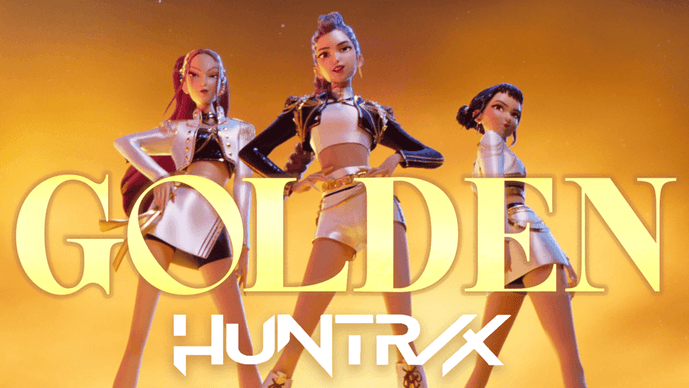
In 2021, Sony Pictures developed an offbeat animated film with a high-concept title; Netflix covered the budget and guaranteed Sony $20 million in profits. Then Netflix dumped the film on streaming with minimal advance marketing. They had no idea what they had on their hands. Five hundred million-plus views, four simultaneous Hot 100 Top 10s, and two Oscars later, KPop Demon Hunters is one of this decade’s biggest cultural phenomena. There’s no greater proof than “Golden,” not the first song released—that would be the demon diss track “Takedown,” covered by TWICE—but by far the biggest. In-universe, it’s K-pop trio HUNTR/X’s new single; in our universe, it’s a hit that seems both out of nowhere and comfortingly familiar.
At the moment, there’s a relative dearth of thoughtfully made media for kids: On one extreme, the media ostensibly for children exists to soothe their parents’ inner child; on the other, the kids are watching AI-generated slop unsupervised on YouTube. KPop Demon Hunters fills the gap, unapologetically indulging every kids’ movie cliché with little of the jaded postmodern “lampshading” that many contemporary animated films love. The accessibility of Netflix means it’s easier to watch, and thus much easier to spread. And from its pop-star protagonists to its side characters (like the hojakdo tiger and magpie) to its food (Rumi loses her mind over kimbap in the film’s most viral moment), everything draws inspiration from Korean art and culture, something Korean Canadian director Maggie Kang hadn’t yet seen depicted in Western animation.
Kang had an idea about a story with demons and an idea about female protagonists with a silly streak, and her husband suggested putting them together. She developed a main trio that’s both, as co-director Chris Appelhans recalls Kang saying, “so badass and so stupid”—likeable but still capable of kicking demon butt. The title explains half the concept: Girl group HUNTR/X moonlight as demon hunters, and the combination of music and fans’ souls creates a shield called the Honmoon, protecting Earth from demons. To fight the trio, the ruler of the demon realm, Gwi-Ma, sends an evil boy band that steals souls. Meanwhile, HUNTR/X leader Rumi (voiced by Arden Cho and sung by Korean American songwriter EJAE) must keep her half-demon side a secret. The summary sounds slightly cynical—a K-pop movie where fan engagement and parasocial attachment save the world?—but, as with the combination of pop art and brand management in Sony’s Spider-Verse franchise, it’s earnest enough to compartmentalize while watching.
In some respects, this is a victory for long-incoming American K-pop acceptance: a megapopular gateway into the genre and its tropes. In the streaming era, when original movie musical songs cross over, they become pop songs by default: Disney tried to make Demi Lovato’s version of “Let It Go” a hit when Frozen came out, but Idina Menzel’s was unfathomably more successful. 2021’s Encanto forewent the pop cover and still got a No. 1 hit with “We Don’t Talk About Bruno.” 2017’s The Greatest Showman became a sleeper success in part because Pasek and Paul’s platitude-heavy songs had almost no direct connection to the narrative, like Top 40 songs that just happened to interrupt a P.T. Barnum biopic. Demon Hunters’ songs cannily work in multiple contexts: Every line pushes the story forward and every hit is diegetic.