

The quest to find rock’n’roll’s holy grail began in Paul McCartney’s music studio in May 2017.
“I was asked to go over and see McCartney at his studio in Sussex,” says Nick Wass, 71, a former electric guitar manager for Höfner, a small German guitar company. “So I go, and he’s very pleasant. And he says, ‘So, you’re Mr Höfner? Do you know where my missing bass guitar is?’ ”
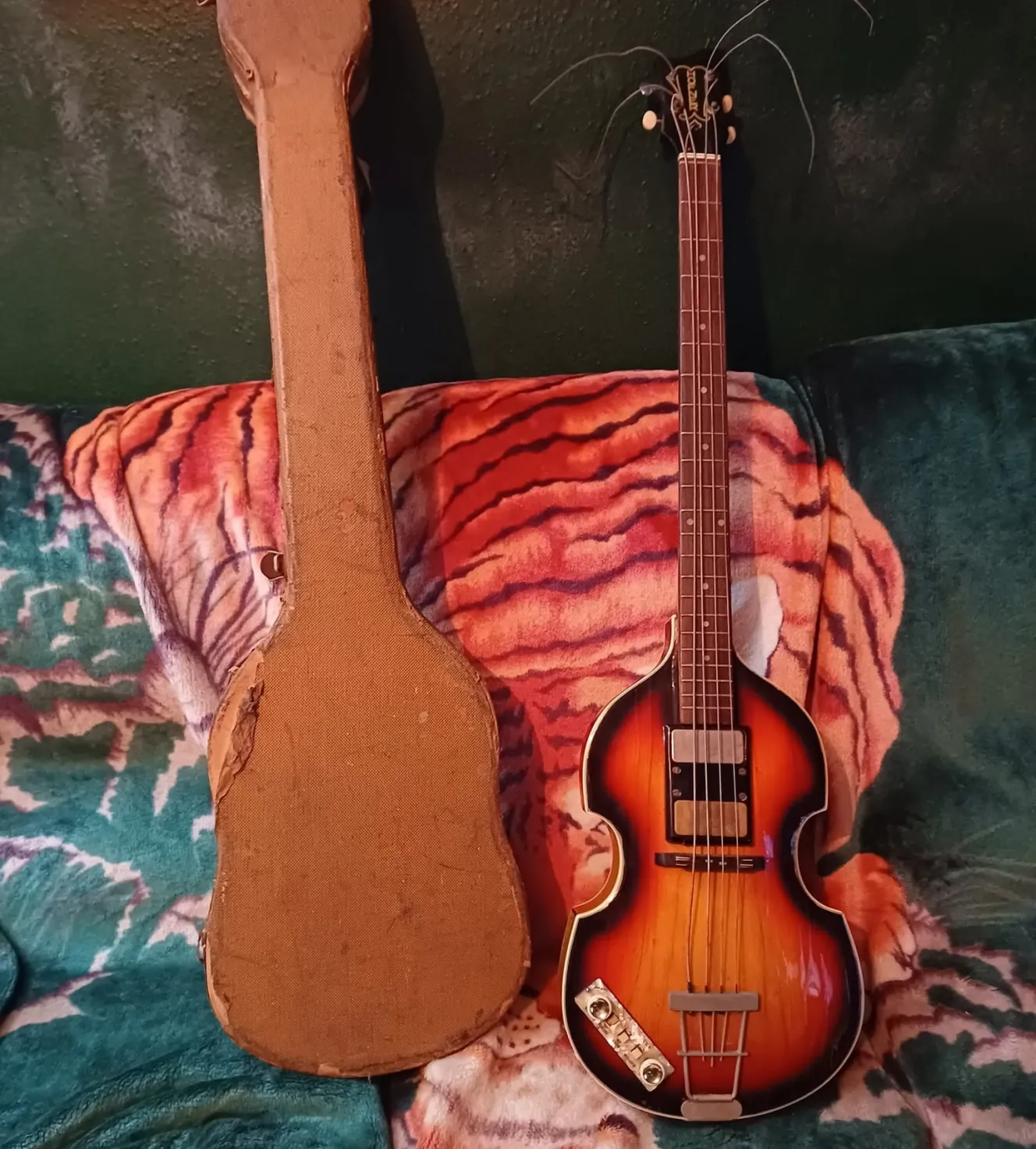
McCartney was referring to his first bass, a Höfner 500/1 violin bass, which he bought, aged 18, in Steinway-Haus music store in Hamburg in 1961 for £30 — £850 in today’s money. He used it to write and perform pop songs that changed music for ever. It was the bass sound of early Beatlemania, heard on hit singles such as Love Me Do (1962) and She Loves You (1963).
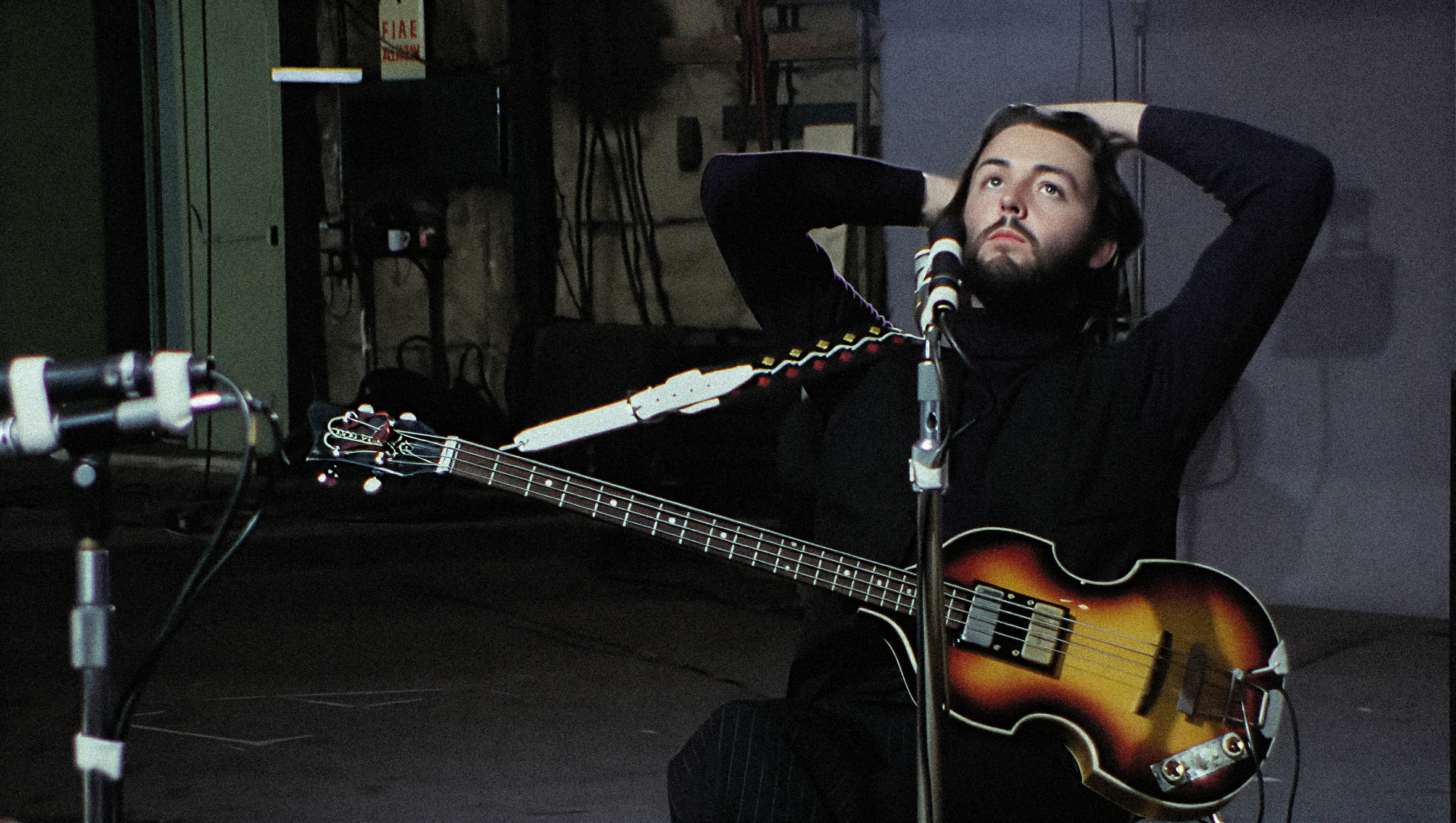 Paul McCartney with his original Höfner 500/1 violin bass during the Let It Be sessions with the Beatles in January 1969
Today, Höfner’s experts say the instrument is worth more than £10 million, making it comparable with David Gilmour’s 1969 Fender Stratocaster, which sold for £10.9 million at auction this month. Except, for 50 years McCartney’s guitar was missing, the prevailing assumption being that it was thrown away or stolen around the time the Beatles were breaking up, between 1969 and 1970.
“There were rumours but it was like chasing a ghost,” Wass says. “Even Paul’s music technician, Keith Smith, said to me, ‘I reckon that got thrown in a skip years ago.’ I don’t think Paul ever told me, ‘Go out and find it.’ But he made clear he was keen that it should be found.”
A few months after their meeting, Wass set up a web page on Höfner’s website, asking for help in his quest. “Maybe 50 people emailed me with various suggestions,” he says.
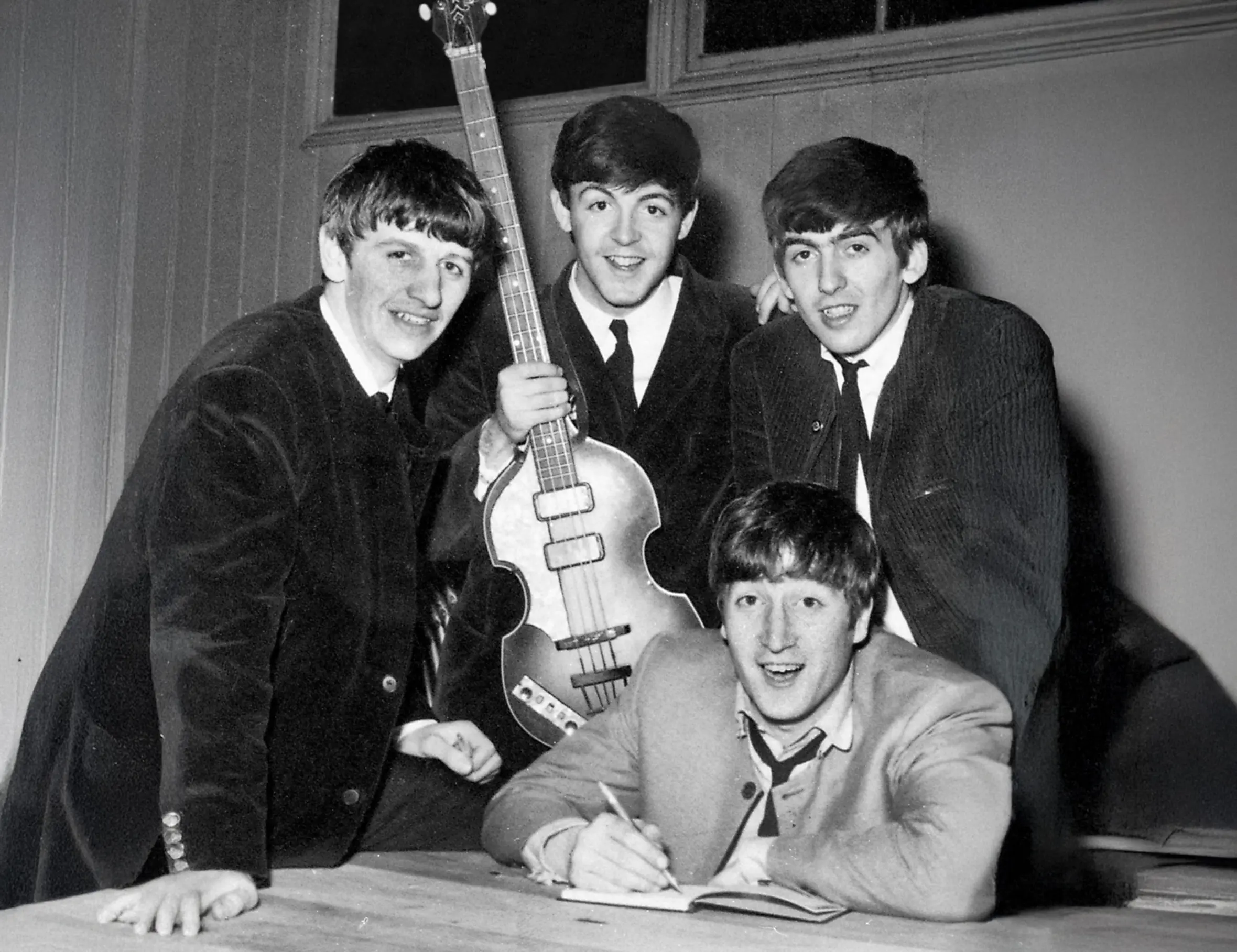 The Beatles backstage in 1962Alamy
Theories ranged from it being sold in a Las Vegas pawn shop to being kept by a mysterious private collector in Canada and somebody seeing the guitar in a backstreet music shop in Tokyo. McCartney imagined it on the wall of a Bavarian castle: something a wealthy German businessman showed off to his friends — “Look, you’ll never guess what I’ve got…”
Ahead of a new BBC documentary, McCartney: The Hunt for the Lost Bass, I spoke to Wass and the other investigators behind the quest to find the instrument. They led me to the one man who knew the truth, who revealed for the first time a secret that had been kept in his family for two generations.
The reluctant bassist
Paul McCartney was 18 in August 1960, with a greased quiff and baby-faced good looks, when he headed to Hamburg’s red-light district with the early line-up of the Beatles. He and John Lennon, 19, sang and played guitar; George Harrison, 17, was on lead guitar and backing vocals; Stuart Sutcliffe, 20, was the bassist; and the drummer was Pete Best, 18. Over the next two years they would play for up to eight hours a day in the city’s clubs and bars, often taking amphetamines to stay awake, transforming themselves from a raw young band from Liverpool into a tight, professional act.
Sutcliffe left the band in July 1961 to pursue a career as an artist. “That meant we didn’t have a bass player,” McCartney recalls in the documentary, “and John and George were, like, ‘Well, I’m not doing it.’ So, that left me. Eventually I found a nice little shop in the centre of Hamburg and saw this bass in the window…”
McCartney bought the Höfner and assumed duties as bassist. In August 1962, 22-year-old Ringo Starr — then known as the best drummer in Liverpool — replaced Best, and the Beatles as we know them were complete.
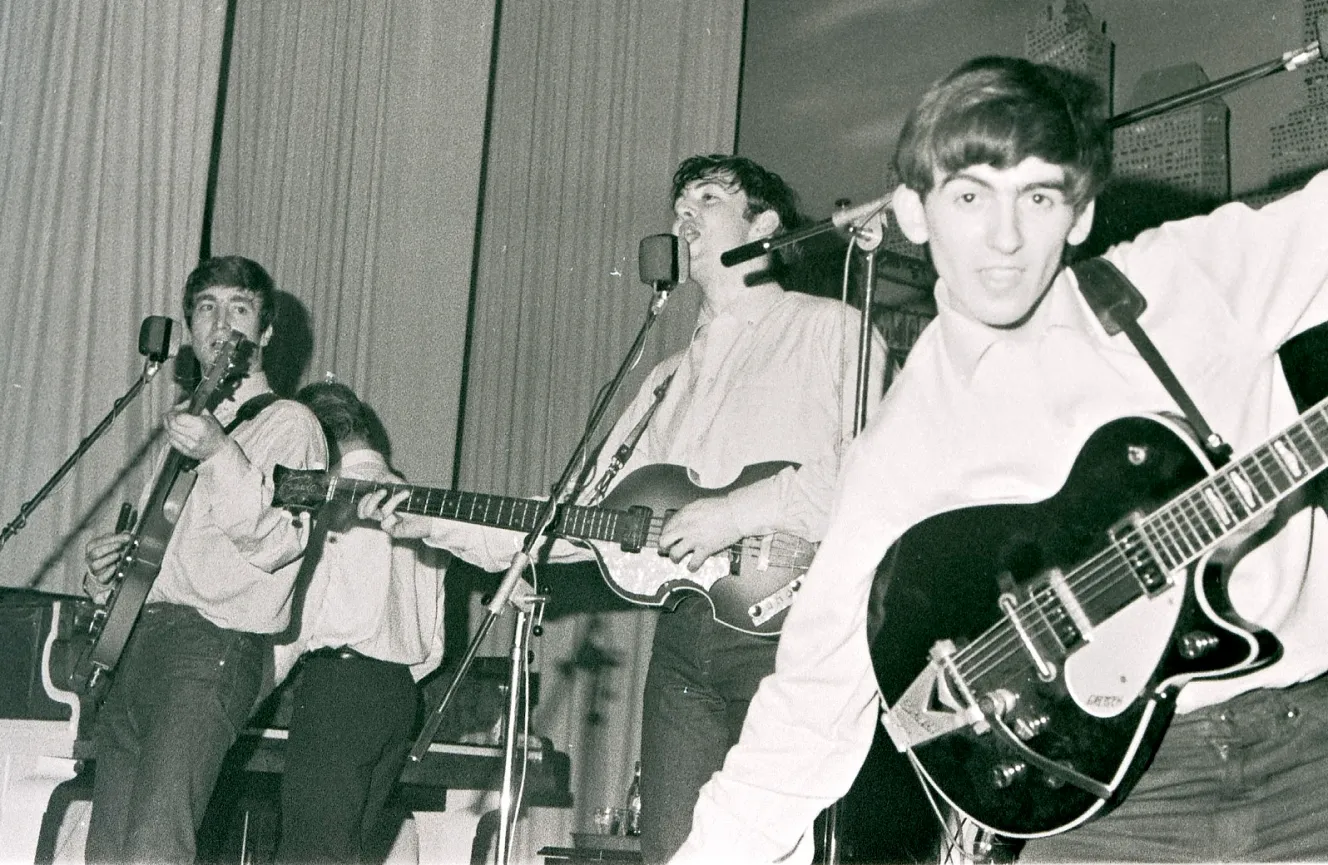 McCartney, John Lennon and George Harrison on stage at the Star-Club in Hamburg, spring 1962Redferns
McCartney played the Höfner in Hamburg and more than 250 times at the Cavern Club back in Liverpool. It was used on their first two albums, recorded at EMI Studios in Abbey Road: Please Please Me, released in March 1963, and With the Beatles, which came out that November.
“You know, in 50 per cent of the publicity pictures for the Beatles in the early days, what is he holding? The Höfner,” Wass says. “It’s almost like he was born with the damn thing.”
By late 1963 the guitar was relegated to being a back-up after McCartney was given an updated model of the 500/1 by Höfner (see below). In 1965 he switched to a specially made Rickenbacker 4001S, but the original Höfner remained in occasional use until the Beatles began to fall apart in 1969. Where on earth did it go?
Wass pored over old Beatles footage and pictures. It was still around in January 1969: its sunburst paint job and violin-shaped body could be seen poking out from behind a coffee table at the headquarters of the band’s Apple record label in Savile Row, west London, in footage from the Let It Be/Get Back sessions, shortly before their concert on the roof of the building on January 30 that year.
It would be the Beatles’ final gig. In April 1970 the band officially split up. After that Wass could find no trace of the bass. Had it been destroyed, lost, stolen or secreted away by a collector? He realised he was going to need some help.
The Lost Bass Project
Scott and Naomi Jones, a married couple, are freelance investigative journalists who used to work at the BBC in London but now live in Devon. They were watching McCartney on TV headlining Glastonbury in 2022 when Scott, a Beatles fan, first became intrigued by the bass he was playing. “It was four or five songs into the set when the lights went down,” says Scott, 59. “And there was just a moment — a glimpse, really — when Paul’s bass caught the light. And I thought, ‘I wonder if that’s his original bass?’ We did some research online and quickly discovered that it wasn’t.”
Scott and Naomi, 52, stumbled on Wass’s Trace the Bass page on the Höfner website and got in touch. The three decided to collaborate and relaunched the quest on September 3, 2023, renaming it the Lost Bass Project. The web page provided clues to help the public identify the instrument: unique little dints, pickups spaced close together, mounted on black wood.
 The investigative journalists Scott and Naomi Jones teamed up with Nick Wass for the Lost Bass ProjectDom Moore For The Sunday Times Magazine
The prevailing theory among fans and online sleuths was that the bass had been stolen from the basement of Apple HQ in January 1969, just before the Beatles broke up. People who worked at Apple describe their working environment as “chaotic” and “like a continuous 24-hour party” at that time. Some of George Harrison’s guitars were said to have gone missing from that basement. Did McCartney’s bass go the same way?
The hunt generated headlines around the world. The trio received 600 calls and emails — a mixed bag of promising leads and utter nonsense. One person emailed to say it was being kept at President Trump’s Mar-a-Lago resort in Palm Beach, Florida. But among the red herrings, one lead stood out.
The theft from Cambridge Gardens
On September 4, 2023, the day after the Lost Bass Project went live, a 79-year-old former roadie for McCartney got in touch with the investigators. Ian Horne had first met McCartney at Abbey Road in the early 1970s. After McCartney left the Beatles he had set up his new band, Wings, in 1971, with his wife, Linda, and Denny Laine, co-founder of the Moody Blues. Horne became their roadie and sound engineer. “The job was a dream come true for me,” Horne tells me.
Crucially, he remembered the first Höfner and revealed to the investigators a key piece of information: it was still in McCartney’s possession two years after the Beatles split. The guitar was famous among his team and was even kept in its original case, but McCartney never used it by then. One evening in 1972, Horne was with Wings in the studio until late. Afterwards he dropped off his brother-in-law, Trevor, a student, in Notting Hill, west London, in his van full of equipment. “He lived on Lancaster Road. You couldn’t park outside his house, so I parked close by on the corner of Cambridge Gardens. Then I went back to his house and spent the night. That area was all squats.”
The next day Horne returned to the van to find the padlock broken. “My heart sank. Somebody had taken two AC30 amps, another acoustic guitar in its case — and Paul McCartney’s original Höfner in its case.”
Horne was distraught. He reported the theft to the police, then returned to Cambridge Gardens with Trevor, armed with tools in case they ran into trouble. They suspected the equipment had been stolen by hippies, druggies or one of the struggling musicians who lived in the flats. “I was in panic mode,” Horne says. “I was worried about Paul’s reaction to losing it.”
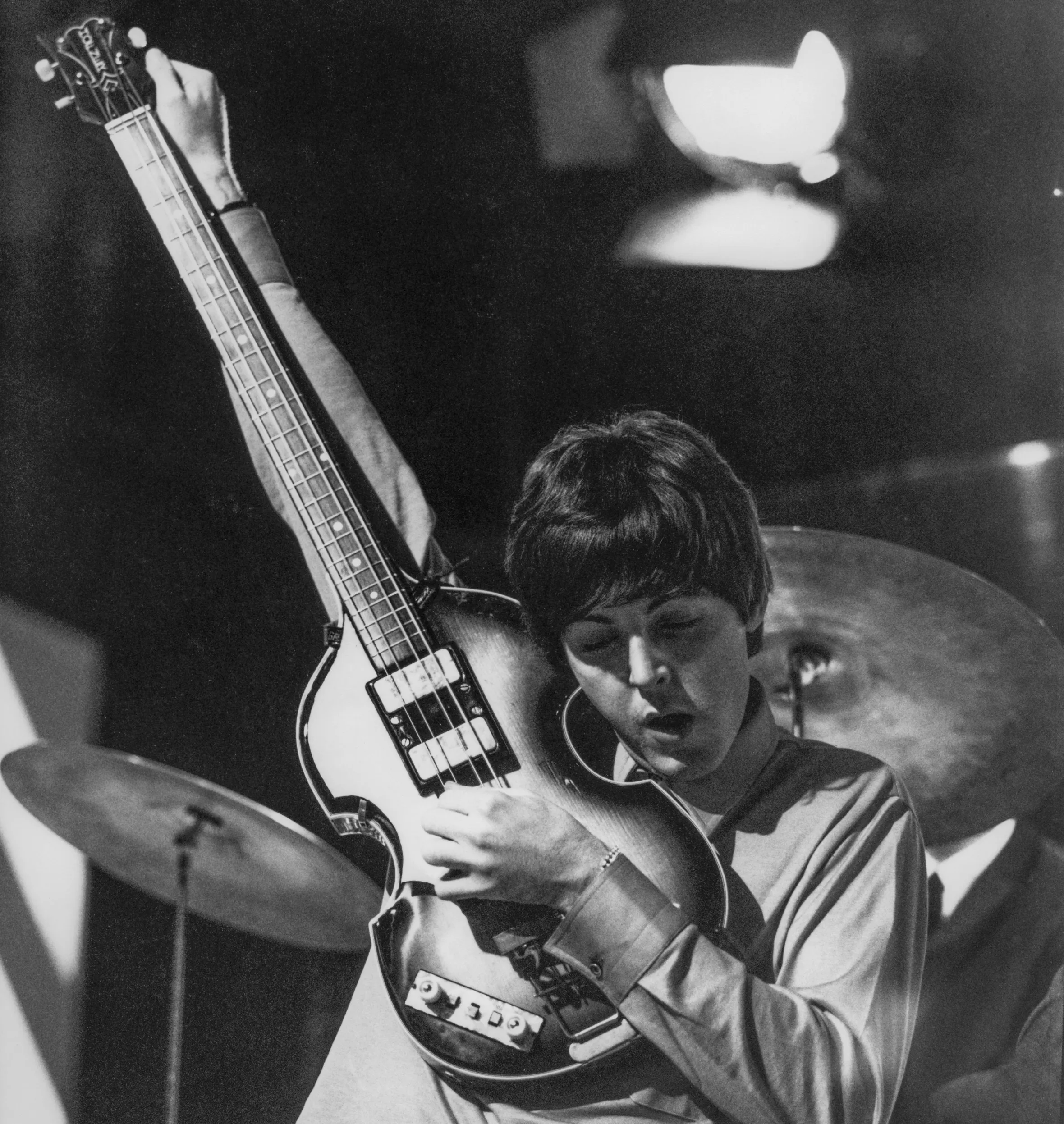 McCartney tuning his Höfner during rehearsals for the TV show Thank Your Lucky Stars in 1964Getty images
Horne even put out an appeal on Police 5, an ITV show that asked for the public’s help to solve crimes with the catchphrase, “Keep ’em peeled!”
“After that, there wasn’t much I could do,” Horne says. “I had to go and tell Paul.” One evening Horne went to McCartney’s house on Cavendish Avenue near Abbey Road. “He came to the door and I explained the truck was broken into and one of the things missing was his Höfner. He just said, ‘It’s OK, I’ve got another one.’ And that was it. We never really discussed it after that. And I spent the next 50 years looking for it, checking out the Höfners at all the gigs I went to in case it was the one. I always thought it was hanging on somebody’s wall, like a stolen Rembrandt painting, you know?”
It is not clear if McCartney had forgotten about the theft — as Naomi Jones points out, he probably had other things on his mind in 1972 — but he never told Wass about it during their meeting.
Horne told the investigators his story and, using Google Maps, helped Naomi to identify the exact spot where the van had been parked when it was broken into 50 years earlier: 100 Cambridge Gardens.
The Joneses surmised that the thief would not have known who owned the bass — or its value. “If this was a Pink Panther-style targeted hit job, why take the amps and the other acoustic guitar? They would have left them,” Scott says. Naomi adds, “It was an unmarked van. There was nothing to suggest it was Paul McCartney or Wings who owned it.”
The couple found an Evening Standard clipping about the theft from the time, reporting the guitar was stolen on October 10, 1972. The investigators now had a date and an address for the theft — and it was the address that gave them their next clue.
Half-truths and lies
One of the many tip-offs Wass had received before he joined forces with the Joneses had come in February 2023, from an ambulance driver called Andy Dickinson. Dickinson relayed in an email something that he claimed he’d once been told by a patient in the back of his ambulance: McCartney’s lost bass had been stolen and thrown into a canal near Notting Hill in west London. What was compelling about this story was the patient’s address: Cambridge Gardens.
“It was too much of a coincidence,” Wass says.
Dickinson, 62, a Beatles fan who himself plays bass, agreed to speak to me. He admits that it wasn’t a patient who told him this story but a colleague called Steve Glenister. He explains that he had heard about the search for McCartney’s bass at the start of 2023. One day while working a shift, he turned to Glenister and told him about the hunt. To Dickinson’s astonishment, Glenister replied, “I think I know where that is.”
Glenister, 62, also agreed to speak to me. He remembers the moment in the ambulance. “I told him, ‘I think it’s ended up in the canal at the top of Ladbroke Grove. My dad told me a bloke had it in the pub.’”
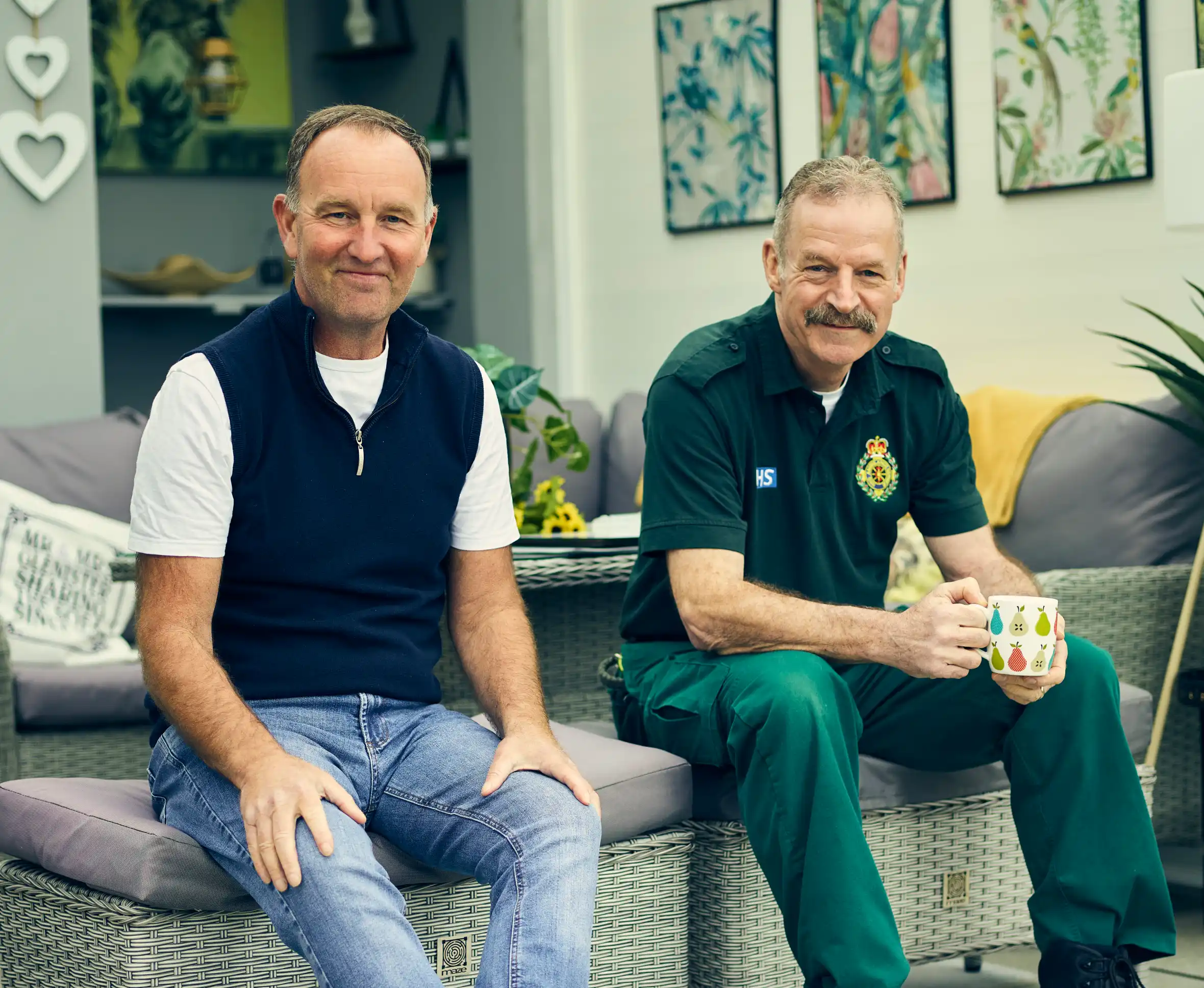 Steve Glenister, left, let his family secret slip to his colleague Andy Dickinson, rightPaul Stuart for The Sunday Times Magazine
Dickinson asked Glenister if he could email the information to Nick Wass. Glenister says he thought, “Oh God, I’ve opened my mouth here, he’s not going to let this go.” They decided to send some details but agreed to say the story came from a patient. Glenister, it would become clear, was protecting a family secret.
Dickinson had an idea to search the canal, Glenister recalls, laughing. “He said, ‘Do you think we can have the canal dredged?’ I told him, ‘It’s a wooden guitar thrown into a canal 50 years ago. There’ll be nothing left!’ ” In reality, the canal story was a way for Glenister to throw Dickinson off the scent.
Meanwhile, the Joneses were doing some digging. They had obtained Glenister’s name from a second email Dickinson had sent them. Naomi made a startling discovery. Checking the electoral register for 1972, they found a George and Linda Glenister registered as living at 100 Cambridge Gardens. The team decided to telephone Steve Glenister and get the full story once and for all. This time, he was ready to tell them the truth.
The family secret
Steve Glenister grew up at 100 Cambridge Gardens with his father, George, his mother, Linda, and his younger brother. “It was good fun,” he tells me. “My uncle and auntie lived there in a flat. There were always a dozen or so kids from the area playing in the garden.”
He remembers seven families living in the building, with his family in the top flat. His dad worked at Paddington station, loading lorries for British Rail. “We were skint, that’s the bottom line of it,” he says. “Dad did his best to make ends meet. Mum used to work, but when I turned up and my brother three years later, she didn’t have an opportunity to work. It was tough.”
When Steve was about ten years old the family moved to Buckinghamshire. There, life ambled along until 1989 when George told his son, who was now in his twenties, an astonishing story in the car. The Beatles’ Love Me Do was playing on the radio. “I said to him, ‘I like the Beatles.’ And he said, ‘Do you?’ ” Steve recalls.
“Then he said, ‘Did I ever tell you about that guitar?’”
“‘What guitar?’” Steve replied.
“‘Paul McCartney’s guitar.’ He started to giggle and laugh. Then he said, ‘I nicked it.’”
 George Glenister (pictured holding his grandson) stole the bass in 1972Glenister family photos
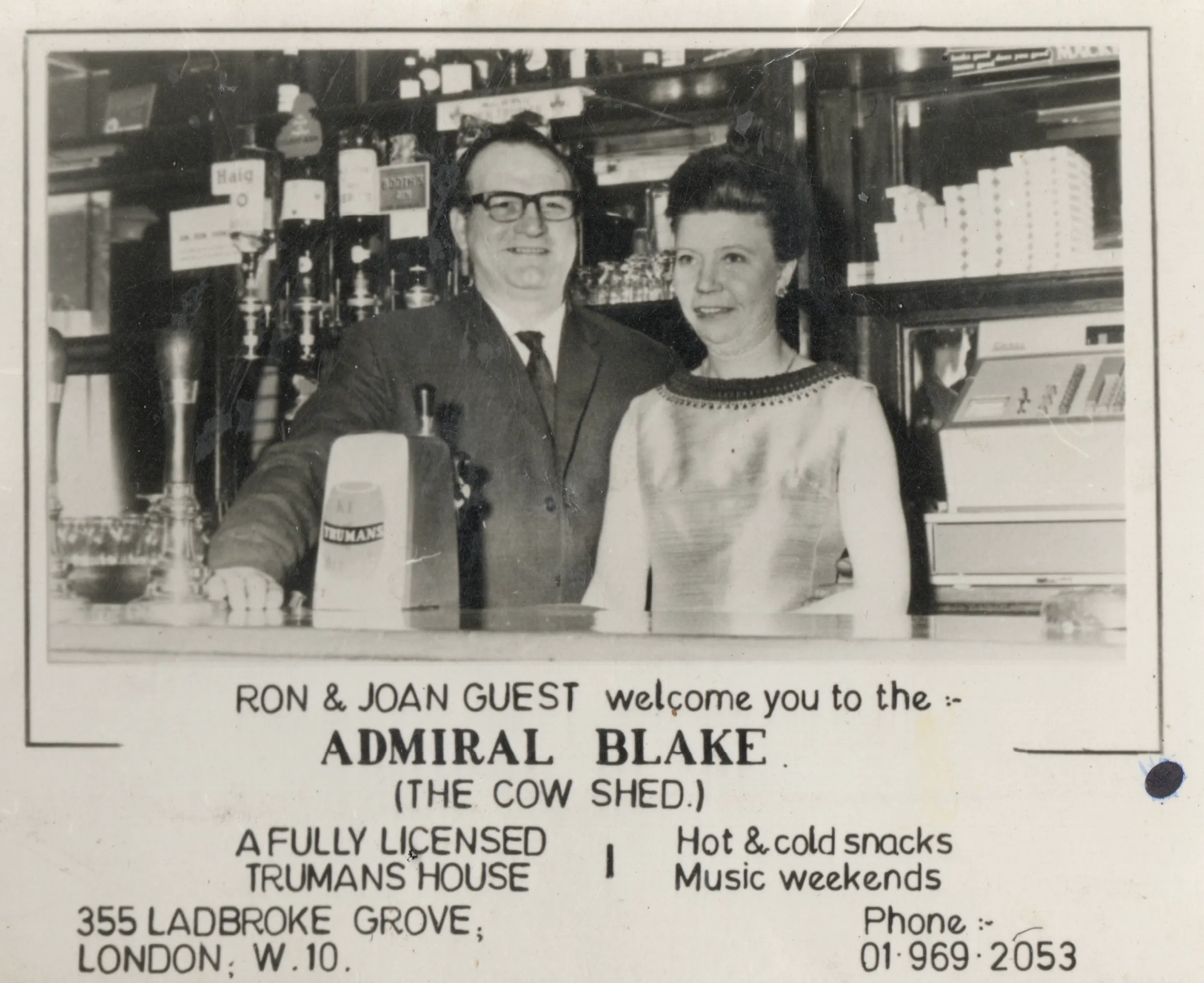 He gave it to Ron Guest, a pub ownercathy guest / facebook
At first, Glenister thought his dad was pulling his leg. “Dad might exaggerate stories, but I had never known him to lie.” He told his father, “But it’s like nicking the Mona Lisa and trying to sell it, Dad. Who’s going to buy it? You can’t do it!”
“I know that now, don’t I?” his dad told him. “I just thought I could knock it out and earn a few quid.”
Years later, when Glenister was 33, he remembers his father telling more of the story at a golf clubhouse near Aylesbury. George said he had no idea it was McCartney’s guitar that he’d stolen until the next day, when a story about the theft appeared in the local newspaper. Realising it was “too hot to handle”, George had given the guitar to Ron Guest, the landlord of the Admiral Blake pub on Ladbroke Grove, for a few pints of beer. George told Guest to “give it to one of his sons”. And that’s the last the Glenister family knew of it.
The discovery in the attic
Naomi pieced the next part of the story together by speaking to friends and relatives of the Guest family. The story goes: Ron gave his guitar to his eldest son, Graham, when he was 17 years old, but two years later, in 1976, Graham died taking part in a rally racing event. The guitar then went back to Ron.
When Ron died in 1992, his second son, Haydn, who lived in Birmingham, acquired the bass. “His daughter remembers him getting it down from the attic in the early 1990s to give her the guitar as a birthday present,” Naomi says. “But she wanted a keyboard.”
Haydn, who was divorced, married a woman called Cathy. The couple moved to Ealing in west London, then to Hastings in East Sussex, bringing the guitar with them. Haydn died during the Covid pandemic, leaving Cathy Guest with the guitar.
“I inherited about 15 guitars,” Cathy, 53, tells me in a text message. “I knew there were a few in the attic but hadn’t been up there for years as it was inaccessible.”
In September 2023 — coincidentally around the time the Lost Bass Project was launched, which Cathy says she was unaware of — she came across the unusual-looking violin-shaped Höfner. She says she put a picture of it into Google Images and it “immediately came up with Paul McCartney. I couldn’t believe it but I knew he only lived about 12 miles away, so I thought I would just drive there.”
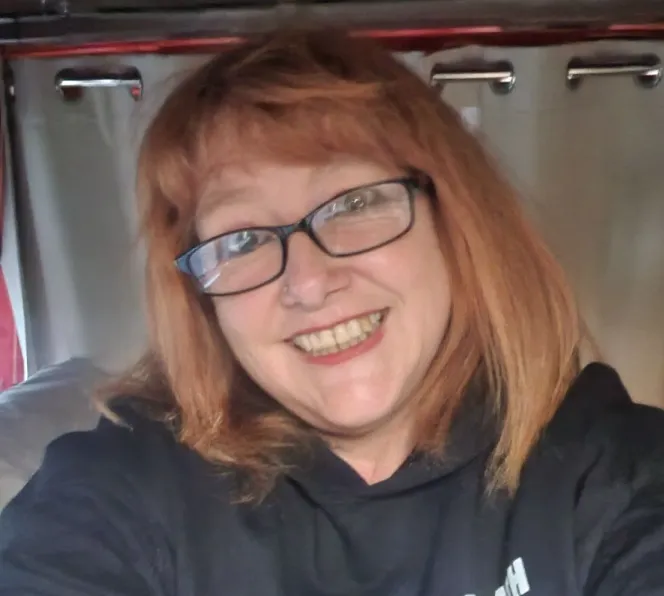 Rob Guest’s daughter-in-law Cathy found it in her atticcathy guest / facebook
McCartney, who lives on a farm in East Sussex, was in Los Angeles at the time, so Cathy spoke to security at the farm and sent pictures of the bass for McCartney and his team to check. She took the instrument home. “I slept with it that night as I was worried.” When the pictures checked out, somebody from McCartney’s team was sent round to her house to pick up the bass. It was returned to McCartney on September 21, 2023.
In the documentary, when McCartney holds it for the first time in more than 50 years, he looks at it with a sense of wonder and remarks, “Welcome home, honey.”
Cathy, a mother of two who works in a launderette, sent me a photo of a note that she left for McCartney in the case of the bass, telling him she was living on benefits. “I am selling my husband’s guitars to fund and feed my children at university as they only have £25 a month to live on,” she wrote.
I ask her if she received any money for returning the instrument. “I cannot discuss that, but I can say I do not have an extravagant life and still work part-time in my launderette,” she replies.
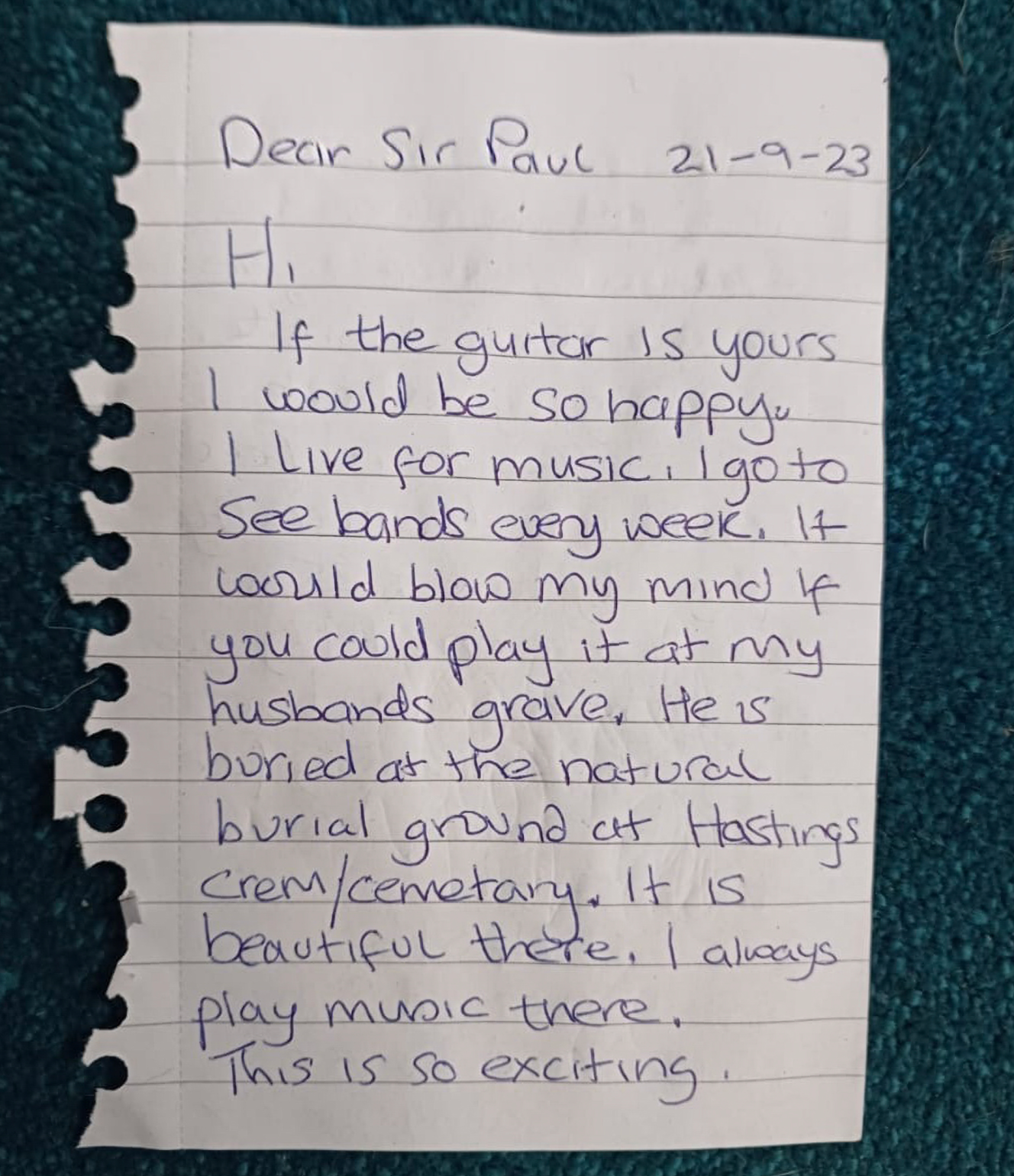 Cathy Guest’s handwritten note to McCartney, which she put in the guitar’s casecathy guest / facebook
 cathy guest / facebook
Play it again, Paul
Nick Wass was in Germany when he got the call from McCartney. “He was quite excited. He said, ‘Hey, hey, I’ve got something to tell you — we’ve got the bass back, but don’t tell anybody.’ ”
Wass flew to England to authenticate the Höfner for insurance purposes. How much does he believe it is worth? “They asked me once and I said £10 million. But what I’ve subsequently said is, ‘It’s priceless.’ Because you’ll never be able to buy it. The McCartney estate will never sell it or it will go into a museum,” Wass says.
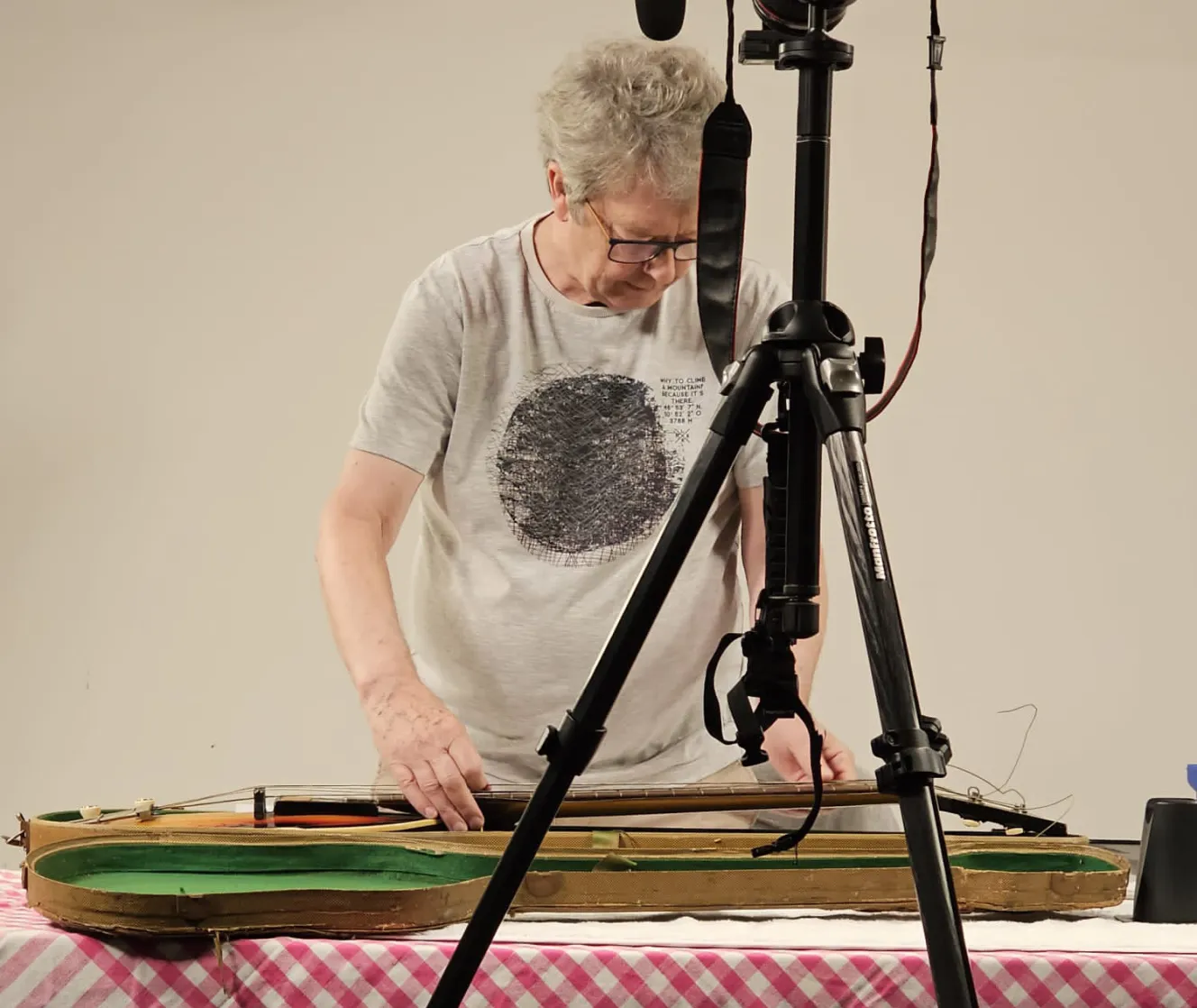 The Höfner expert Nick Wass checks the bass overthe lost bass project
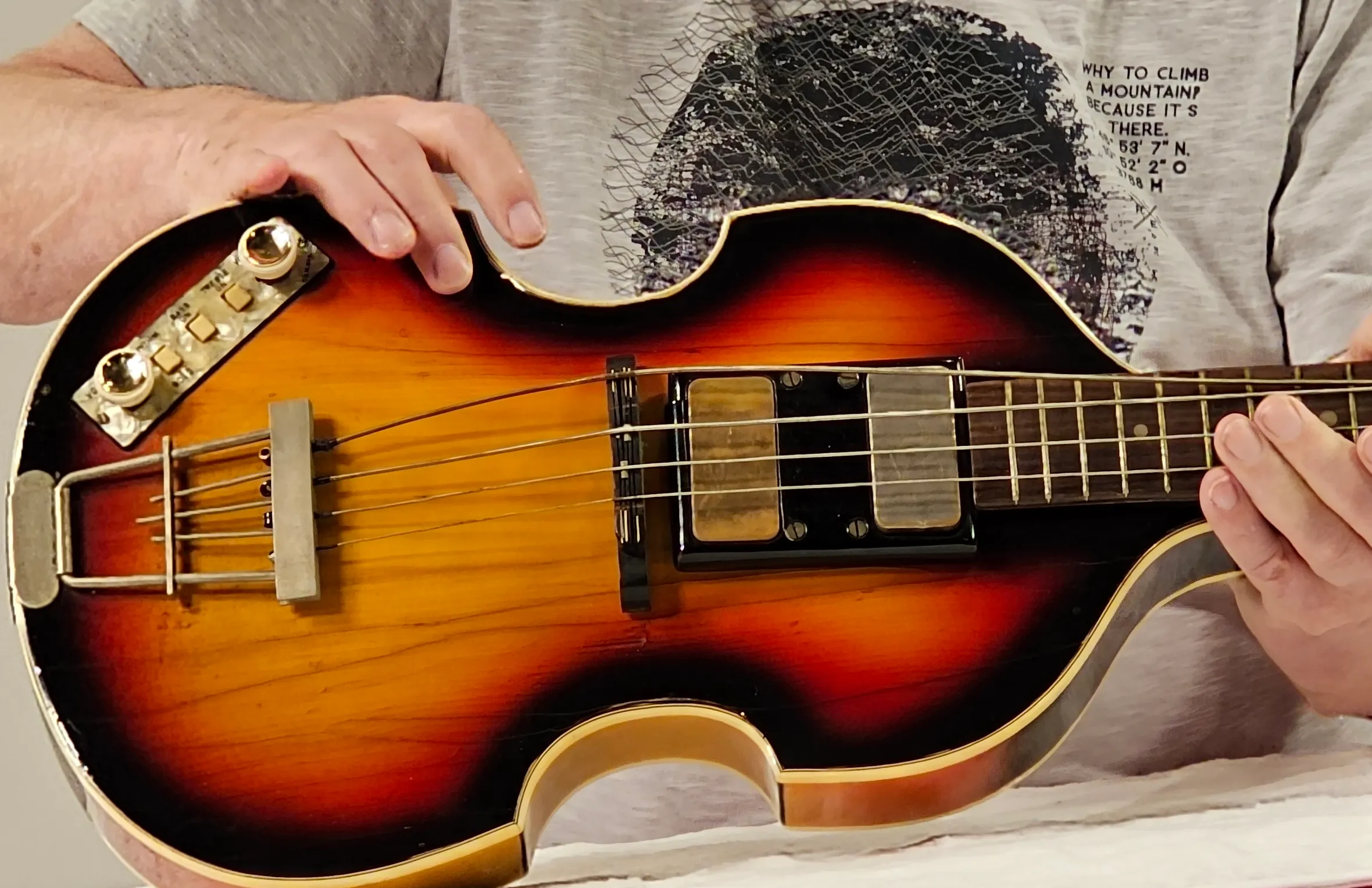 the lost bass project
The news wasn’t revealed to the world until February 13, 2024, when Cathy’s son Ruaidhri, 23, posted on X: “To my friends and family I inherited this item which has been returned to Paul McCartney. Share the news.”
Two days later, a statement appeared on McCartney’s website declaring the bass had been returned. “Paul is incredibly grateful to all those involved.”
Wass, Scott and Naomi were given free tickets to see McCartney perform live at the O2 in London on December 19, 2024. They suspected he might play his old Höfner. They were not disappointed. “A while ago I had a bass besides this one, my original bass,” McCartney told the audience. “It got nicked… We’ve been looking for it for 50 years and, well, I got it back. Here to make its first stage appearance in 50 years is my original bass.” Naturally, he played Get Back.
McCartney doesn’t blame George Glenister much, telling the documentary that his “petty thievery” was not unlike what he and the Beatles might have got up to, growing up poor in Liverpool. “We got out of that pretty quickly, luckily. The Beatles took over and we found an honest profession. But I can sympathise with people who don’t have that kind of luck.”
 McCartney played his Höfner for the first time since its return at the O2 in London on December 19, 2024PA
For Steve Glenister, the story raises a more complex side to his father’s character, who he says was a “lovely lad”. “Everybody who watches that documentary thinks my father was a thief,” he says. “But Dad didn’t do it for a pat on the back. It was to earn a few quid for clothes and things. That was Dad.”
McCartney: The Hunt for the Lost Bass, a BBC Arts Arena documentary, airs on BBC2 and iPlayer on April 11 and in select cinemas on April 2 and 4