
Venkat Raman
Auckland, March 29, 2026
The escalating war in the Middle East and the strategic closure of the Strait of Hormuz have impacted supply chains across the globe, the most critical of which is the supply of petrol and gas for countries like New Zealand.
Energy security is the foundation of modern infrastructure, and any prolonged blockage of maritime trade routes threatens the flow of essential fuels required for transport, industry, and daily life. As a farming country, New Zealand is safe in its food supply, although imports could suffer if the war and its attendant disruptions continue or worsen. The nation is not immune to the broader economic contagion, and imports of essential machinery and fertilisers could be significantly affected if the conflict intensifies.
Proactive Measures
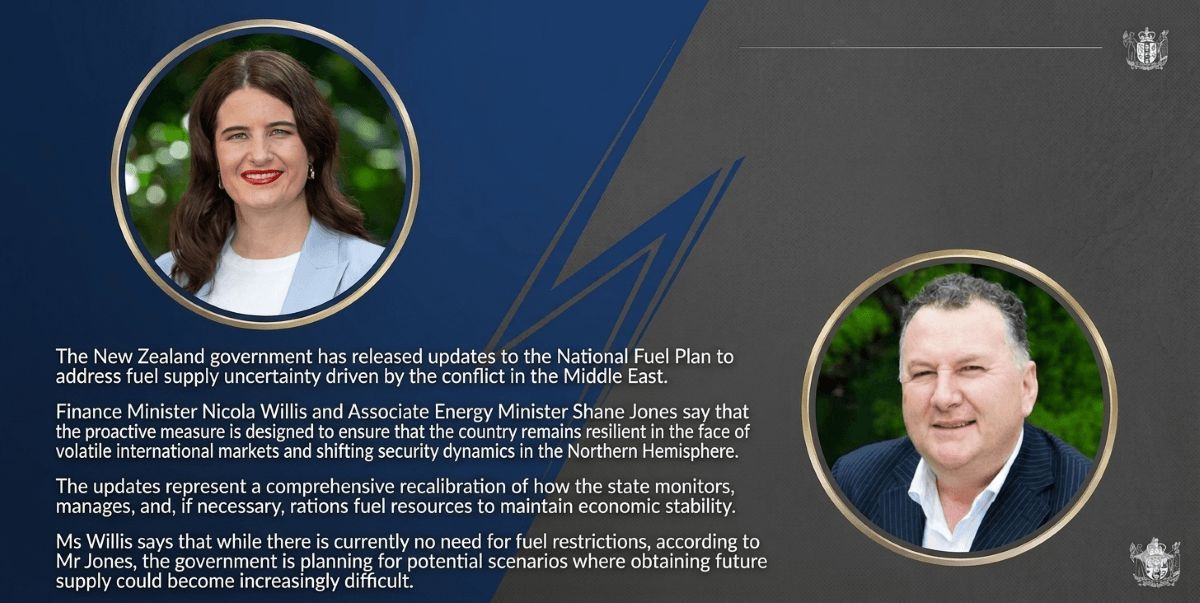
The New Zealand government released updates to the National Fuel Plan on Friday (March 27, 2026) to address fuel supply uncertainty driven by the conflict in the Middle East, Finance Minister Nicola Willis and Associate Energy Minister Shane Jones said.
This proactive measure is designed to ensure that the country remains resilient in the face of volatile international markets and shifting security dynamics in the Northern Hemisphere. The updates represent a comprehensive recalibration of how the state monitors, manages, and, if necessary, rations fuel resources to maintain economic stability.
Ms Willis said that while there is currently no need for fuel restrictions, New Zealanders can be assured that the government is planning carefully, acting early and making sure that New Zealand is well-positioned to respond, whatever the global environment brings.
She said that the primary objective of these updates is to provide a sense of certainty to both households and the business sector during a time of heightened international anxiety and supply chain instability.
Ensuring that New Zealand has the fuel needed to protect jobs, livelihoods and the wider economy in managing the impact of global fuel disruption, Ms Willis said that the updates give practical effect to the National Fuel Plan established in 2024.
“We have reflected on the specific potential risks New Zealand could face as a result of major fuel disruption driven by the conflict in the Middle East,” she said.
A Phased Response to Energy Security
The revised Plan outlines four clear phases that respond proportionately to the risks to New Zealand’s fuel security. These phases are not applied as a blanket measure but are assessed separately for petrol, diesel and jet fuel to reflect their different functions and challenges.
For instance, a shortage in jet fuel might impact international travel and logistics, while a diesel shortage would have more immediate and drastic consequences for the agricultural and construction sectors.
At each phase is a set of measures that would be taken in response to escalating risks to New Zealand’s fuel security. This graduated system ensures that the government does not overreach during minor market fluctuations but possesses the necessary authority to intervene should a genuine crisis emerge.
The decision-making process is centralised within a specialised body called ‘The Fuel Security Ministerial Oversight Group’ to ensure rapid response times and consistent communication.
The Group will be responsible for deciding whether a shift between phases is appropriate, with the group required to consider a move when there is a change in any of the six assessment criteria. These criteria will be used to assess a movement up or down a response phase, providing a transparent framework for industry stakeholders and the public alike.
Specific Criteria for Assessment
The specific criteria that the oversight group will monitor include (a) export restrictions, if any of New Zealand’s source refineries introduce or relax export restrictions (b) changes to New Zealand’s fuel stock levels of plus or minus three days since the most recent published update if a fuel company informs the government that they are unlikely or unable to fill future orders (c) a breach, or a notification of an imminent breach, of the minimum storage obligations (d) any significant policy changes in Australia or from the International Energy Agency and (e) a significant disruption to regional distribution.
Ms Willis said that the Plan is designed to keep fuel flowing where it matters most, relying on market settings wherever possible, and only stepping in further if supply is genuinely at risk.
Four Phases of Risk Management
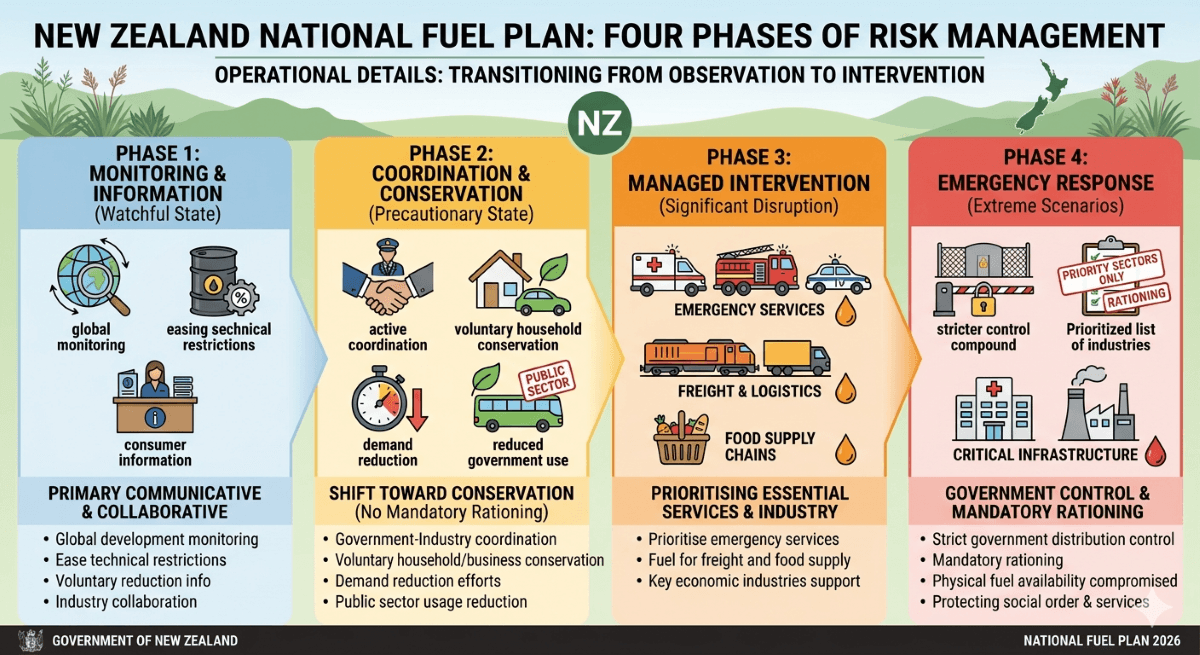
The operational details of the Plan specify how the government will transition from observation to intervention.
Phase One of the Plan focuses on monitoring global developments, easing restrictions to increase optionality (such as changing fuel specifications), providing information to fuel consumers on measures to support voluntary reductions in fuel use, and working with fuel companies to keep fuel moving efficiently across the country. This stage is primarily communicative and collaborative, seeking to use market logic to smooth out supply ripples.
Phase Two would see more active coordination between government and industry to shore up fuel supply and support increased efforts in demand reduction. At this phase, there would be a stronger push for voluntary uptake by households and businesses of measures that help to conserve fuel, and a reduction in the public sector’s use of fuel where appropriate. This phase signals a shift toward conservation without the need for mandatory rationing.
If disruption increases, the Plan allows for stronger interventions at Phases Three and Four, including prioritising fuel for emergency services, freight and food supply chains, and key industries that underpin New Zealand’s economy. These final stages are reserved for extreme scenarios where the physical availability of fuel is compromised to the point of threatening social order or essential services.
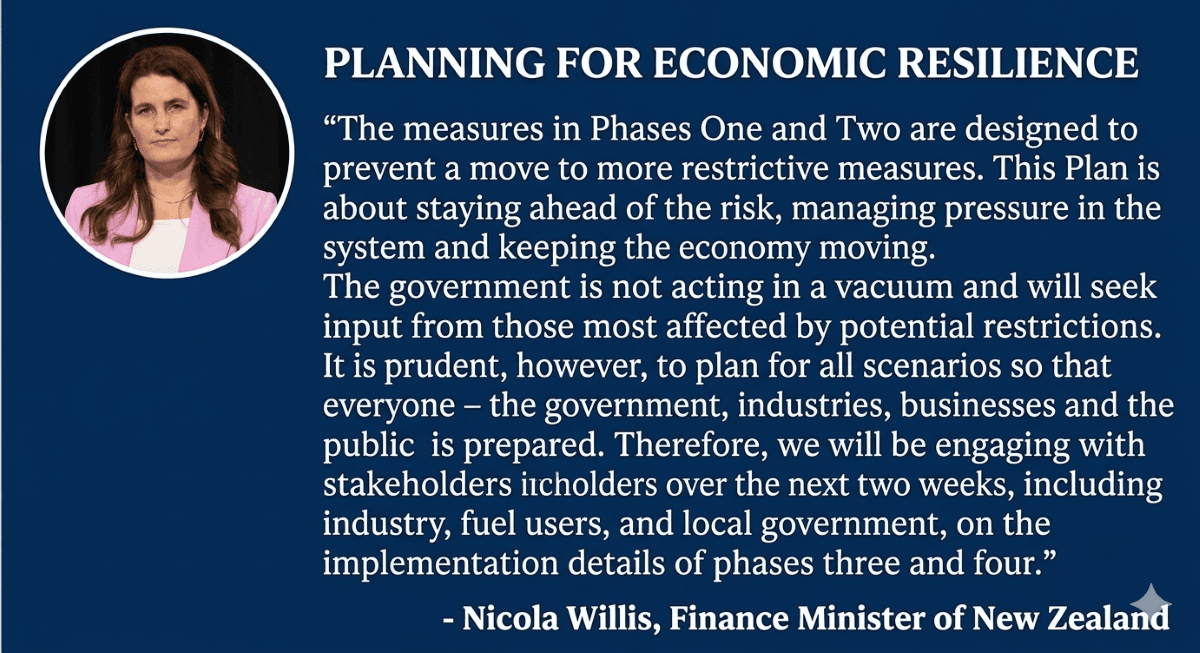
Ms Willis said that the measures in Phases One and Two are designed to prevent a move to more restrictive measures.
“This Plan is about staying ahead of the risk, managing pressure in the system and keeping the economy moving. The government is not acting in a vacuum and will seek input from those most affected by potential restrictions. It is prudent, however, to plan for all scenarios so that everyone – the government, industries, businesses and the general public is prepared. Therefore, we will be engaging with stakeholders over the next two weeks, including industry, fuel users, and local government, on the implementation details of phases three and four,” she said.
Industry Collaboration and Strategic Resilience
Energy Minister Shane Jones said that the government has worked closely with industry on developing the updates to the National Fuel Plan.
He said that the success of the strategy depends on a transparent relationship between the public sector and the private companies that manage the national fuel infrastructure.
“This is critical because the Plan relies on fuel companies cooperating and working constructively with the government. I expect that we continue to work together as the situation evolves. The industry will play a key role in providing advice to the Ministerial Oversight Group if and when we are required to consider a move between phases,” he said.
Mr Jones said that while the outlook in the Middle East remains difficult, New Zealand has sufficient fuel stocks.
“We are planning for potential scenarios where obtaining future supply could become increasingly difficult,” he said.
Aligning specifications with Australia
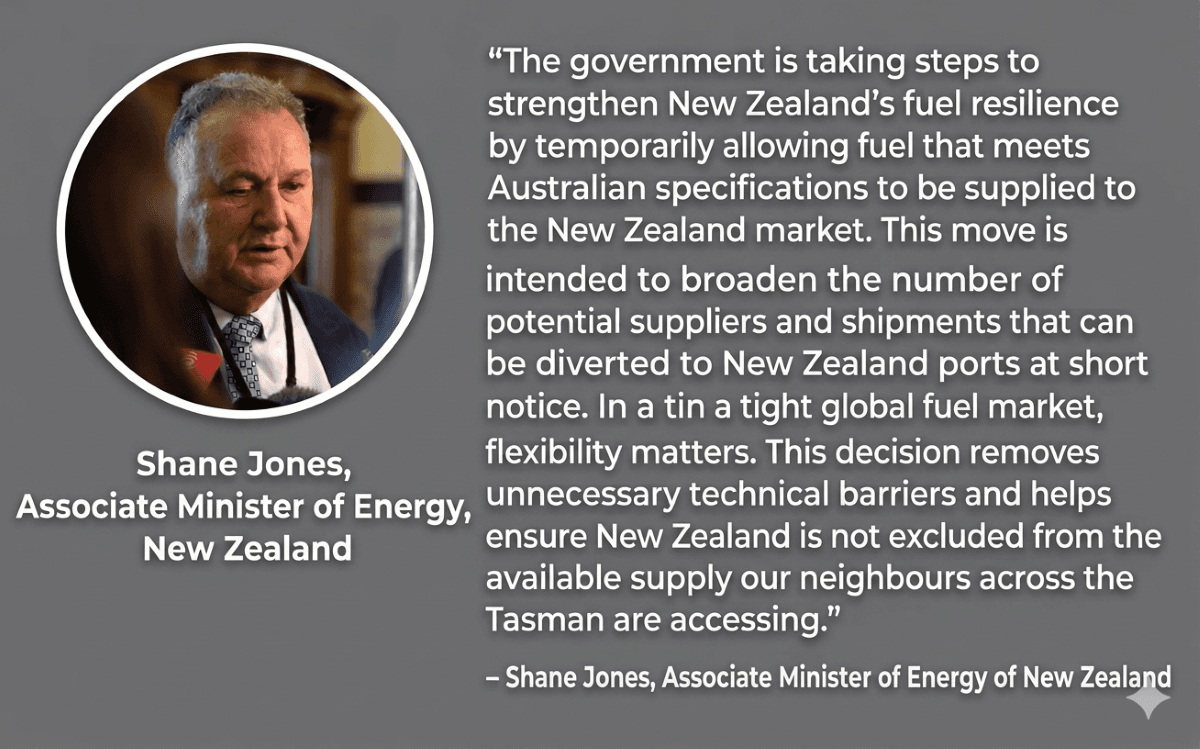
In an earlier media release, Mr Jones said that the government is taking steps to strengthen New Zealand’s fuel resilience by temporarily allowing fuel that meets Australian specifications to be supplied to the New Zealand market.
This move is intended to broaden the number of potential suppliers and shipments that can be diverted to New Zealand ports at short notice.
“In a tight global fuel market, flexibility matters. Countries that can access a wider range of shipments are better placed to keep fuel flowing. This decision removes unnecessary technical barriers and helps ensure New Zealand is not excluded from the available supply our neighbours across the Tasman are accessing,” Mr Jones said.
The temporary alignment will open up more options for fuel importers by allowing fuel refined to Australian specifications to be supplied domestically. By harmonising these standards, New Zealand effectively joins a larger regional purchasing pool, which is vital when tankers are being rerouted due to conflict in the Strait of Hormuz.
Mr Jones said that the change reduces the risk of supply disruptions driven purely by technical specification differences.
“Fuel companies have told us this could allow them to secure shipments more quickly and from a wider pool of suppliers. Our fuel specifications are already very similar to Australia’s. Fuel refined to Australian standards is compatible with New Zealand vehicles and meets safety and quality expectations,” she said.
Despite this alignment, the government is maintaining certain environmental safeguards.
Mr Jones said that New Zealand will not, at this stage, be following Australia’s lead and relaxing standards to allow higher sulphur fuel. Australia has decided that it can access high-sulphur fuel from its Brisbane refinery, a specific domestic requirement that does not currently apply to the New Zealand context.
“However, we will keep an eye on whether further changes to fuel specifications could open up further supply channels if necessary. This indicates a willingness to be pragmatic if the situation in the Middle East deteriorates to a point where environmental standards must be weighed against the total absence of fuel,” Mr Jones said.
According to him, this is a sensible, time-limited step that gives importers access to a broader range of fuel shipments, including those already in our region.
“We are closely monitoring market conditions and will keep under review any further practical measures that could strengthen New Zealand’s fuel supply resilience while global conditions remain uncertain,” he said.
The temporary alignment with Australian specifications could remain in place for up to 12 months if needed. This provides a sufficient window for the global market to stabilise or for New Zealand to secure more permanent alternative arrangements.
Technical Standards and Consumer Protection
Fuel specifications set the minimum technical and environmental requirements that petrol, diesel and other transport fuels must meet before they can be supplied in New Zealand.
Each country has its own fuel specifications, often tailored to specific climate conditions or engine types common in that region. Where there are differences in fuel specifications for the purpose of catering to different climatic conditions, this is dealt with by the requirement that fuel sold in New Zealand must still be fit for the common purpose.
For example, this means diesel for hot climates cannot be sold in very cold ones, ensuring that even under emergency supply conditions, the fuel remains functional for the end user.
“The New Zealand government remains committed to ensuring that while supply is maintained, the quality of the fuel does not lead to mechanical failure or excessive environmental degradation. As the conflict continues to disrupt the flow of oil through the Middle East, these updates to the National Fuel Plan serve as the primary defensive line for the national economy. Through a combination of phased monitoring, industry cooperation, and regional alignment with Australia, the government aims to navigate the current crisis without resorting to the drastic rationing measures seen in previous decades,” Mr Jones said.
The Fuel update gives practical effect to the National Fuel Plan established in 2024 and reflects the specific potential risks New Zealand could face as a result of major fuel disruption driven by the conflict in the Middle East.
It is a Plan built on the foundation of resilience and anticipation.
Ensuring New Zealand has the fuel we need to protect jobs, livelihoods and the wider economy is our first priority in managing the impact of global fuel disruption. While there is currently no need for fuel restrictions, the public can be assured that the government is planning carefully, acting early and making sure New Zealand is well-positioned to respond, whatever the global environment brings.