
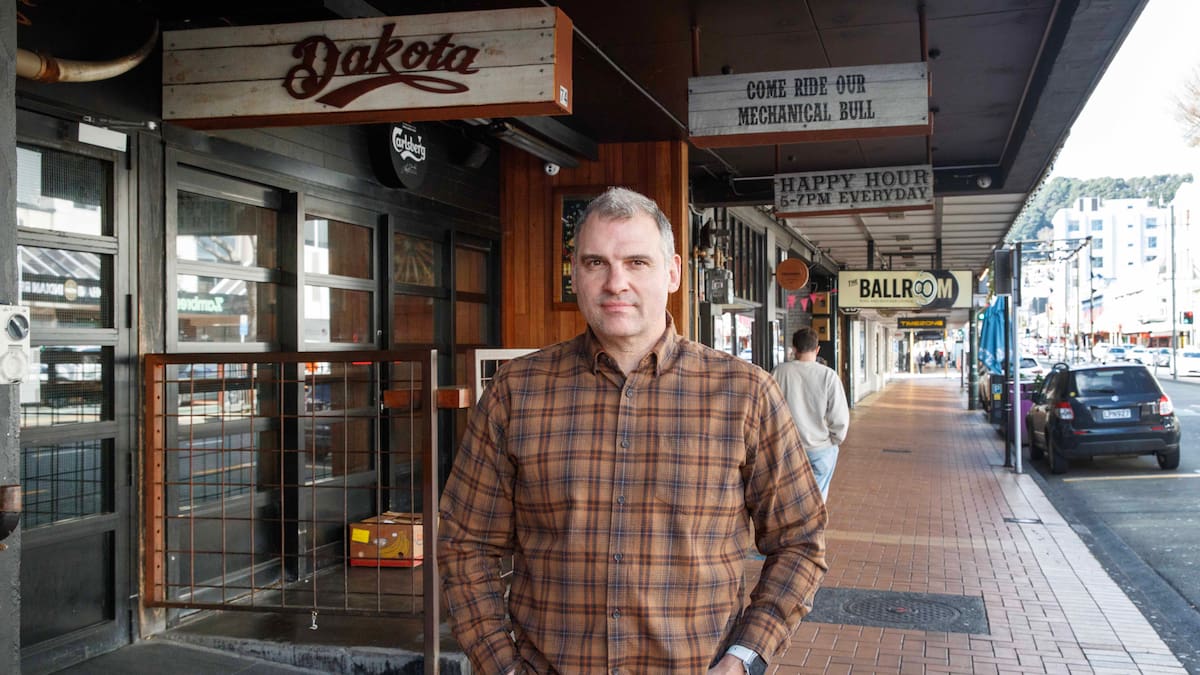
According to a recent Alcohol Regulatory and Licensing Authority decision police applied to suspend or cancel the licence held by Dakota’s parent company Rhinestone Cowboy in respect of the bar at Courtenay Place.
A second application has been taken by the police against Dakota’s manager Robert Brooks for the suspension of his manager’s certificate.
Both applications were based on a controlled purchase operation (CPO) across a number of licensed premises in the Wellington CBD on October 2, 2025.
The decision said a 16-year-old entered the Dakota Bar about 7pm, accompanied by an undercover police officer. The pair stood by one of the wooden leaners at the back of the bar.
The teen then approached the bar by herself and purchased two Corona beers from a female staff member. The worker did not check the youth’s ID or ask for age verification.
A short time later, police spoke to the staff member, Lauren Foss, and she acknowledged she had sold alcohol to the teen and did not ask for ID as she thought the youth had already been checked.
Foss, who also holds a manager’s certificate and is employed regularly as duty manager at the Dakota Bar, has already been dealt with by the authority.
Police then spoke to Brooks, who was duty manager at the time of the sale.
It was not the first time the company and Brooks had come before the authority. The previous time also arose from a failed CPO.
On September 27, 2024, another 16-year-old volunteer was served alcohol at the bar. This resulted in a 48-hour on-licence suspension and Brooks’ managers’ certificate was suspended for 28 days.
The Dakota Bar on Courtenay Place in Wellington.
Sergeant Tulimanu Leuluai told the authority only two CPOs have been undertaken at Dakota Bar over the past year, and both resulted in alcohol being sold to a young person.
The sergeant argued the bar had a 100% failure rate for CPOs over that period.
“However, it remains of concern to us that this is the second time in under a year that both Mr Ubiaga, by his company, and Mr Brooks are before the authority for the same offence,” the authority said.
The authority ordered the bar’s on-licence be suspended for a period of 96 hours, which occurred from 8am March 9 to 8am March 13, as well as Brook’s managers’ certificate being suspended for 56 days from February 25 to April 21.
In the case of Rhinestone Cowboy and its licence for Dakota Bar, a third negative holding within a three-year period would result in an application for the cancellation of the licence.
For Brooks, a third negative holding within the relevant three-year period would result in the cancellation of his managers’ certificate.
Ubiaga told NZME the police target certain venues and he wanted to work with them more co-operatively.
“I’m not going to sit here and pretend those results didn’t happen.
“We failed twice and I take full responsibility for that. At the end of the day it’s my premises, my licence, and it’s on me to make sure the staff are doing what they’re supposed to do. There’s no getting around that.”
He said after the first failure he thought he’d done enough to retrain staff.
“When it happened a second time I was gutted.”
But he said some venues on the road had never had a CPO.
“And some of those places, if you walked in on a Friday night, you’d have serious questions about how they’re operating.
“So yes, we failed and we have to own that. But the broader point still stands – if you’re only testing the same places over and over again, you’re not getting a true picture of what’s happening across the board.
“You’re just hammering the ones already on your list while others fly completely under the radar.”
Ubiaga said he’d welcome a system where every venue gets tested regularly by police, so no one felt singled out and the venues “genuinely cutting corners” would be caught out.
“I just wish they’d work with us more. To be a fair test they need to test every venue at least once every two years, not just a handful of venues.”
He said the tests are often done when there is no security on the door because everyone’s ID gets checked and scanned.
“Underages aren’t coming out to a pub before 11pm anyway because they can’t afford to drink.”
Ubiaga said he’d implemented considerable changes to the training of his staff and had devised his own testing procedure, akin to a CPO and using an of-age volunteer, at his own bars and in others.
He said a co-operative system by the police would include more support for training bar staff, regular check-ins and open lines of communication where operators can raise concerns early without feeling like they’re putting a target on their own back.
“If a bar manager spots a trend they should feel comfortable picking up the phone without worrying it’ll trigger an inspection. That kind of intelligence sharing benefits everyone.”
Police also applied to the authority for the suspension or cancellation of the on-licence for Dakota after it alleged the bar irresponsibly advertised alcohol as a pub quiz reward, but the application was dismissed.
The promotional advertisement said, “Tuesday night 7pm start over $150 of Bar Tabs to be won” and “bar tab on the line”.
Ubiaga told NZME it was “ridiculous” he was taken to the authority for something he said was widely used in the hospitality industry.
A police spokesperson said the message was simple.
“If you are selling alcohol, you have a responsibility to do so lawfully. Flouting your obligations as a licensee helps contribute to alcohol harm, which police work to prevent alongside our partner agencies,” the spokesperson said.
“It’s also important to remember that police is just one agency involved in the liquor licensing process.”
Authority chairman Judge Robert Spear said for there to be any irresponsible promotion of alcohol to constitute a breach, there had to be a direct link between the promotion or advertisement for the one part and alcohol for the second part and the alcohol had to be free of charge.
He said although the on-licence predominantly sells alcohol, the use of the phrase “bar tab(s)” did not by itself imply a connection only to alcohol and none is to be assumed.
“While any bar tab offered or won implies something free of charge, that something for free does not necessarily mean alcohol where products other than alcohol can be procured as well.”
Ubiaga gave evidence to the authority to demonstrate bar tabs were also utilised for food and non-alcoholic beverages.
“The authority notes that while the earliest advertisement subject to the February 2025 correspondence did link ‘bar tabs’ to ‘a shot’, this was dealt with by the inspectorate by way of a warning and this reference was removed from subsequent promotions.”
Ubiaga also owns The Residence, which was forced to shut for two days last year for an irresponsible promotion of alcohol, when it displayed a chalkboard at the front of the bar that said, “Manager’s pick of the week, happy hour 2 for 1, 4pm–6pm”.
That same month a post on Dakota’s Facebook page advertised “2 for 1 cocktail 10pm–11pm tonight”.
The council had argued it was a criminal offence to advertise in a way that leads people to believe the price of a drink is 25% or more below the price at which the alcohol is ordinarily sold, and promoting it in a way that can be seen from outside the business.
Brianna McIlraith is a Queenstown-based reporter for Open Justice covering courts in the lower South Island. She has been a journalist since 2018 and has had a strong interest in business and financial journalism.