
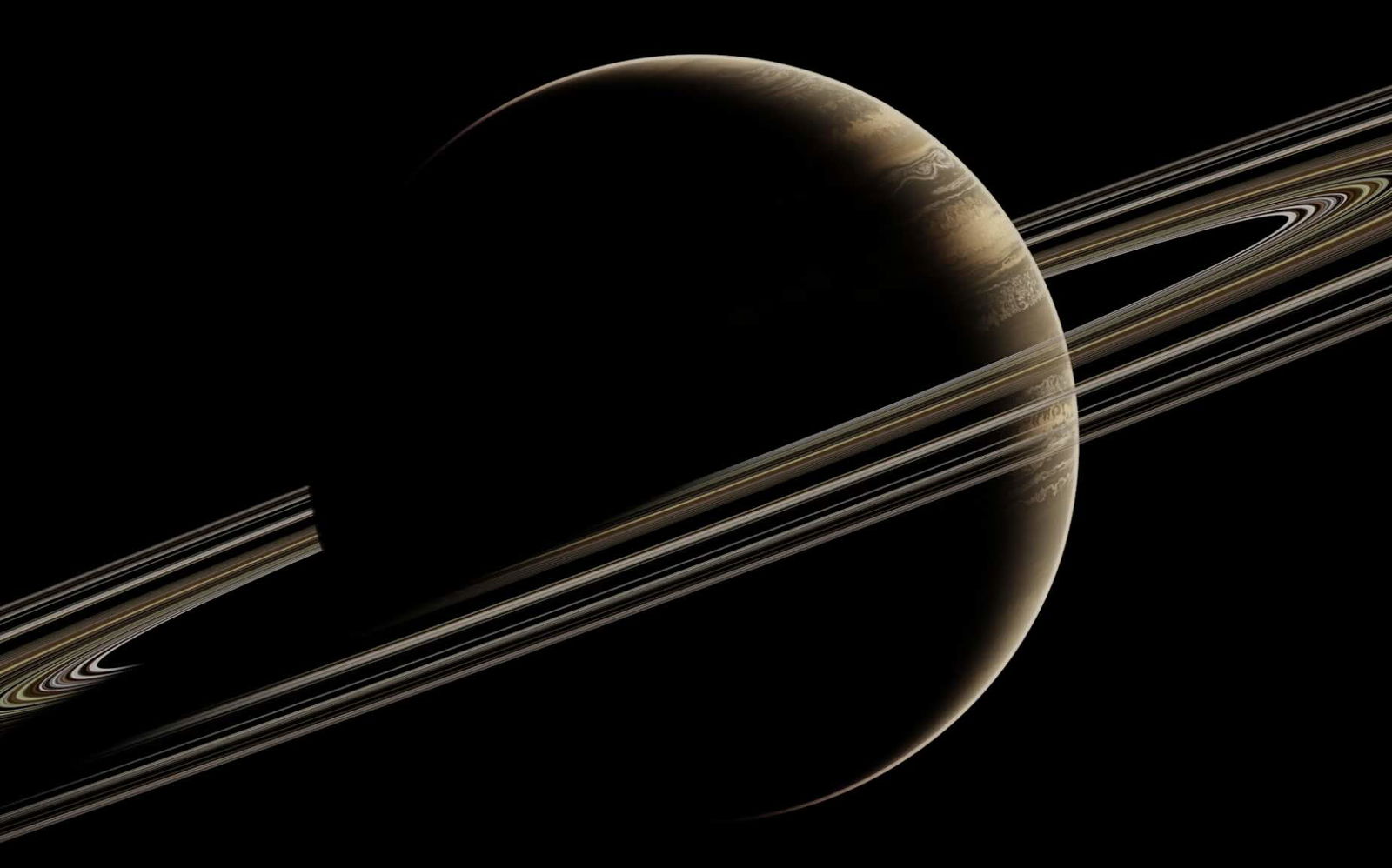
Astronomers have long been intrigued by planet Saturn, and new research is revealing how a decades-long mystery involving the ringed planet’s spin has finally been solved.
Led by a team of researchers at Northumbria University, the mystery lies at the core of the planet, heated and charged by its aurora. According to new research, the entire system is driven by a self-sustaining feedback loop powered by the planet’s own northern lights.
The discovery follows the discovery decades ago based on data from NASA’s Cassini spacecraft, which showed that Saturn’s rotation rate was not constant, unlike most planets, whose spins remain fairly consistent. This inconsistency raised questions about what factors could potentially cause Saturn’s rotation to somehow increase or slow down with time.
“What we are seeing is essentially a planetary heat pump. Saturn’s aurora heats its atmosphere, the atmosphere drives winds, the winds produce currents that power the aurora, and so it goes on. The system feeds itself,” says lead researcher Professor Tom Stallard in a statement.
“For decades, we knew something strange was happening with Saturn’s apparent rotation rate, but we could not explain it,” Stallard said. “We then showed it was being driven by atmospheric winds, but we still did not know why those winds existed.”
“These new observations, made possible by JWST, finally give us the evidence we needed to close that loop,” Stallard added.
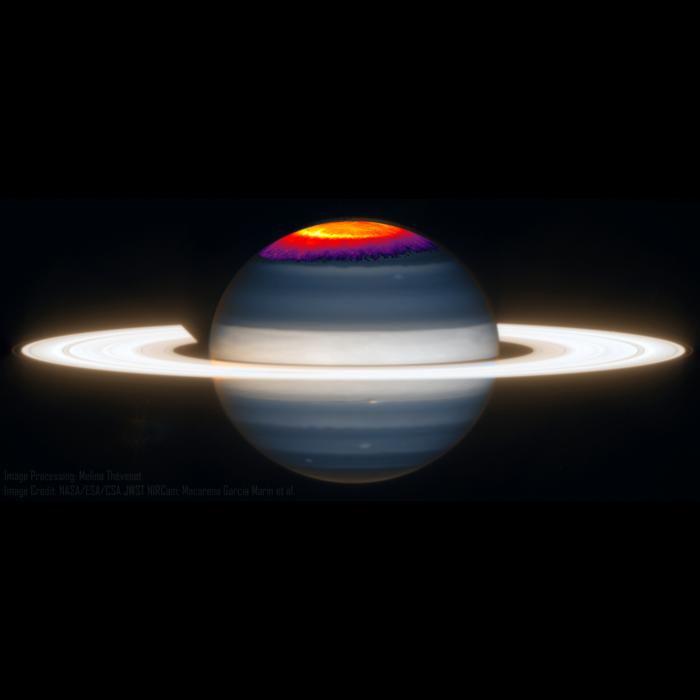 This image shows the asymmetric temperature structure revealed in the new paper, as it was observed from JWST. These are offset from where the currents flow into and out of the planet, but ultimately, the winds generated by this temperature offset are what drive those currents. Image/movie credit: NASA/ESA/CSA, Tom Stallard (Northumbria University), Melina Thévenot, Macarena Garcia Marin (STScI/ESA).
In 2021, scientists proposed that the changing “spin” was only an illusion. Instead of the planet itself altering its rotation, the powerful winds in Saturn’s upper atmosphere were generating electrical currents. Astronomers believed these currents influenced the planet’s aurora, creating signals that made it seem like the rotation rate was shifting.
But scientists were still puzzled. What was driving those atmospheric winds?
By using new data from the James Webb Space Telescope (JWST), researchers looked more closely at detailed observations of Saturn’s “northern lights” over the course of a Saturnian day. The new JWST data reviewed far surpassed any previous data on the planet’s rotation.
By studying infrared emissions from a form of molecular hydrogen cation known as the trihydrogen cation, which serves as a natural thermometer in Saturn’s atmosphere, the team mapped temperature and particle density in the aurora, revealing subtle heating and cooling variations that were not apparent in earlier data.

The findings revealed a clear pattern to scientists: the aurora itself is responsible for heating the atmosphere across the planet. The local heating created winds, which in turn produce electrical currents. That means those current powers of Saturn’s “northern light” or aurora create a feedback loop.
Overall, Saturn’s aurora acts like a planetary heat engine. It heats the atmosphere, drives winds, and sustains the electrical currents that power the aurora. Scientists now understand that the rotation rate would change as the planet’s spin undergoes minor changes with time.
The discovery not only solves a long-standing mystery but also reshapes our understanding of how planetary systems work. Further, it can also provide astronomers with new insights into planets, atmospheric behavior, and the connection between planetary weather systems and space environments across the universe.
The findings were published in the Journal of Geophysical Research: Space Physics.
Chrissy Newton is a PR professional and the founder of VOCAB Communications. She currently appears on The Discovery Channel and Max and hosts the Rebelliously Curious podcast, which can be found on YouTube and on all audio podcast streaming platforms. Follow her on X: @ChrissyNewton, Instagram: @BeingChrissyNewton, and chrissynewton.com. To contact Chrissy with a story, please email chrissy @ thedebrief.org.