
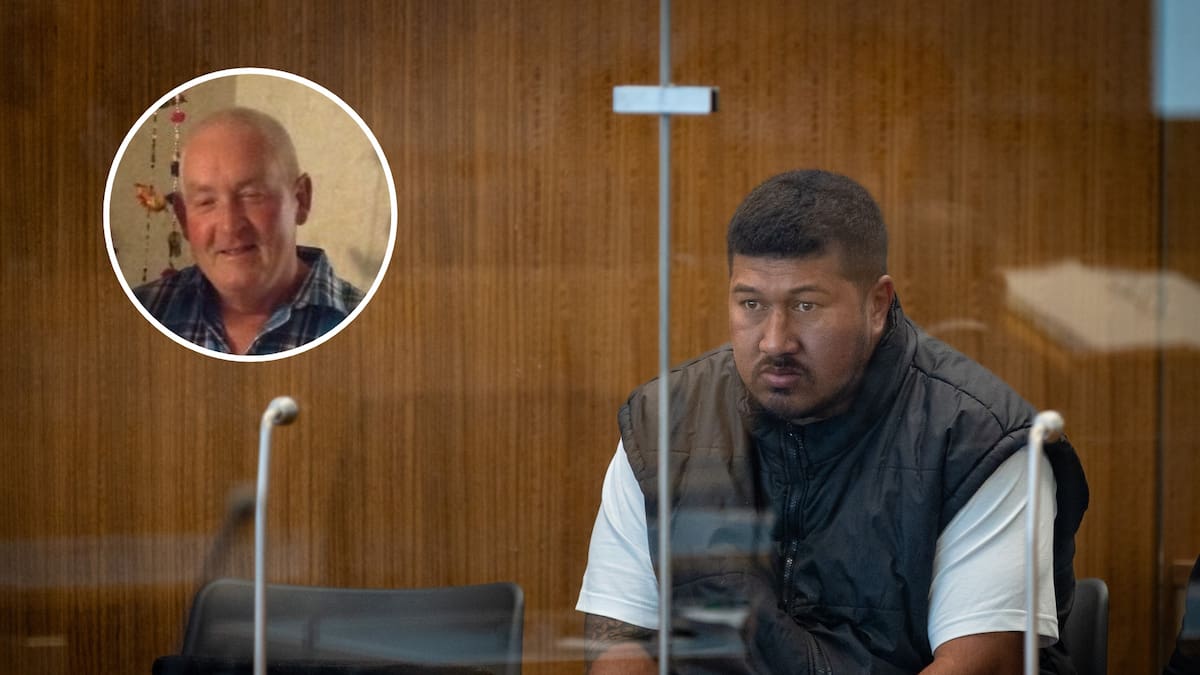
“The prolonged court process has been harder to heal,” Davies’ eldest daughter said.
Crown prosecutor Sylvie Arnerich said Kauri had caused the delay by denying the charges for 18 months and allegedly feigned being unfit to stand trial.
But Kauri’s lawyer, Isaac Koya, argued the delay was not his client’s fault, as he was genuinely unwell and had difficulty communicating.
Kauri was remorseful for his actions, Koya said.
An earlier crash, seizure and diagnosis
Before the fatal crash in 2021, Kauri hit a tree while driving in August 2020.
He was charged with careless driving and told police he had fallen asleep at the wheel.
Less than a week later, he had a seizure and was taken to Middlemore Hospital in Auckland.
He was discharged later that day, given epilepsy medication and told not to drive until after his appointment at a neurology clinic.
At the neurology appointment in September 2020, an MRI revealed Kauri had a benign tumour on the left side of his brain.
Faalili Kauri at times wept in the dock while hearing the impact statements of his victim Morlais Davies’ family.
A doctor at the clinic said the tumour may have caused the seizure, but was unsure.
A month later, an electroencephalogram (EEG) of electrical activity in Kauri’s brain showed evidence of epilepsy in the right side of his brain.
The agreed summary facts said it was then suggested by medical staff that the tumour was an “incidental finding” unrelated to the seizure.
At the neurology clinic in December 2020, the doctor told Kauri to take his epilepsy medication twice a day without fail.
The doctor also said he was unable to drive until he had been “seizure-free” for 12 months.
Lying to authorities
Despite the warning not to drive and missing two follow-up MRI appointments in January 2021, Kauri applied for a learner’s licence in March 2021.
Part of the application asked him to complete a medical declaration, asking; “Do you have a medical condition that could affect your ability to drive?”.
Examples included “convulsions” and “epilepsy or fits”, to which Kauri answered “no”.
He passed the theory test that month and was issued a learner’s licence.
A month later, police dropped his careless driving charge after Kauri gave them the early doctor’s report diagnosing his brain tumour before the epilepsy was found.
These lies later led to a Crown charge of making false declarations.
The fatal crash
After the careless driving charge was dropped, a concerned police prosecutor wrote to the New Zealand Transport Agency (NZTA) asking that they review Kauri’s ability to drive.
The NZTA tried to contact the defendant in June 2021, and when he did not respond, it formally revoked his learner’s licence a month later.
However, on the morning of October 11, 2021, Kauri drove his stepson to work, something he did every morning, the summary stated.
He had not taken his epilepsy medication since the end of 2020.
While driving along the Highbrook Dr exit on Auckland’s southern motorway, in East Tāmaki, Kauri began having a seizure.
The car came to a stop, but then his foot pressed the accelerator, causing it to reach a speed of 130km/h.
As he convulsed, his stepson unsuccessfully tried to get Kauri’s foot off the accelerator before grabbing the steering wheel to avoid crashing.
The car taxied on the grass median strip before scraping a car on its left and crashing into the back of Davies’ vehicle.
Morlais Davies was described as funny, kind and would help anyone – especially his children.
The force of the collision caused Davies’ vehicle to spin, mount the grass median, then flip.
It rolled several times and, at one point, was completely airborne before landing upside down.
Davies, who was on his way to work, died immediately from his injuries.
A family separated by Covid 19 rules
In court, another Crown prosecutor, Jong Kim, read the victim impact statements from three of Davies’ six siblings.
Davies was from Wales and some of his family were listening via audio-visual link.
Due to Covid 19 restrictions at the time, Davies’ Welsh family were unable to travel to his funeral, comfort his New Zealand family, nor “lay him to rest”, one sister’s statement said.
“[Which was] horrendous and continues to prey on my mind,” she said.
They had a memorial service for Davies overseas, which was so popular that the church was full, and guests had to gather outside to pay their respects.
She also said her “biggest struggle” was understanding why Kauri didn’t “own up” to the offending from the outset.
‘Please don’t let this happen to another family’
A victim impact statement by Davies’ wife was read by a family friend.
“I have watched my children go through something so awful, I would not wish that on anyone,” she said.
She issued a warning to Kauri, telling him that they had family members who had previously suffered from epilepsy and seizures.
“As a family, we understand epilepsy,” she said.
“Listen to your health professionals. Please don’t let this happen to another family.”
One of her daughters echoed that sentiment.
“Please think before you act,” she said.
Another daughter also directed a message to Kauri.
“You cannot change what has already happened and nothing will bring my dad back.
“Please do not destroy another family the way my family has been destroyed.
“Listen to the medical professionals and listen to the law,” she pleaded.
From denying his illness to ‘exaggerating’ it
Crown prosecutor Sylvie Arnerich described the crash as a “fairly unusual case” with the “highest degree” of recklessness.
She also underlined the significance of Kauri’s decision to drive despite instructions from medical staff and NZTA not to.
Arnerich refuted that Kauri’s false declaration was due to a language barrier.
The defendant was from Samoa and had an interpreter with him in the dock at sentencing.
Eighteen months after charges were laid, Arnerich said that Koya signalled that his client may not be mentally fit to stand trial.
At the hearing to declare his mental fitness in December, Arnerich claimed Kauri walked in a normal fashion outside the courtroom.
But once he entered the hearing, he changed his demeanour by limping, sitting slumped and not speaking, she alleged, adding he walked “normally” again once leaving the courtroom.
While there was no dispute that he had epilepsy, Arnerich suggested Kauri had “exaggerated or malingered his symptoms”.
She said that was one of many active steps Kauri took to prolong proceedings and avoid taking accountability.
Kauri was found fit to stand trial by Judge Richard McIlraith and pleaded guilty soon after.
Koya strongly objected to the Crown’s idea that his client had consciously prolonged the process.
He said from the beginning, Kauri displayed an inability to understand the charges and to give instructions.
‘The decision to drive was cultural’
Koya also told the judge that Kauri had a sick mother and stepmother in Samoa.
He said Kauri had driven that day to help send money back to his family.
“The decision to drive was cultural,” Koya submitted.
“He was more or less compelled to work and provide for his parents in Samoa.”
Judge McIlraith said the Crown’s view that Kauri showed little remorse was a “bit harsh”.
While finding it clear he was fit to stand trial, the judge also found he struggled with the legal process.
Part of that struggle was due to his remorse, the judge said.
He lessened Kauri’s sentence for his remorse, guilty plea, and the effect incarceration would have on his illnesses.
For reckless driving causing death, making a false declaration and driving while his licence was revoked, Kauri was sentenced to two and-a-half years in prison.
He was disqualified from driving for four years.
Ella Scott-Fleming has been a journalist for three years and previously worked at the Otago Daily Times, Gore Ensign and Metro Magazine. She has an interest in court and general reporting. She’s currently based in Auckland covering justice related stories.