
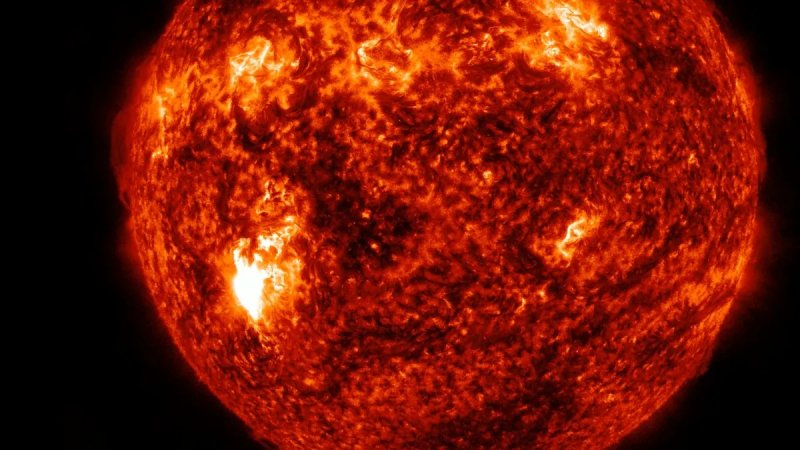
A powerful X1.4-class solar flare erupted from Active Region 4405 on March 30, 2026, producing a large coronal mass ejection (CME) and triggering renewed monitoring of potential space weather impacts, according to solar observation data.
The flare peaked at 03:19 UTC, following an initial eruption at 02:47 UTC and ending at 03:44 UTC. It was accompanied by a strong Type II radio emission, indicating a fast-moving shock wave with an estimated speed of 1,872 km/s, a sign that a significant CME was generated, News.Az reports, citing The Watchers.
Subsequent coronagraph imagery confirmed a wide CME propagating eastward into space, with scientists noting that a partial Earth-directed component cannot yet be ruled out. Further analysis is underway to determine its trajectory.
The event also produced a strong 10cm radio burst, which can interfere with sensitive systems such as GPS, radar, and satellite communications. Temporary radio disruptions were expected across regions including East Asia, Southeast Asia, Australia, and the western Pacific.
Solar activity had been relatively low in the preceding 24 hours, but rising solar wind speeds, increasing from around 350 km/s to 450 km/s, along with shifting magnetic field conditions, signaled heightened space weather variability.
Forecasters also noted that geomagnetic conditions could reach minor storm levels (G1) due to coronal hole high-speed streams, with further disturbances expected through March 31 before easing later.
Scientists continue to monitor whether the CME will interact with Earth’s magnetic field in the coming days.