
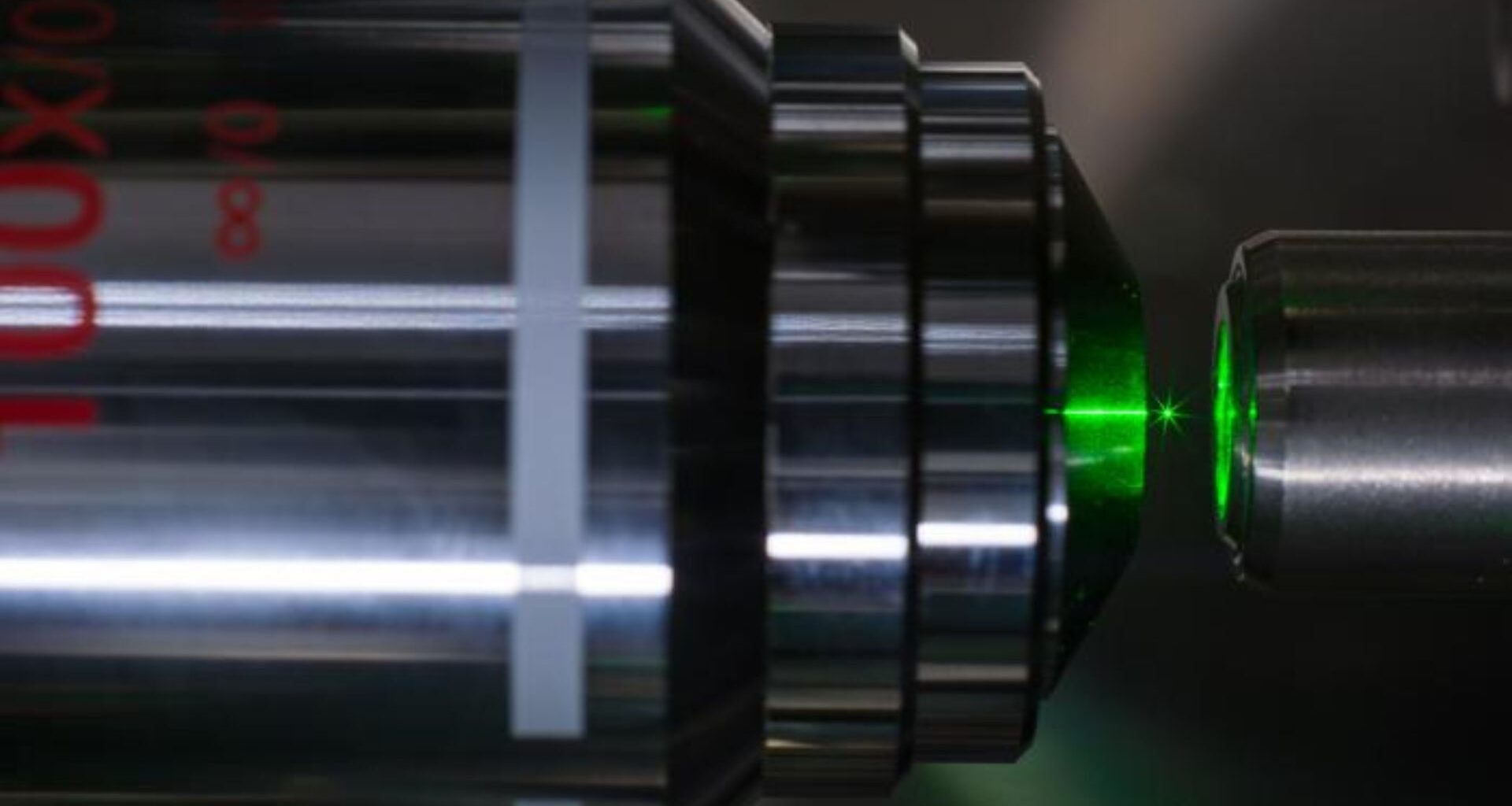
Scientists at the University of Rochester and Rochester Institute of Technology have engineered a squeezed phonon laser that could help develop ‘unjammable’ navigation systems and delve into quantum phenomena like entanglement.
Lasers, first invented in the 1960s, have opened new avenues for research and practical applications. From corrective eye surgery to confining plasma for nuclear fusion research and from entertainment to quickening checkout at supermarkets, lasers are now part of our everyday lives.
While the lasers we use control photons, or light particles, scientists have also created lasers that control other fundamental particles, such as vibrations and sound. These are known as phonons and open up opportunities for further research in quantum physics, gravity, and particle acceleration.
Why are phonons important?
Phonons are quasiparticles since they represent an excited state in the quantum mechanical quantization of the modes of vibration of elastic structures. Simply put, just like photons are quantized light waves, phonons are quantized sound waves.
First introduced in 1930, the concept is important because it helps understand condensed matter systems. While classical mechanics treats normal modes as wave-like phenomena, phonons also exhibit particle-like properties, earning them the moniker of quasiparticles.
Nick Vamivakas, a professor of Optical Physics at the University of Rochester, along with his colleagues, demonstrated a phonon laser in 2019. By trapping and levitating phonons in a vacuum with an optical tweezer, the researchers demonstrated the technology with the device, but also encountered noise issues.
Reducing noise in a phonon laser
“While a laser looks to the naked eye like a steady beam, there’s actually a lot of fluctuation, which causes noise when you’re using lasers for measurement,” said Vamivakas in a press release. “By pushing and pulling on a phonon laser with light in the right way, we can reduce that phonon laser fluctuation significantly.”
The researchers were able to squeeze the thermal noise intrinsic to the phonon laser and measure acceleration more accurately than with photon-based lasers or radio-frequency sources.
The researchers are also confident that their device could be used to make pinpoint measurements of gravity and other forces. Put together, these could be used to make quantum compasses that are not only more accurate but also ‘unjammable’ since they would not rely on satellites for operation.
Since high-frequency acoustic oscillations can also be used to manipulate quantum states, phonon lasers could be deployed to study them in greater detail and open avenues for future quantum sensing and quantum computing.
Additionally, phonon lasers could serve as sources of surface acoustic waves (SAWs) for operating microchips. Devices made with these chips would be faster, smaller, and more energy-efficient than radio-frequency-based devices.
Since sound waves travel more effectively through watery tissues than light does, researchers are also keen on developing phonon-based lasers to deliver accurate ultrasonic imaging and possibly non-invasive therapies in the future.
Vamivakas and colleagues are keen to see the technology develop on these fronts in the future.
Their research was published in the journal Nature Communications.