
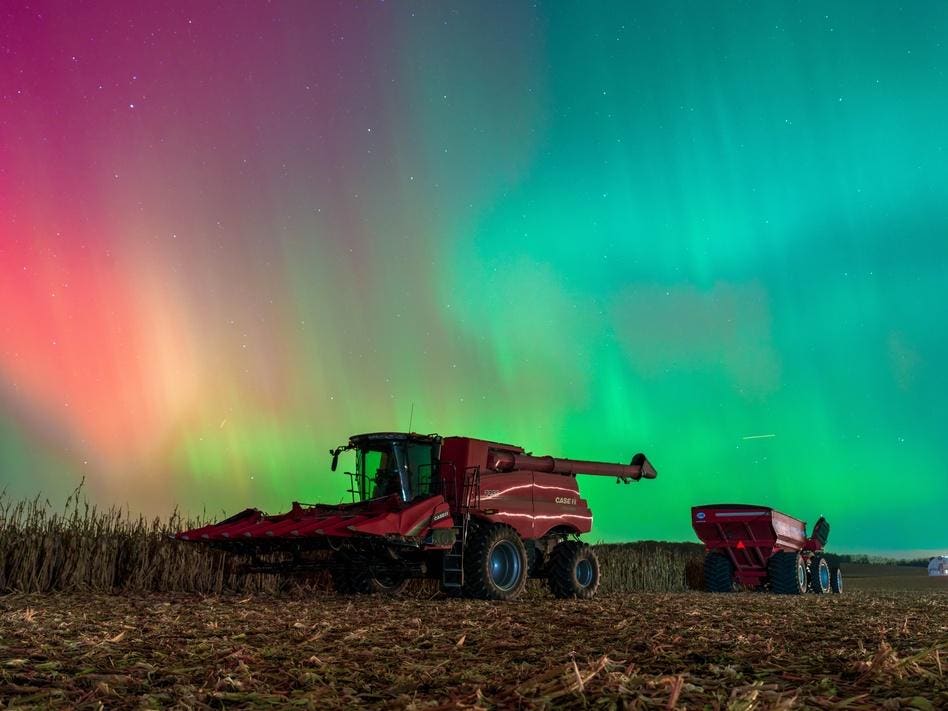
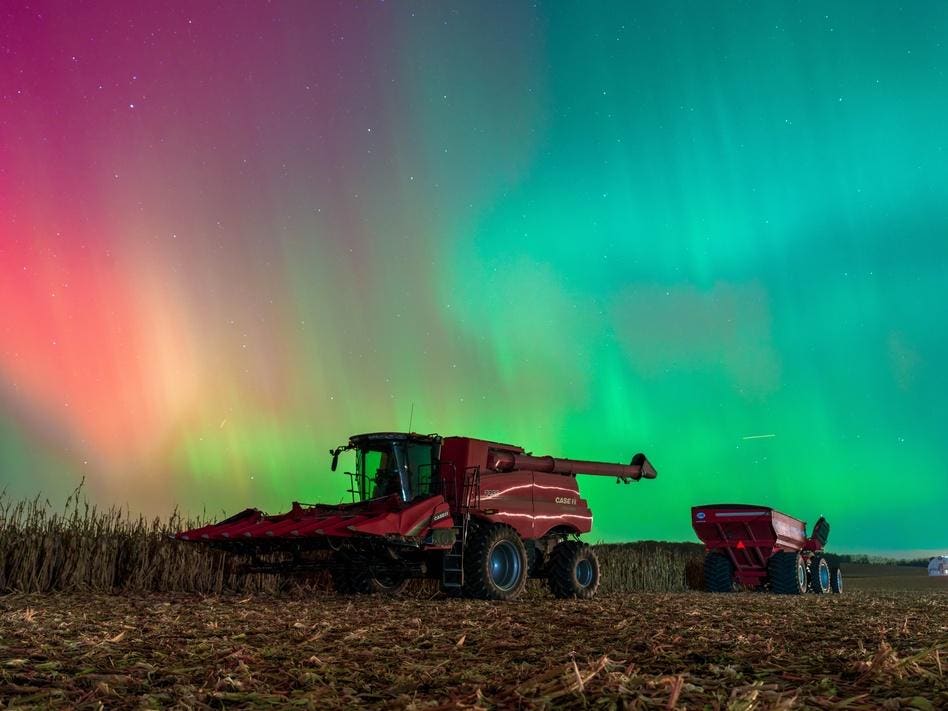
NOAA is forecasting a G1-class geomagnetic storm on Monday, March 30, through Tuesday, March 31, with the aurora borealis possible from northern U.S. states and Canada. . (Photo by Ross Harried/NurPhoto via Getty Images)
NurPhoto via Getty Images
The northern lights may be seen in U.S. states Monday, March 30, through Tuesday, March 31, after the National Oceanic and Atmospheric Administration (NOAA) issued a geomagnetic storm watch, warning that a G1 or G2-class geomagnetic storm is likely. Geomagnetic effects may include auroras, likely in the northern sky in the hours before dawn on March 31.
It comes in the wake of an X1.5-class solar flare — intense blasts of radiation that travel at light speed — on March 30, which erupted from sunspot 4405. It produced a coronal mass ejection — a cloud of charged particles that causes aurora when interacting with Earth’s magnetic field. Crucially, the CME appears to be traveling in the direction of Earth and is expected to produce a G2 or G3-class geomagnetic storm on Tuesday, March 31, through Wednesday, April 1, according to SpaceWeather.com.
A bright, near-full pink moon will be in the sky after dark and will shine all night, making it harder to see faint aurora.
Northern Lights Alert: Where And When To Look
NOAA’s aurora view line shows the northern lights potentially visible — most likely low on the northern horizon — in up to 10 U.S. states near the Canada border. States in pole position include Alaska and (northerly parts of) Washington, Idaho, Montana, North Dakota, South Dakota, Minnesota, Wisconsin, Michigan and Maine.
If a G2-class geomagnetic storm erupts — which is possible — it could potentially make aurora viewable from states much farther south. That could mean faint auroras visible low on the northern horizon in northern regions of Oregon, Wyoming, Nebraska, Iowa, Illinois, Indiana, Ohio, New York, Vermont and New Hampshire. However, states farther north will always have a better chance.
For the best views, wait until the moon is down, using a light pollution map and a Dark Sky Place Finder (though finding a clear sky will also be essential). The clearer and darker the northern sky, the more vibrant the display — even during moderate geomagnetic storms.
NOAA’s aurora viewline for Monday, March 20, 2026.
NOAAMassive Sunspots
The solar surface is currently covered in sunspots — magnetic disturbances on the sun’s surface — with over 10 regions. Sunspots are cooler regions on the sun caused by a concentration of magnetic field lines, according to NASA and tend to produce solar flares, which in turn cause coronal mass ejections.
The sun’s 27-day rotation is bringing more sunspots into view from Earth, which means the chances of solar activity and northern lights are higher in the coming week or two. As the sun rotates, sunspots will turn to face Earth, putting the planet in what scientists describe as the “strike zone.”
Northern Lights Alert: Latest Updates
The exact timing of space weather is difficult to predict because it depends on the speed of the solar wind. Continually monitor NOAA’s 30-minute aurora forecast and SpaceWeatherLive.com, as well as apps such as Aurora Now, My Aurora Forecast, SpaceWeatherLive or Glendale Aurora, which provide live solar wind data.
Look for data on the interplanetary magnetic field’s Bz component, which determines how easily solar energy enters Earth’s magnetosphere. When Bz points north, Earth’s field resists it; when Bz swings south, the two fields connect, allowing plasma to stream in. A sustained southward Bz of -5 nT or stronger usually signals an imminent display of aurora.
How To Photograph The Northern Lights
If your smartphone has a Night Mode or Pro Mode, you can capture a beautiful aurora photo with these steps:
Use your main lens, not the ultra-wide, for sharper results.Stabilize the camera using a tripod or rest it on a firm surface such as a car roof, wall, or post.Shoot in RAW format if available, as it makes post-editing easier.Expect long exposures between five and ten seconds. Even faint glows that look grayish to the eye often appear vividly green, purple or red in photos.What Causes The Northern Lights
The solar wind — streams of charged particles flowing from the sun and interacting with Earth’s magnetic field — causes the northern and southern lights. While most are deflected, some particles spiral along magnetic field lines toward the poles, colliding with oxygen and nitrogen atoms high in the atmosphere. These collisions excite the gases, causing them to release energy as shimmering light.
Wishing you clear skies and wide eyes.