
Other options business owners would consider taking included reducing their spending in other areas (35%), encouraging team members to work from home or reducing days on site (16%) and changing transport or logistics arrangements (16%).
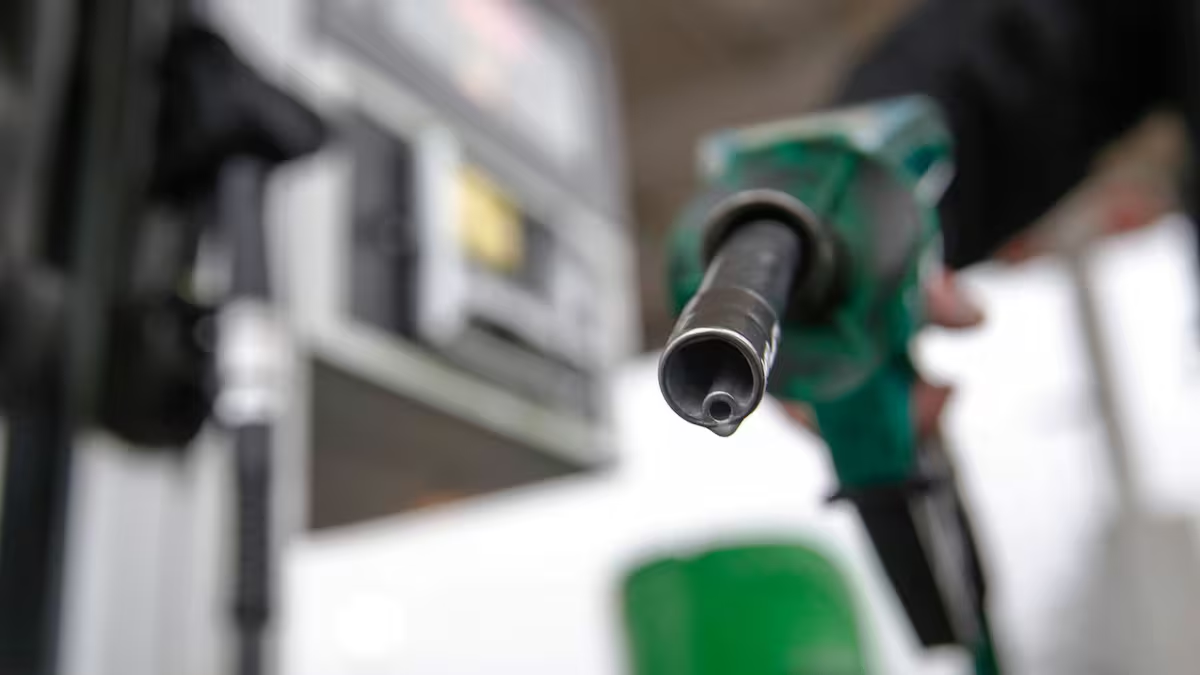
Six in 10 (61%) of SMEs said fuel – either directly or via transport and logistics – was “critical” or “very important” to their ability to operate.
MYOB chief customer officer Dean Chadwick said the conflict escalation in the Middle East is a blunt reminder of how quickly global events can flow through to local business conditions.
“For many SMEs, fuel isn’t optional – it underpins everything from getting goods to market, transporting their own supplies, traveling to connect with customers and keeping day-to-day operations running.”
Chadwick said heading into 2026, sentiment and revenue was gradually lifting for more SMEs, with many planning to capitalise on improving economic confidence.
“Now, faced with another major economic challenge, attention has turned quickly to assessing what fuel supply and pricing levels mean for their business and how they can get ahead of it,” he said.
Just over half (52%) of those surveyed said higher fuel costs hit their business the most through supplier price increases, followed by the costs of the business’ own fleet (47%), courier and freight costs (41%) and supply chain disruption (30%).
According to fuel tracking app Gaspy, the average cost of diesel has increased 148% from $1.38 a litre on March 3 to $3.43 as of yesterday.
Meanwhile, the average cost of 91 grade petrol hit $3.42 recently, up from $2.49 at the beginning of the Middle East conflict.
The increase in fuel costs has meant Rotorua-based central North Island tourism transport business Ready2Roll Tours & Transfers has already been forced to impose a surcharge on its customers.
Director Carleen Dahya, who runs the business with her husband Alan Dahya, said the operation has been hit hard by rising fuel prices, with the cost of filling up a vehicle jumping from $140 a week ago to $260.
The business operates 18 vehicles.
She said introducing a surcharge was the only way to maintain their margins, however, some of their regular services were still not recovering costs.
“If we’re doing an airport transfer, we’re still doing it for love.
“Other people that we deal with, they are losing on every job they’re doing at the moment because they don’t feel that people will pay an extra $10 surcharge for their trips.”
Dahya said the business was warning customers booking for January next year about a possible surcharge.
“We’re telling them now that if it’s still going by next year there will still be a surcharge.
“We’re just wondering how much higher do we need to go to alleviate what’s happening.”
Dahya said a fear of the price of diesel going to $4 or even $5 a litre was giving her sleepless nights.
“It’s going to have a knock-on effect, because everyone’s grocery bills are going to go up, your freight’s going to go up, everything’s going to go up because now all the vehicles that are doing the bulk of the work are bearing the brunt of the cost,” she said.
Aaron Davidson, general manager of Auckland-based Superior Doors, said while the business is currently facing increased freight surcharges, it was adopting a watch and hold approach on its own pricing.
“Price adjustments are not made impulsively, as they can be disruptive and involve significant internal work,” he said.
“Like many in our sector at present, we’re currently holding our prices. Although future adjustments are possible if the cost pressures continue or issues become more entrenched.”
Davidson said he was more concerned about the long-term effects the operation may face.
“The immediate impact is simply on the distribution of our products and on the cost of the raw materials that we are receiving because of the surcharges that are being added on.
“But obviously it’s a fluid situation and there’s a lot more already baked in, even if things resolve themselves relatively promptly.”
Davidson said he was focusing on what he could control and the business was taking the “path of least regret” by ramping up production and increasing the stock it holds.
“My first reaction was to go away and talk to our internationally-exposed suppliers. I immediately sat down with them, ascertained how much stock they have currently on premises, how much they have currently on the water and asked can they please increase their stock holdings, accelerate their purchasing and things like that.
“Even if shipments and everything were to stop right now, we wouldn’t see disruption for three to six months because of the amount of stock we all hold, so that’s good.”
Cameron Smith is an Auckland-based business reporter. He joined the Herald in 2015 and has covered business and sports. He reports on topics such as retail, small business, the workplace and macroeconomics.