
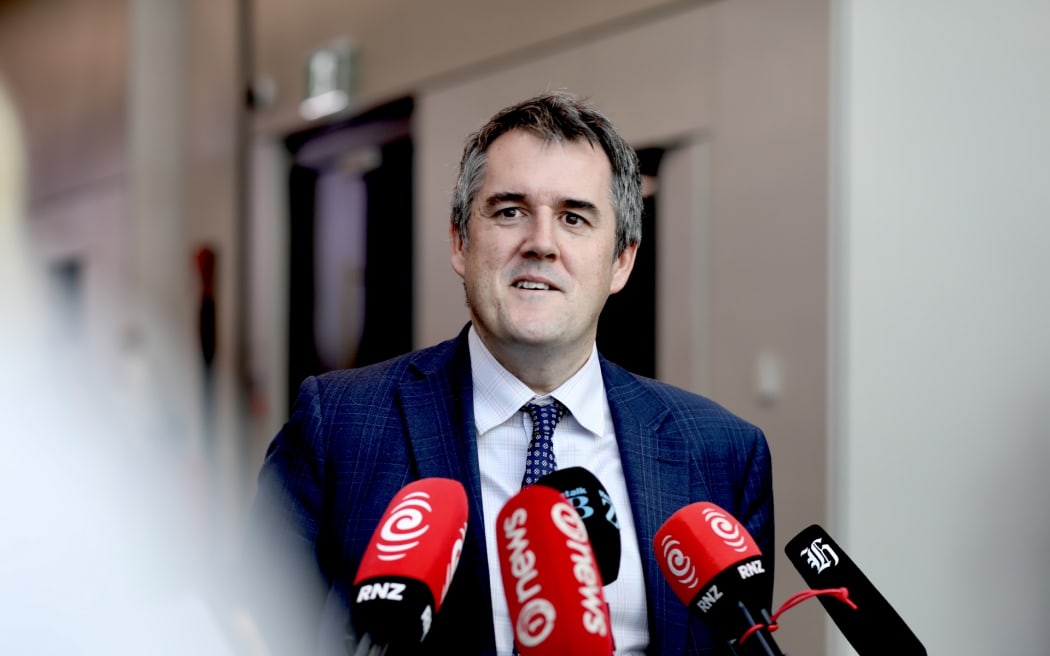
Housing Minister Chris Bishop.
Photo: RNZ/Marika Khabazi
The government has made yet another change to legislation setting out the plan to accommodate new homes in Auckland in the coming decades.
Housing Minister Chris Bishop said the government will reduce the minimum housing capacity required for Auckland Council’s Plan Change 120 to 1.4 million, after already revising the figure in February.
Auckland Council had been progressing a new plan to accommodate up to 2 million homes in the coming decades.
The council opted out of medium-density rules that apply to most major cities on the proviso it set up zoning for 30 years of growth.
The council’s Plan Change 120 set out the process for doing this, but the government had come under pressure from proponents of heritage homes who raised concerns about further intensification in character areas that were already seeing major development.
On Tuesday, it was announced the government agreed to revise the minimum housing capacity required by Plan Change 120, with Bishop saying Aucklanders had been clear they want housing growth, “so long as it happens in the right places and where infrastructure can support it.”
“Our expectation is that this revised capacity number finally brings consensus on this important issue. Aucklanders deserve certainty on this city-shaping plan change,” said Bishop.
He said advice from officials estimate the capacity enabled by PC120 was “still likely to be around 1.6 million homes” once mandatory requirements under the National Policy Statement on Urban Development and upzoning around the City Rail Link were taken into account.
Auckland Council will still need to provide for significant housing growth, Bishop said.
The latest change also addressed a “transitional issue” affecting developers and property owners after the withdrawal of an earlier plan change – those who had started projects under the Medium Density Residential Standards and were “left in limbo” when those rules were withdrawn, Bishop said.
Projects can continue if approvals were already in place or they were partway through the consent process.
Bishop also planned to investigate planning provisions that “may be holding back Auckland’s city centre”.
Bishop told reporters on Tuesday afternoon it was important to get a “durable consensus” on the issue.
He said housing growth was important, and it was important to grow in the “right places,” which he said was around train stations, bus stations and the central city.
“That’s where most people – not everyone – but most people think we should grow, and that’s what this plan will provide for.”
Once parliament legislates it is over to the Council to decide “exactly where Auckland grows.”
Auckland MP and ACT leader David Seymour added the change to 1.4 million brings the number closer to the Auckland Unitary Plan agreed on “way back in 2016,” which was what the party campaigned on as part of the coalition agreement.
“That means Auckland can get back to growing on Auckland’s terms with less interference from Wellington.”
“I opposed the medium density residential standard five years ago, and I oppose Auckland being meddled in by Wellington up to this day.”
He said when he agreed to 1.6 million in Februrary, he understood that “several 100,000 homes would be located in greenfields.”
“The council has said they don’t want to do that. I think that’s really disappointing. They’ve said that they want most development to be within 10k of Queen Street.
“That’s their right and their choice as a council, but it’s also caused a change in the target number that the government has set.”
He said the information outlining the intensification would occur within 10km of Queen Street was “exactly the kind of information we needed, because it led to us changing the number.”
Guiding principles set by Auckland Council for how it will change PC120 in response to the new minimum housing capacity include:
downzoning in areas where homes are more susceptible to natural hazards such as flooding
enabling intensification in mandatory areas including around stations benefiting from investment in the City Rail Link
reducing housing capacity in areas more than ten kilometres from the city centre as a starting point
and reassessing requirements in places that are less well-served by public transport
Bishop indicated the legislation would be progressed quickly to minimise disruption to the existing PC120 process.
Once the new capacity requirement was in place, the council would decide which parts of the plan to withdraw or amend. Where parts of the plan are withdrawn, the existing Auckland Unitary Plan zoning will remain in place.
There will also be further opportunities to provide feedback.
Mayor Wayne Brown said in a statement the change would give Auckland more flexibility to grow into the city it wants to be, “a global city, not embarrassingly the world’s biggest suburb”.
“This has been going on for years, over successive governments. If we waited for everyone to agree, we’d never get anywhere. It’s time to stop the talk, for Wellington to get out of the way, and let Auckland get on with building Auckland.”
He also noted it would give greater ability to downzone for natural hazards and retain intensification where it makes the most sense, that was along major transport routes and the CRL “where we’ve already sunk billions into the pipes, roads, and tracks beneath our feet”.
Sign up for Ngā Pitopito Kōrero, a daily newsletter curated by our editors and delivered straight to your inbox every weekday.